 NL·0248
Herbarium of the Nature Library
- Name
- Alcedo atthis
- Family
- Alcedinidae
- Native to
- Europe, North Africa, the Middle East, Central Asia, South and East Asia to New Guinea and the Solomon Islands
- Habitat
- Rivers, Lakes, Wetland, Estuaries
On eBird ↗
Common Kingfisher
Live sightings near you, the range map, bar charts of when it is seen, and Macaulay Library photos and recordings.
Common kingfisher
Alcedo atthis
Also calledSayyad al-samak (Arabic) · Mahi-khorak (Persian) · Yalıçapkını (Turkish) · Chhota kilkila (Urdu/Hindi) · Eisvogel (German) · Martin-pêcheur (French)
A tiny flash of electric blue and orange along quiet rivers. It plunges headfirst for small fish and nests at the end of a tunnel in an earth bank.
The common kingfisher, also known as the Eurasian kingfisher and river kingfisher, is a small kingfisher with seven subspecies recognized within its wide distribution across Eurasia and North Africa. It is resident in much of its range, but migrates from areas where rivers freeze in winter. Wikipedia
What it can do
- iIts blue back is structural colour produced by the nanostructure of the feathers, not pigment
- iiDives with eyes covered by a protective membrane and corrects for refraction when aiming
- iiiIts bill entering water with little splash inspired the redesigned nose of the 500 Series Shinkansen
- ivPairs may raise two or three broods a year to offset heavy winter losses
In the field
Field marks
- aBrilliant cobalt-to-turquoise upperparts with a pale-blue back stripe
- bOrange underparts and cheek patch, white throat and neck patch
- cLong dagger bill; female has an orange base to the lower mandible
- dStubby tail and tiny red feet
- Voice
- A shrill, piercing whistle, 'tseee' or 'chee-kee', given in low, fast flight over water.
- Not to be confused with
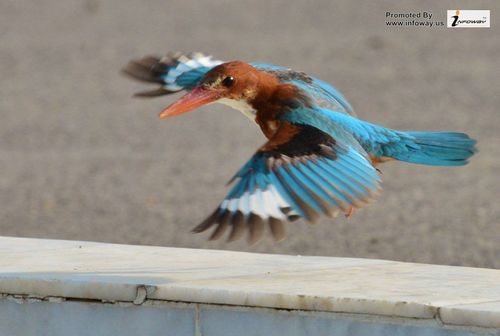
- No other small European bird is this colour. In the Middle East, white-throated kingfisher is much larger with a red bill, and pied kingfisher is black and white and hovers.
- Where to see it
- Lowland rivers across Europe; the Danube Delta, the Camargue, Turkish and Iraqi marshes; wintering birds on Mediterranean coasts.
- When
- Resident in western Europe; northern and eastern birds move south in winter
Listen
Looking for field recordings…
Life & habits
- Diet
- Small fish such as minnows and sticklebacks; aquatic insects, tadpoles
- Habitat
- Clear, slow rivers, streams, canals and lakes with earth banks; coasts in winter
- Size
- 16–17 cm; wingspan 24–26 cm; 34–46 g
- Lifespan
- Most live 1–2 years
Perches still over water, then plunge-dives and beats the fish against a branch before swallowing it headfirst.
Where it lives
Recorded sightings
—
geo-referenced records in GBIF, from museums, herbaria and field observers.
Native range
Europe, North Africa, the Middle East, Central Asia, South and East Asia to New Guinea and the Solomon Islands
Drag the globe to turn it. Dots are where records exist, not a range map; darker means more records.
In the old herbals & bestiaries
Woodcuts and engravings matched from the Source Library’s scanned books by name. Plates marked “relative” show a close kin rather than this exact species. Click a plate to read the page it came from, with translation.

Jan Jonston — Naeukeurige beschryving van de natuur der viervoetige dieren (1660)
Jan Jonston · 1660 · p.135

The Natural History of Carolina, Florida and the Bahama Islands, Vol. 1
Mark Catesby · 1777 · p.224

The Malay Archipelago: The Land of the Orang-Utan and the Bird of Paradise
Alfred Russel Wallace · 1869 · p.330

Of the Eggs and Nests of Birds
Giuseppe Zinanni (Ginanni) (1692-1753) · 1737 · p.165

History of Animals, Book I: On Viviparous Quadrupeds
Conrad Gessner · 1554 · p.736

Noah's Ark
Athanasius Kircher · 1675 · p.139

Historiae Animalium Liber III: De Avium Natura
Conrad Gesner · 1555 · p.636

Historiae Animalium Liber III: De Avium Natura
Conrad Gesner · 1555 · p.591

Sancai Tuhui (Vol. 90)
王圻, 王思義 · 1609 · p.38
In the stacks
Searching the stacks…
Every page naming Alcedo atthis in the Biodiversity Heritage Library →
Marginalia
Greek myth turned the grieving Alcyone into a kingfisher, and the calm 'halcyon days' around the winter solstice were believed to be granted by the gods so it could nest on the sea.
Curiosity
Engineer Eiji Nakatsu, a birdwatcher, modelled the 500 Series Shinkansen's nose on the kingfisher's bill to reduce the loud 'tunnel boom' (pressure-wave bang) when trains left tunnels.
Kinship

Fact-checked: 1 correction made to this sheet. Photographs: iNaturalist contributors under the licences shown. Records: GBIF.org. Historical plates: Source Library (CC BY-SA 4.0; originals public domain). Summary text: Nature Library editors and Wikipedia (CC BY-SA). Medicinal and edibility notes are historical and educational, not advice. iNaturalist taxon 2599.