 NL·0333
Herbarium of the Nature Library
- Name
- Alces alces
- Family
- Cervidae
- Native to
- Boreal and mixed forests of northern Europe, Russia and Siberia, Mongolia, northeastern China, Canada, Alaska and the northern USA
- Habitat
- Boreal forest, Temperate forest, Wetland, Lakeshore
Moose
Alces alces
Also calledElk (British English) · Älg (Swedish) · Elg (Norwegian) · Hirvi (Finnish) · Los' (Russian) · Mos (Abenaki/Eastern Algonquian, origin of 'moose') · Alce (Spanish/Portuguese)
The largest living deer, a long-legged browser of northern forests and lakes. Bulls grow broad, palmate antlers that can span more than 1.5 m and are shed each winter. Moose wade and even dive in lakes to feed on water plants rich in sodium.
The moose or elk is the world's tallest, largest and heaviest extant species of deer and the only extant species in the genus Alces. It is also the tallest, and the second-largest, land animal in North America, falling short only to the American bison in body mass. Most adult male moose have broad, palmate antlers; most other members of the deer family have pointed antlers with a dendritic ("twig-like") configuration. Moose inhabit the circumpolar boreal forests or temperate broadleaf and mixed forests of the Northern Hemisphere, thriving in cooler, temperate areas as well as subarctic climates. Wikipedia
What it can do
- iDives to about 5–6 m and stays under for nearly a minute to graze aquatic plants
- iiCan close its nostrils underwater
- iiiLong legs let it wade through deep snow and step over fallen trees
- ivGrows a new set of antlers, up to about 30 kg, every spring and summer
In the field
Field marks
- aSilhouette: very tall humped shoulders, long legs, short neck and a long, overhanging muzzle
- bDewlap ('bell') of skin hanging from the throat
- cBulls' antlers broad and palm-shaped (palmate), less often branching
- dTracks: cloven hoofprints 13–15 cm long; signs include stripped bark, browsed tops of young trees and large piles of oval pellets
- Voice
- Cows give a long, nasal, moaning call in the rut; bulls answer with deep grunts or croaks.
- Not to be confused with
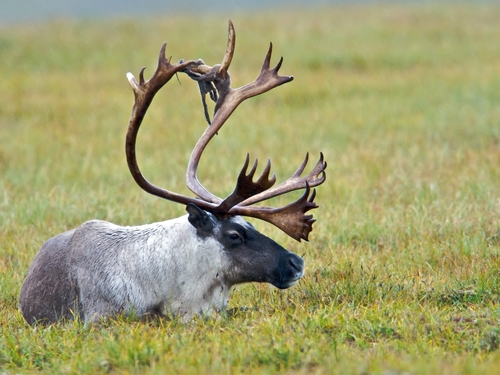
- Wapiti/elk (Cervus canadensis) is reddish with a pale rump patch and branched (not palmate) antlers. Reindeer are smaller, with white necks and antlers in both sexes.
- Where to see it
- Algonquin Provincial Park (Ontario); Denali (Alaska); Grand Teton (Wyoming); Baxter State Park (Maine); Biebrza National Park (Poland); forests of central Sweden and Norway
- When
- Resident; rut in September–October; summer sightings in lakes and ponds at dawn and dusk
Listen
Looking for field recordings…
Life & habits
- Diet
- Browse: willow, birch, aspen shoots and bark; aquatic plants in summer
- Habitat
- Northern forest with lakes, bogs, rivers and young regrowth
- Size
- Shoulder height 1.4–2.1 m; bulls 380–700 kg
- Lifespan
- About 15–20 years
Mostly solitary. In the autumn rut bulls spar and call, and cows with calves are fiercely protective.
Where it lives
Recorded sightings
—
geo-referenced records in GBIF, from museums, herbaria and field observers.
Native range
Boreal and mixed forests of northern Europe, Russia and Siberia, Mongolia, northeastern China, Canada, Alaska and the northern USA
Drag the globe to turn it. Dots are where records exist, not a range map; darker means more records.
In the old herbals & bestiaries
Woodcuts and engravings matched from the Source Library’s scanned books by name. Plates marked “relative” show a close kin rather than this exact species. Click a plate to read the page it came from, with translation.

Cosmographey: das ist Beschreibung aller Laender
Münster, Sebastian · 1598 · p.1289

History of All Cloven-Hoofed Quadrupeds
Ulisse Aldrovandi · 1621 · p.891

History of All Cloven-Hoofed Quadrupeds
Ulisse Aldrovandi · 1621 · p.892

Introductory Book
Michael Scot · 1350 · p.129

Noah's Ark
Athanasius Kircher · 1675 · p.106
In the stacks
Searching the stacks…
Every page naming Alces alces in the Biodiversity Heritage Library →
Marginalia
Paintings and carvings of moose (elk) appear in Stone Age rock art across Scandinavia and Russia, including the Alta rock carvings in Norway. Julius Caesar's Gallic War records a tale that 'alces' had no knee joints and slept leaning against trees.
Curiosity
The word 'moose' comes from an Eastern Algonquian name, often glossed as 'twig-eater' or 'he strips off bark'.
Kinship

Photographs: iNaturalist contributors under the licences shown. Records: GBIF.org. Historical plates: Source Library (CC BY-SA 4.0; originals public domain). Summary text: Nature Library editors and Wikipedia (CC BY-SA). Medicinal and edibility notes are historical and educational, not advice. iNaturalist taxon 522193.