 NL·0498
Herbarium of the Nature Library
- Name
- Amblyrhynchus cristatus
- Family
- Iguanidae
- Native to
- Galápagos Islands, Ecuador
- Habitat
- Rocky shore, Intertidal zone, Subtidal reef
Marine iguana
Amblyrhynchus cristatus
Also calledIguana marina (Spanish) · Sea iguana
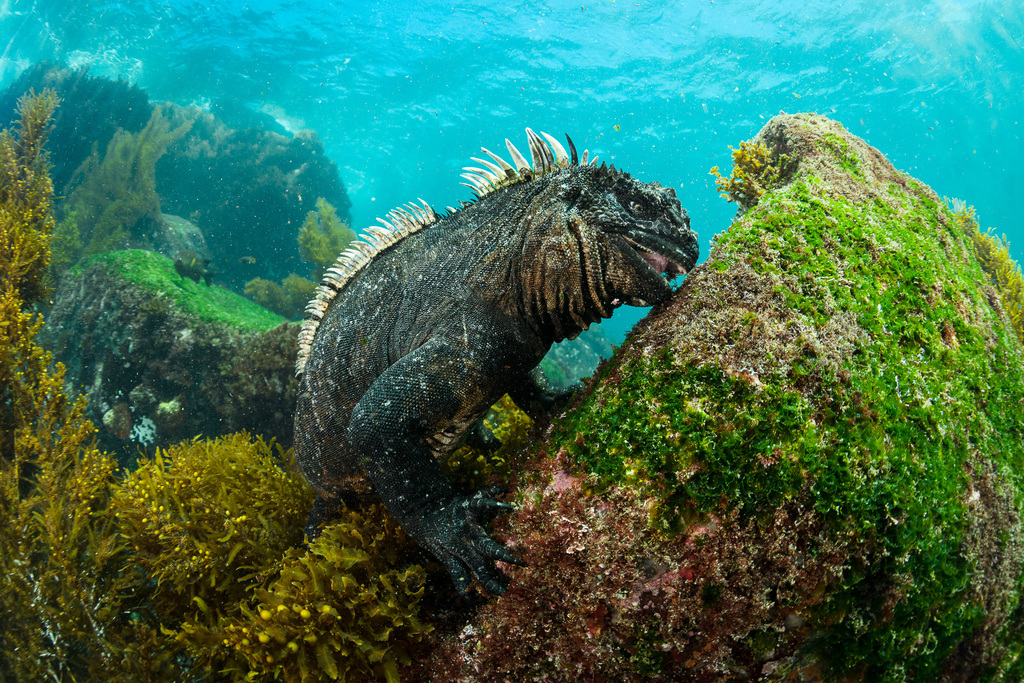
The only lizard in the world that forages in the sea. On the Galápagos Islands it dives into cold surf to graze algae, then warms up on black lava rocks. Charles Darwin recorded that they had been called 'imps of darkness'.
The marine iguana, also known as the sea iguana, saltwater iguana, or Galápagos marine iguana, is a species of iguana found only on the Galápagos Islands (Ecuador). Unique among modern lizards, it is a marine reptile that has the ability to forage in the sea for algae, which make up almost all of its diet. Marine iguanas are the only extant lizard that spends time in a marine environment. Large males are able to dive to find this food source, while females and smaller males feed during low tide in the intertidal zone. They mainly live in colonies on rocky shores where they bask after visiting the relatively cold water or intertidal zone, but can also be seen in marshes, mangrove swamps and beaches. Large males defend territories for a short period, but smaller males have other breeding strategies. After mating, the female digs a nest hole in the soil where she lays her eggs, leaving them to hatch on their own a few months later. Wikipedia
What it can do
- iDives to over 10 m and grazes algae on rocks with its short blunt snout
- iiSneezes out excess salt from glands near its nose
- iiiShrinks its body, even its bones, when food is short in El Niño years, then grows again
- ivDigests seaweed with the help of gut microbes
In the field
Field marks
- aShort, blunt snout and spiny crest along the back
- bBlack or grey body; on some islands males are mottled red and green in the breeding season
- cFlattened tail for swimming
- dOften white-crusted head from sneezed salt
- Not to be confused with
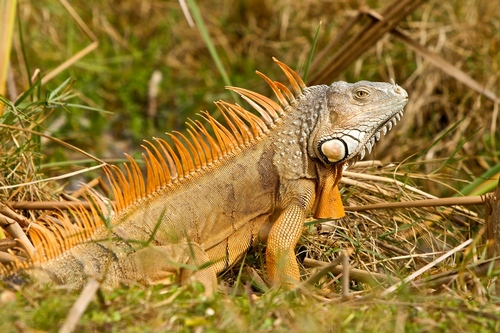
- Galápagos land iguanas (Conolophus) are yellow-brown with a long rounded tail and live inland. Lava lizards (Microlophus) are much smaller.
- Where to see it
- All main Galápagos islands; Española (Punta Suárez) for red-green males, Fernandina (Punta Espinoza) for large colonies
- When
- Resident; breeding coloration and mating December–January on many islands
Life & habits
- Diet
- Red and green algae from intertidal and subtidal rocks
- Habitat
- Rocky lava coasts and nearby water
- Size
- Up to ~1.3 m including tail; males larger
- Lifespan
- ~12 years or more
Large males dive offshore, while females and smaller iguanas graze on algae exposed at low tide. They pile together on rocks at night to keep warm.
Where it lives
Recorded sightings
—
geo-referenced records in GBIF, from museums, herbaria and field observers.
Native range
Galápagos Islands, Ecuador
Drag the globe to turn it. Dots are where records exist, not a range map; darker means more records.
In the old herbals & bestiaries
No plate in the Source Library names this exact species, so these show its closest relatives as the old naturalists drew them: same genus, or the same kind of animal. Click a plate to read the page it came from, with translation.

Unterhaltungen aus der Naturgeschichte
Relative · Wilhelm, Gottlieb Tobias · 1792 · p.415

Unterhaltungen aus der Naturgeschichte / [Tafelband.]
Relative · Borkhausen, Moritz Balthasar (1760-1806) · n.d. · p.61

Georg Wolfgang Knorr — Deliciae naturae selectae (1771)
Relative · Georg Wolfgang Knorr · 1771 · p.367

Ten Books of Exotic Things
Relative · Carolus Clusius · 1605 · p.136

Historia naturalis Brasiliae
Relative · Willem Piso / Georg Marcgraf · 1648 · p.381

De Indiae utriusque re naturali et medica
Relative · Willem Piso · 1658 · p.458

Unterhaltungen aus der Naturgeschichte / 3 Die Amphibien
Relative · Wilhelm, Gottlieb Tobias · 1794 · p.415
In the stacks
Searching the stacks…
Every page naming Amblyrhynchus cristatus in the Biodiversity Heritage Library →
Marginalia
Darwin wrote in 1835 that marine iguanas were 'hideous-looking' and 'most disgusting, clumsy lizards', and noted that 'somebody calls them imps of darkness', a phrase used earlier by Lord Byron's 1826 voyage account. He threw one into the sea repeatedly to watch it swim back.
Curiosity
In El Niño years marine iguanas can shrink by up to ~20% in length, and their bones get shorter, then they regrow when food returns.
Kinship




Fact-checked: 2 corrections made to this sheet. Photographs: iNaturalist contributors under the licences shown. Records: GBIF.org. Historical plates: Source Library (CC BY-SA 4.0; originals public domain). Summary text: Nature Library editors and Wikipedia (CC BY-SA). Medicinal and edibility notes are historical and educational, not advice. iNaturalist taxon 35347.