 NL·0216
Herbarium of the Nature Library
- Name
- Aquila chrysaetos
- Family
- Accipitridae
- Native to
- North America, Europe, North Africa and Asia
- Habitat
- Mountains, Steppe, Tundra, Open moorland
On eBird ↗
Golden Eagle
Live sightings near you, the range map, bar charts of when it is seen, and Macaulay Library photos and recordings.
Golden eagle
Aquila chrysaetos
Also calledBerkut (Kazakh/Russian) · ʿUqāb (Arabic) · Águila real (Spanish) · Jīndiāo (Chinese) · Steinadler (German)
The most widespread eagle in the world, ranging across the Northern Hemisphere. Kazakh hunters in Mongolia still fly trained females to catch foxes.
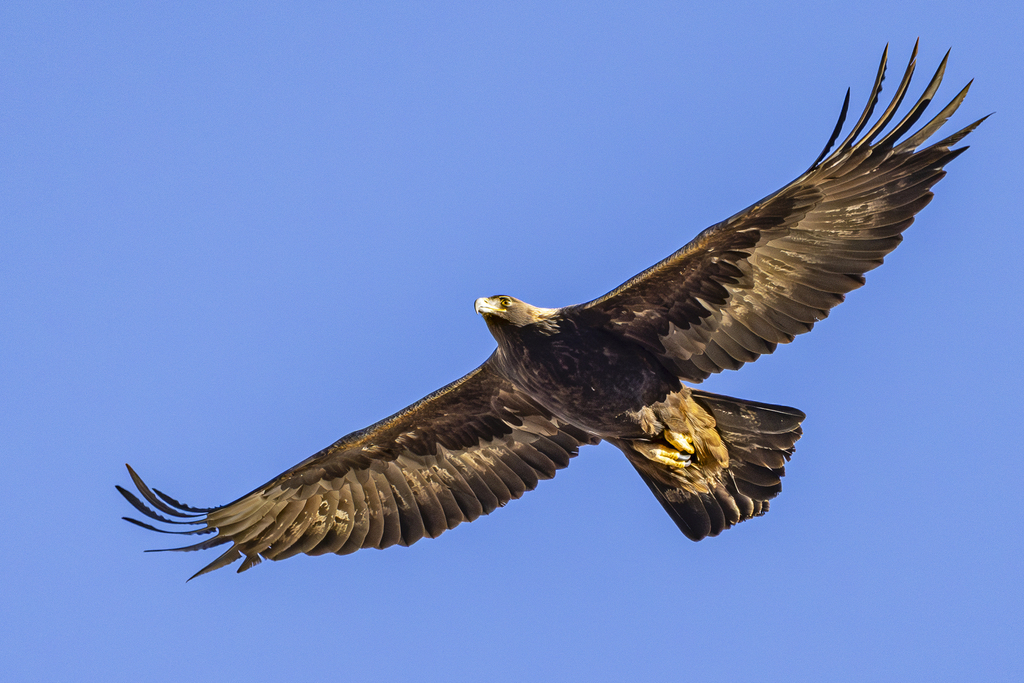
The golden eagle is a bird of prey living in the Northern Hemisphere. It is the most widely distributed species of eagle. Like all eagles, it belongs to the family Accipitridae. They are one of the best-known birds of prey in the Northern Hemisphere. These birds are dark brown, with lighter golden-brown plumage on their napes. Immature eagles of this species typically have white on the tail and often have white markings on the wings. Golden eagles use their agility and speed combined with powerful feet and large, sharp talons to hunt a variety of prey, mainly hares, rabbits, marmots, and other ground squirrels. Wikipedia
What it can do
- iTakes prey as large as young deer and foxes
- iiCan dive at around 240 km/h
- iiiEyesight several times sharper than humans'
- ivTerritories can span over 100 km²
In the field
Field marks
- aVery large dark brown eagle with a golden-buff nape
- bLegs feathered to the toes
- cJuveniles have white patches in the wings and a white tail base with dark tip
- dSoars with wings in a shallow V
- Voice
- Usually silent; occasional yelping or mewing calls
- Not to be confused with
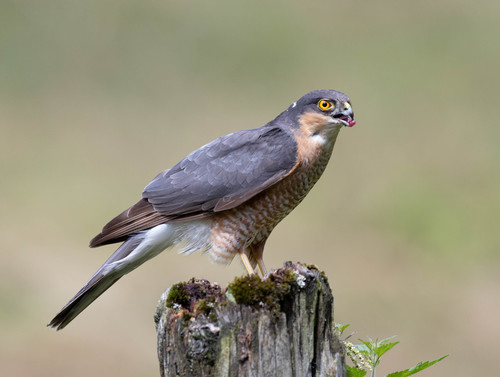
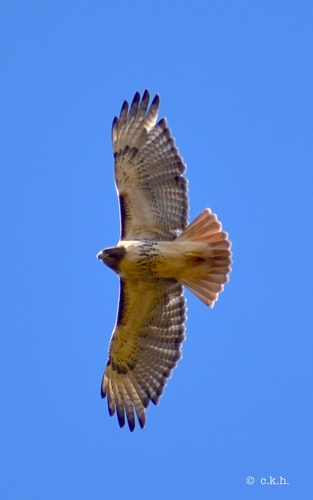
- Young bald eagles have bigger heads and bills, bare lower legs and blotchy white mottling. White-tailed eagle has a huge bill, short wedge-shaped tail and broad 'barn-door' wings.
- Where to see it
- Scottish Highlands and islands (e.g. Mull, Cairngorms), the Alps, Denali and the mountain West of North America
- When
- Resident in most of its range; northern birds move south in winter
Listen
Looking for field recordings…
Life & habits
- Diet
- Hares, rabbits, marmots, ground squirrels, birds; carrion in winter
- Habitat
- Open mountains, steppe and moorland
- Size
- 66–102 cm; wingspan 1.8–2.3 m
- Lifespan
- Around 20–30 years in the wild
Pairs perform undulating 'sky-dance' flights, rising and plunging over their territory.
Where it lives
Recorded sightings
—
geo-referenced records in GBIF, from museums, herbaria and field observers.
Native range
North America, Europe, North Africa and Asia
Drag the globe to turn it. Dots are where records exist, not a range map; darker means more records.
In the old herbals & bestiaries
Woodcuts and engravings matched from the Source Library’s scanned books by name. Plates marked “relative” show a close kin rather than this exact species. Click a plate to read the page it came from, with translation.

François Bouchard — Recueil de cent-trente-trois oiseaux des plus belles especes (1775)
François Bouchard · 1775 · p.6

Ornithologiae: de avibus historiae libri XII
Ulisse Aldrovandi · 1599 · p.133

History of Animals, Book I: On Viviparous Quadrupeds
Conrad Gessner · 1554 · p.377

Ornithology: The History of Birds
Ulisse Aldrovandi · 1599 · p.402

Ornithology
Ulisse Aldrovandi · 1599 · p.267

Ornithologiae: de avibus historiae libri XII
Ulisse Aldrovandi · 1599 · p.134

François Bouchard — Recueil de cent-trente-trois oiseaux des plus belles especes (1775)
François Bouchard · 1775 · p.12
In the stacks
Searching the stacks…
Every page naming Aquila chrysaetos in the Biodiversity Heritage Library →
Marginalia
Kazakh berkutchi have hunted with golden eagles for centuries, celebrated at the annual Golden Eagle Festival in Bayan-Ölgii. It is the national bird of Mexico, Germany, Albania and Kazakhstan.
Curiosity
Kazakh eagle hunters have used trained golden eagles to take wolves.
Kinship




Photographs: iNaturalist contributors under the licences shown. Records: GBIF.org. Historical plates: Source Library (CC BY-SA 4.0; originals public domain). Summary text: Nature Library editors and Wikipedia (CC BY-SA). Medicinal and edibility notes are historical and educational, not advice. iNaturalist taxon 5074.