 NL·0581
Herbarium of the Nature Library
- Name
- Ardeotis nigriceps
- Family
- Otididae
- Native to
- Formerly much of India and eastern Pakistan; now mainly Jaisalmer district, Rajasthan, with tiny remnants in Gujarat, Maharashtra and Karnataka; possibly occasional in Cholistan, Pakistan
- Habitat
- Semi-desert, Grassland
On eBird ↗
Great Indian Bustard
Live sightings near you, the range map, bar charts of when it is seen, and Macaulay Library photos and recordings.
Great Indian bustard
Ardeotis nigriceps
Also calledGodawan (Rajasthani/Hindi)
A tall, ostrich-like bustard, among the heaviest flying birds in the world, now reduced to fewer than 200 birds (including those in captivity), almost all in the Thar Desert of Rajasthan. Collision with overhead power lines is one of its biggest killers.
The great Indian bustard or Indian bustard is a bustard occurring on the Indian subcontinent. It is a large bird with a horizontal body, long bare legs and is among the heaviest of the flying birds. Once common on the dry grasslands and shrubland in India, as few as 150 individuals were estimated to survive as of 2018, reduced from an estimated 250 individuals in 2011. It is critically endangered due to hunting and habitat loss. It is protected under the Indian Wild Life (Protection) Act, 1972. Wikipedia
What it can do
- iMales can weigh around 15 kg, among the heaviest flying birds
- iiIn display, the male inflates a large throat pouch and cocks his tail, booming
- iiiLays a single egg on bare ground
In the field
Field marks
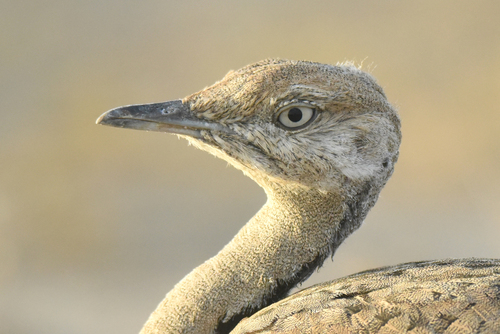
- aVery large, long-legged bird with a horizontal body
- bBlack crown and crest on a white head and neck
- cBrown back and wings; males have a black breast band
- dBlack-and-white wing pattern in flight
- Voice
- A deep, booming 'hoonk' carried a long way, given by displaying males
- Not to be confused with
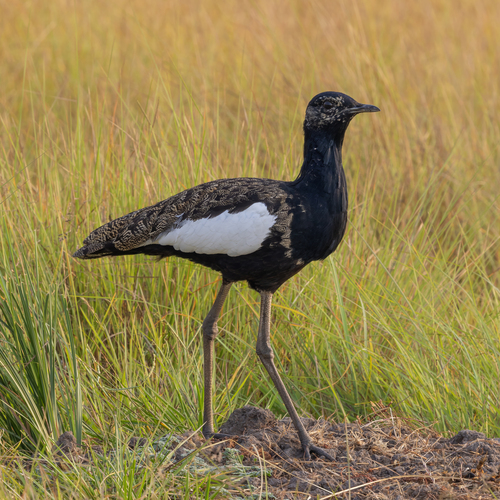
- Macqueen's (houbara) bustard is much smaller and sandy with a black neck stripe; Lesser florican is small with long head plumes in breeding males.
- Where to see it
- Desert National Park near Jaisalmer, Rajasthan (with permits)
- When
- Resident; displays mainly during the monsoon
Listen
Looking for field recordings…
Life & habits
- Diet
- Grasshoppers, beetles, small lizards and rodents; also seeds, berries and shoots
- Habitat
- Arid and semi-arid grassland with scattered scrub
- Size
- About 1 m tall; males up to about 15 kg
Walks slowly through grassland; its forward-facing eyes and poor manoeuvrability in flight make it unable to avoid power lines.
Where it lives
Recorded sightings
—
geo-referenced records in GBIF, from museums, herbaria and field observers.
Native range
Formerly much of India and eastern Pakistan; now mainly Jaisalmer district, Rajasthan, with tiny remnants in Gujarat, Maharashtra and Karnataka; possibly occasional in Cholistan, Pakistan
Drag the globe to turn it. Dots are where records exist, not a range map; darker means more records.
In the old herbals & bestiaries
No plate in the Source Library names this exact species, so these show its closest relatives as the old naturalists drew them: same genus, or the same kind of animal. Click a plate to read the page it came from, with translation.


In the stacks
Searching the stacks…
Every page naming Ardeotis nigriceps in the Biodiversity Heritage Library →
Marginalia
The ornithologist Salim Ali proposed it as India's national bird. It is the state bird of Rajasthan, and India's Supreme Court has heard cases on burying or marking power lines in its habitat.
Curiosity
A captive breeding centre at Jaisalmer has hatched dozens of chicks since 2019 as insurance against extinction.
Kinship



Fact-checked: 1 correction made to this sheet. Photographs: iNaturalist contributors under the licences shown. Records: GBIF.org. Historical plates: Source Library (CC BY-SA 4.0; originals public domain). Summary text: Nature Library editors and Wikipedia (CC BY-SA). Medicinal and edibility notes are historical and educational, not advice. iNaturalist taxon 114.