 NL·0323
Herbarium of the Nature Library
- Name
- Casuarius casuarius
- Family
- Casuariidae
- Native to
- Northern Queensland, New Guinea and nearby islands
- Habitat
- Tropical rainforest, Swamp forest
On eBird ↗
Southern Cassowary
Live sightings near you, the range map, bar charts of when it is seen, and Macaulay Library photos and recordings.
Southern cassowary
Casuarius casuarius
Also calledMuruk (Tok Pisin) · Kasuari (Malay/Indonesian)
A towering, flightless rainforest bird with a bony casque and a dagger-like inner claw. It is a crucial seed disperser for rainforest trees, swallowing fruit whole and depositing seeds far away.
The southern cassowary, also known as double-wattled cassowary, Australian cassowary, or two-wattled cassowary, is a large, flightless, mostly black bird, found in Indonesia, Papua New Guinea, and northeastern Australia. It is one of the three living species of cassowary, alongside the dwarf cassowary and the northern cassowary. It is a ratite and therefore related to the emu, ostrich, rhea and kiwi. Southern cassowaries are among the largest birds in the world, only weighing less than ostriches. Wikipedia
What it can do
- iDisperses seeds of more than 200 plant species, some almost entirely dependent on it
- iiInner toe bears a claw up to about 12 cm long, a formidable weapon
- iiiLow-frequency booming calls may be partly below human hearing
- ivSwims well and can run at up to around 50 km/h through forest
In the field
Field marks
- aVery large, black, hair-like plumage
- bTall, helmet-like brown casque
- cBright blue neck with two red wattles
- dMassive grey legs with three toes
- eJuveniles brown; chicks striped
- Voice
- Deep, rumbling booms and low hisses; mostly heard at close range.
- Not to be confused with
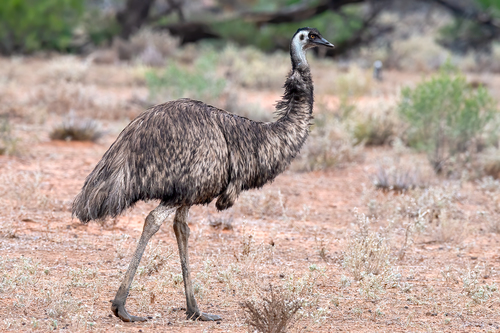
- Emu is grey-brown and lacks the casque and wattles; it lives in open country. In New Guinea, northern and dwarf cassowaries have different wattle patterns (one or none).
- Where to see it
- Mission Beach and Etty Bay (Queensland), Daintree, Cape York; New Guinea lowlands
- When
- Resident
Listen
Looking for field recordings…
Life & habits
- Diet
- Fallen fruit, fungi, invertebrates and small vertebrates
- Habitat
- Tropical rainforest, swamp forest, adjacent woodland
- Size
- 1.5–1.8 m tall; females up to about 60–70 kg
- Lifespan
- Up to about 40 years in captivity
The male alone incubates the eggs for about 50 days and raises the striped chicks for up to nine months.
Where it lives
Recorded sightings
—
geo-referenced records in GBIF, from museums, herbaria and field observers.
Native range
Northern Queensland, New Guinea and nearby islands
Drag the globe to turn it. Dots are where records exist, not a range map; darker means more records.
In the old herbals & bestiaries
No plate in the Source Library names this exact species, so these show its closest relatives as the old naturalists drew them: same genus, or the same kind of animal. Click a plate to read the page it came from, with translation.

Ten Books of Exotic Things
Relative · Carolus Clusius · 1605 · p.118

De Indiae utriusque re naturali et medica
Relative · Willem Piso · 1658 · p.473

Theater of Earthly Creatures
Relative · Anonymous · 1672 · p.214

Theater of Earthly Creatures
Relative · Anonymous · 1672 · p.264

Jan Jonston — Naeukeurige beschryving van de natuur der viervoetige dieren (1660)
Relative · Jan Jonston · 1660 · p.94
In the stacks
Searching the stacks…
Every page naming Casuarius casuarius in the Biodiversity Heritage Library →
Marginalia
A 2021 study of ancient eggshell suggested people in New Guinea may have collected and raised cassowary chicks as long as 18,000 years ago, and cassowary-bone daggers were made there into the 20th century.
Curiosity
Although listed as Least Concern globally, the Australian population is listed as Endangered under Australian law.
Kinship



Photographs: iNaturalist contributors under the licences shown. Records: GBIF.org. Historical plates: Source Library (CC BY-SA 4.0; originals public domain). Summary text: Nature Library editors and Wikipedia (CC BY-SA). Medicinal and edibility notes are historical and educational, not advice. iNaturalist taxon 20500.