 NL·0335
Herbarium of the Nature Library
- Name
- Cetorhinus maximus
- Family
- Cetorhinidae
- Native to
- Temperate seas worldwide; most often seen in the North Atlantic and North Pacific
- Habitat
- Coastal waters, Continental shelf, Open ocean (pelagic)
Basking shark
Cetorhinus maximus
Also calledPeregrino (Spanish) · Ubazame (Japanese) · Requin pèlerin (French) · Liamhán gréine (Irish, 'sunfish')
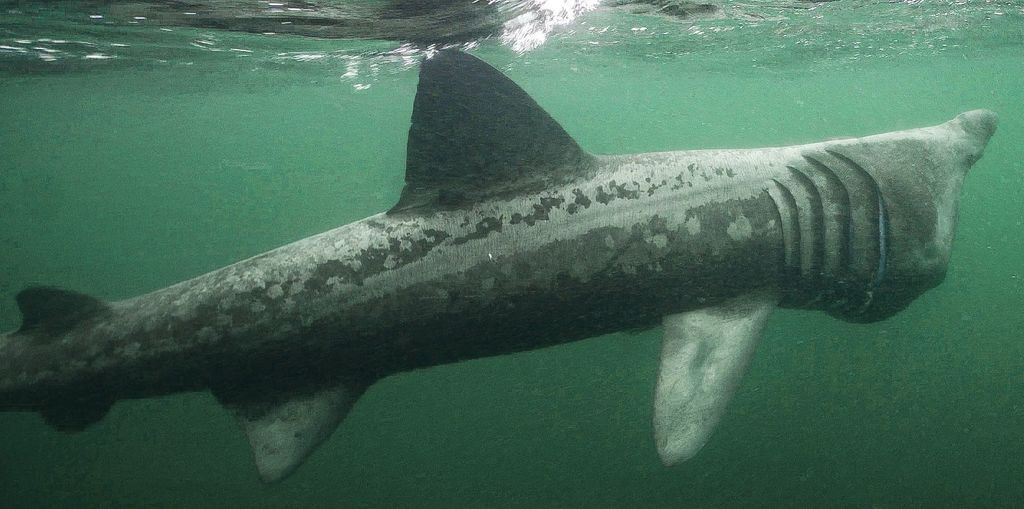
The second-largest fish, a gentle giant that strains plankton through cavernous jaws. In summer it cruises surface waters off Britain, Ireland and New England with its mouth agape.
The basking shark is the second-largest living shark and fish, after the whale shark. It is one of three plankton-eating shark species, along with the whale shark and megamouth shark. Typically, basking sharks reach 7.9 m (26 ft) in length, but large individuals have been known to grow more than 10 m (33 ft) long. It is usually greyish-brown, with mottled skin, with the inside of the mouth being white in colour. The caudal fin has a strong lateral keel and a crescent shape. Other common names include bone shark, elephant shark, sailfish, and sunfish. Wikipedia
What it can do
- iFilters an estimated 2,000 tonnes of water per hour through gill rakers
- iiPassive ram feeder: swims with mouth open rather than sucking water in
- iiiTagging shows it dives deep in winter and crosses ocean basins
- ivBreaches fully clear of the water despite weighing several tonnes
In the field
Field marks
- aEnormous size with a large triangular dorsal fin and tail tip often both visible at surface
- bHuge gill slits that nearly encircle the head
- cCavernous mouth opening wide when feeding; conical pointed snout
- dGrey-brown mottled body
- Not to be confused with
- Whale shark has white spots and a flat, broad head; great white has small gill slits and a dark-edged mouth of teeth. Two fins visible at once often lead to 'sea serpent' or 'two sharks' reports.
- Where to see it
- Hebrides (Coll, Tiree), Cornwall, west Ireland (Malin Head), Isle of Man, Cape Cod
- When
- Summer visitor May–Sep in the NE Atlantic
Life & habits
- Diet
- Zooplankton, mainly copepods
- Habitat
- Surface to over 1,000 m; often near tidal fronts where plankton concentrates
- Size
- Commonly 6–8 m; up to ~10–12 m
- Lifespan
- Estimated around 50 years
Gathers in summer groups at plankton-rich fronts and swims slowly in circles; courtship-like 'nose-to-tail' following has been observed.
Where it lives
Recorded sightings
—
geo-referenced records in GBIF, from museums, herbaria and field observers.
Native range
Temperate seas worldwide; most often seen in the North Atlantic and North Pacific
Drag the globe to turn it. Dots are where records exist, not a range map; darker means more records.
In the stacks
Searching the stacks…
Every page naming Cetorhinus maximus in the Biodiversity Heritage Library →
Marginalia
Gavin Maxwell's Harpoon at a Venture (1952) recounts his failed Hebridean basking-shark fishery; the shark's liver oil once lit lamps in Ireland and Scotland.
Curiosity
Rotting basking shark carcasses lose their lower jaws and gill structure, leaving a long-necked shape mistaken for plesiosaur 'sea monsters' such as the 1977 Zuiyo-maru carcass.
Kinship




Photographs: iNaturalist contributors under the licences shown. Records: GBIF.org. Historical plates: Source Library (CC BY-SA 4.0; originals public domain). Summary text: Nature Library editors and Wikipedia (CC BY-SA). Medicinal and edibility notes are historical and educational, not advice. iNaturalist taxon 82128.