 NL·0409
Herbarium of the Nature Library
- Name
- Daubentonia madagascariensis
- Family
- Daubentoniidae
- Native to
- Madagascar, mainly the eastern rainforests and scattered western and northern forests
- Habitat
- Tropical rainforest, Dry deciduous forest, Mangrove
Aye-aye
Daubentonia madagascariensis
Also calledAye-aye / Hay-hay (Malagasy) · Zhǐhóu 指猴 (Chinese) · Ayeaye (French)
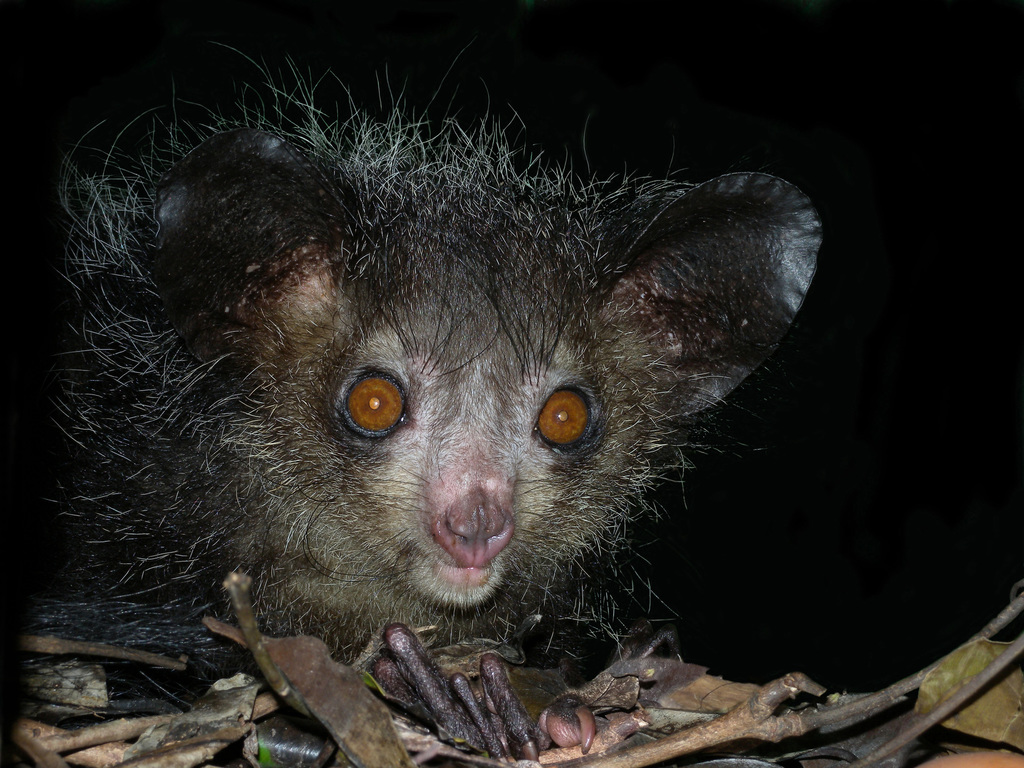
A nocturnal lemur of Madagascar with bat-like ears, rodent-like teeth and a strange, skeletal middle finger. It finds grubs by tapping on wood and listening for hollow tunnels.
The aye-aye is a long-fingered lemur, a strepsirrhine primate native to Madagascar with rodent-like teeth that perpetually grow and a special thin middle finger that they can use to catch grubs and larvae out of tree trunks. Wikipedia
What it can do
- iTaps wood with its thin middle finger and listens to find hollow insect tunnels (percussive foraging)
- iiGnaws into wood with ever-growing incisors, then hooks out larvae with that ball-jointed finger
- iiiHas an extra 'pseudothumb' on each wrist
- ivTurns its large ears independently to locate sounds
In the field
Field marks
- aShaggy dark fur
- bHuge ears
- cLong, thin middle finger
- dBushy tail
- Not to be confused with
- Unmistakable.
- Where to see it
- Nosy Mangabe Special Reserve
- When
- Resident; nocturnal
Listen
Looking for field recordings…
Life & habits
- Diet
- Omnivore: wood-boring beetle larvae, seeds, nectar, fungi, coconuts and other fruit
- Habitat
- Rainforest, dry forest, mangroves and plantations
- Size
- 2–2.6 kg; body ~40 cm with a bushy tail of 45–55 cm
- Lifespan
- Poorly known in the wild; 20+ years in captivity
The world's largest nocturnal primate, it spends the day curled in a ball-shaped nest of leaves high in the canopy.
Where it lives
Recorded sightings
—
geo-referenced records in GBIF, from museums, herbaria and field observers.
Native range
Madagascar, mainly the eastern rainforests and scattered western and northern forests
Drag the globe to turn it. Dots are where records exist, not a range map; darker means more records.
In the stacks
Marginalia
In parts of Madagascar, local fady (taboos) hold the aye-aye to be a sign of death and it may be killed on sight. Pierre Sonnerat brought the first description to Europe in 1782, and early naturalists classed it as a squirrel.
Curiosity
It is the only primate known to find food by tapping and listening, a method otherwise used by woodpeckers.
Kinship





Photographs: iNaturalist contributors under the licences shown. Records: GBIF.org. Historical plates: Source Library (CC BY-SA 4.0; originals public domain). Summary text: Nature Library editors and Wikipedia (CC BY-SA). Medicinal and edibility notes are historical and educational, not advice. iNaturalist taxon 43558.