 NL·0463
Herbarium of the Nature Library
- Name
- Gavialis gangeticus
- Family
- Gavialidae
- Native to
- Rivers of northern India and Nepal (Chambal, Girwa, Son, Gandak, Rapti–Narayani, Ganges); extinct in Pakistan, Bhutan and Myanmar, and possibly in Bangladesh
- Habitat
- Large rivers, Sandbanks
Gharial
Gavialis gangeticus
Also calledGhariyal (Hindi, Urdu) · Ghorial (Bengali) · Gharial (Nepali) · Gavial
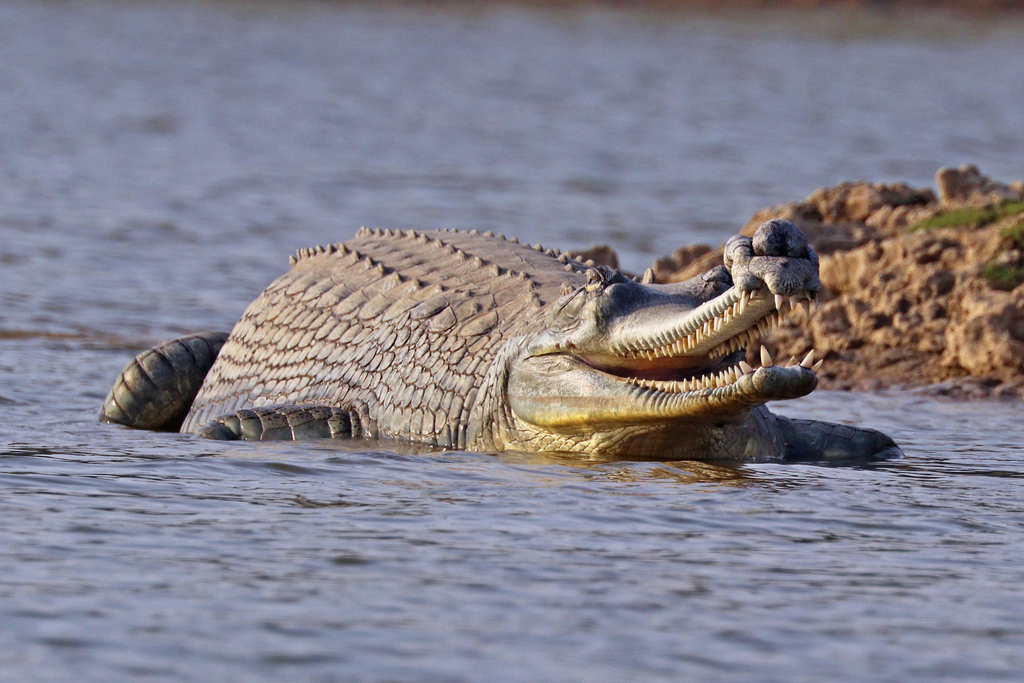
A fish-eating crocodilian of the great rivers of northern India and Nepal, with a very long, needle-thin snout. Mature males grow a bulbous knob on the snout tip, the ghara ('pot'), that gives the species its name. It is Critically Endangered, surviving mainly in a few protected stretches of river.
The gharial, also known as gavial or fish-eating crocodile, is a crocodilian in the family Gavialidae and among the longest of all living crocodilians. Mature females are 2.6 to 4.5 m long, and males 3 to 6 m. Adult males have a distinct boss at the end of the snout, which resembles an earthenware pot known as a ghara, hence the name "gharial". The gharial is well adapted to catching fish because of its long, narrow snout and 110 sharp, interlocking teeth. Wikipedia
What it can do
- iSnaps sideways at fish with its thin snout, which meets little water resistance
- iiMales make a buzzing sound with the ghara, which also helps them blow bubbles
- iiiAmong the longest of all crocodilians, with males reaching ~5–6 m
In the field
Field marks
- aVery long, narrow snout with many interlocking teeth
- bBulbous knob (ghara) on the snout tip of adult males
- cOlive to grey-brown body
- dBasks on river sandbanks
- Not to be confused with
- The mugger crocodile has a broad, heavy snout. The false gharial (Tomistoma schlegelii) of Southeast Asia has a slightly broader snout tapering from the head and lives far away.
- Where to see it
- National Chambal Sanctuary (Madhya Pradesh–Rajasthan–Uttar Pradesh), Katarniaghat on the Girwa River, Chitwan National Park (Nepal)
- When
- Resident; best seen basking in winter (Nov–Mar); nesting Mar–Apr; hatching in June
Life & habits
- Diet
- Almost entirely fish
- Habitat
- Deep, fast-flowing rivers with high sandbanks for basking and nesting
- Size
- Males up to ~5–6 m; females ~3.5–4.5 m
Rarely leaves the water except to bask and nest on sandbanks. Hatchlings stay in groups (crèches) guarded by adults, sometimes riding on a large male's back. Its legs are too weak for it to walk upright on land, so it slides on its belly.
Where it lives
Recorded sightings
—
geo-referenced records in GBIF, from museums, herbaria and field observers.
Native range
Rivers of northern India and Nepal (Chambal, Girwa, Son, Gandak, Rapti–Narayani, Ganges); extinct in Pakistan, Bhutan and Myanmar, and possibly in Bangladesh
Drag the globe to turn it. Dots are where records exist, not a range map; darker means more records.
In the stacks
Searching the stacks…
Every page naming Gavialis gangeticus in the Biodiversity Heritage Library →
Marginalia
In the 1970s fewer than 200 gharials were left in the wild, and India's Project Crocodile, started in 1975, reared hatchlings from collected eggs for release. In Hindu art, the makara, vehicle of the river goddess Ganga, is often shown with a long snout like a gharial.
Curiosity
In 2007–08 more than 100 gharials died on the Chambal River from a disease or toxin, which showed how vulnerable a few small populations can be.
Kinship




Photographs: iNaturalist contributors under the licences shown. Records: GBIF.org. Historical plates: Source Library (CC BY-SA 4.0; originals public domain). Summary text: Nature Library editors and Wikipedia (CC BY-SA). Medicinal and edibility notes are historical and educational, not advice. iNaturalist taxon 116523.