 NL·0748
Herbarium of the Nature Library
- Name
- Geronticus eremita
- Family
- Threskiornithidae
- Native to
- Wild colonies in Souss-Massa (Morocco); semi-wild colony at Birecik (Turkey); reintroduced in Austria, Germany, Italy and Spain; formerly Syria, central Europe and North Africa
- Habitat
- Coastal cliffs, Semi-desert, Steppe, Farmland
On eBird ↗
Northern Bald Ibis
Live sightings near you, the range map, bar charts of when it is seen, and Macaulay Library photos and recordings.
Northern bald ibis
Geronticus eremita
Also calledKelaynak (Turkish) · Waldrapp (German) · Ibis chauve (French) · Ibis eremita (Spanish) · Abu minjal (Arabic)
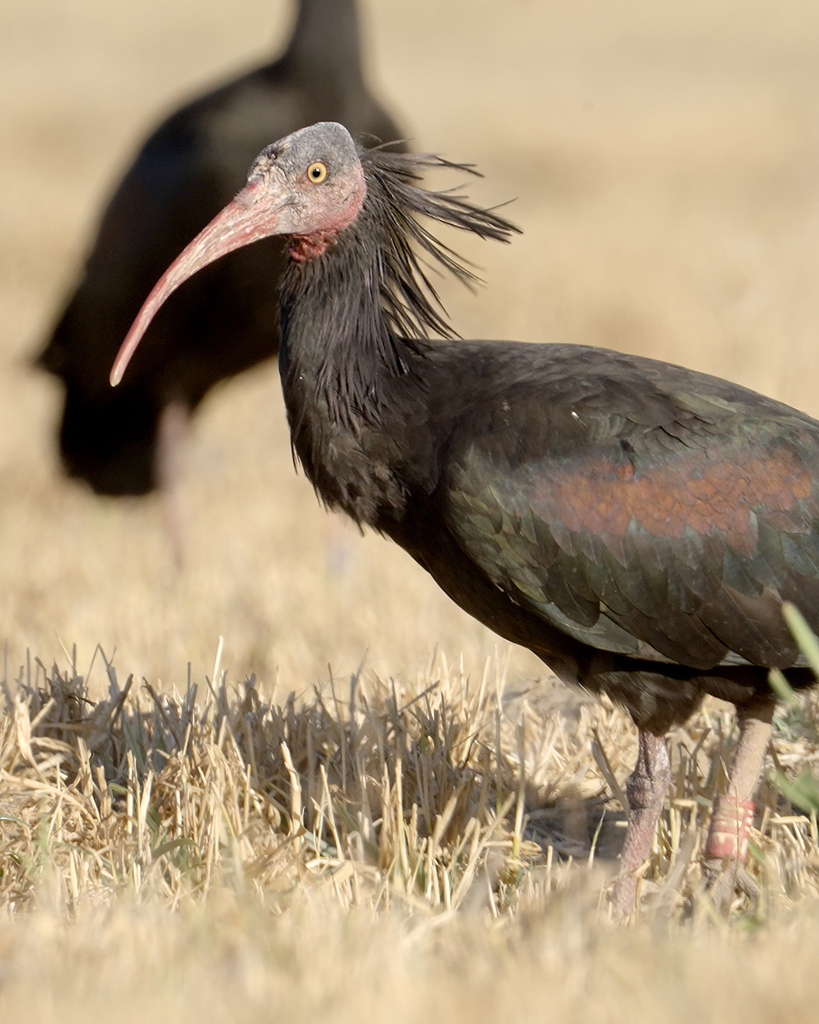
A glossy black ibis with a bare red face, a ragged ruff and a curved red bill. Once widespread in Europe, the Middle East and North Africa, it survives in the wild mainly on Morocco's Atlantic coast, with reintroduced populations in Europe.
The northern bald ibis, hermit ibis, or Waldrapp is a migratory Old World ibis found in open areas such as grasslands, rocky mountains, and semi-deserts, often close to running water. This 70–80 cm (28–31 in) glossy black ibis, which, unlike many members of the ibis family, is non-wading, has an unfeathered red face and head, and a long, curved red bill. It breeds colonially on coastal or mountain cliff ledges, where it typically lays two to three eggs in a stick nest, and feeds on lizards, insects, and other small animals. Wikipedia
What it can do
- iNests on cliff ledges in colonies
- iiProbes soil for insects and small reptiles in dry grassland
- iiiReintroduced European birds have learned a migration route by following ultralight aircraft
- ivFormation flying saves energy, as studied in this species
In the field
Field marks
- aBlack plumage glossed with green and purple
- bBare red face and head
- cLong, curved red bill
- dShaggy ruff of feathers on the nape
- Voice
- A guttural 'hyoh' or 'chrup' and various croaks at the colony.
- Not to be confused with
- Glossy ibis is slimmer with a feathered head and darker bill. Cormorants fly with straight bills. Southern bald ibis lives only in southern Africa.
- Where to see it
- Souss-Massa National Park and Tamri (Morocco), Birecik (Turkey), and reintroduced birds in Austria and Tuscany.
- When
- Resident in Morocco; reintroduced European birds migrate to Tuscany for winter
Listen
Looking for field recordings…
Life & habits
- Diet
- Beetles, larvae, worms, lizards and other small animals
- Habitat
- Rocky coasts, cliffs and semi-arid steppe and farmland
- Size
- 70–80 cm; wingspan 125–135 cm; 1–1.5 kg
Feeds in loose flocks, probing the ground with its curved bill while walking.
Where it lives
Recorded sightings
—
geo-referenced records in GBIF, from museums, herbaria and field observers.
Native range
Wild colonies in Souss-Massa (Morocco); semi-wild colony at Birecik (Turkey); reintroduced in Austria, Germany, Italy and Spain; formerly Syria, central Europe and North Africa
Drag the globe to turn it. Dots are where records exist, not a range map; darker means more records.
In the old herbals & bestiaries
Woodcuts and engravings matched from the Source Library’s scanned books by name. Plates marked “relative” show a close kin rather than this exact species. Click a plate to read the page it came from, with translation.

In the stacks
Searching the stacks…
Every page naming Geronticus eremita in the Biodiversity Heritage Library →
Marginalia
The ancient Egyptian hieroglyph 'akh', meaning spirit or shining one, depicts this ibis, and in Birecik it was traditionally believed to guide pilgrims to Mecca.
Curiosity
Conrad Gessner described it in Switzerland in 1555, but after it vanished from Europe it was dismissed as a mythical bird until it was rediscovered in the Middle East.
Kinship

Photographs: iNaturalist contributors under the licences shown. Records: GBIF.org. Historical plates: Source Library (CC BY-SA 4.0; originals public domain). Summary text: Nature Library editors and Wikipedia (CC BY-SA). Medicinal and edibility notes are historical and educational, not advice. iNaturalist taxon 3753.