 NL·0486
Herbarium of the Nature Library
- Name
- Gorilla beringei
- Family
- Hominidae
- Native to
- Virunga Mountains (Rwanda, Uganda, DR Congo), Bwindi Impenetrable Forest (Uganda) and eastern DR Congo lowland and montane forests
- Habitat
- Montane forest, Bamboo forest, Lowland rainforest
Eastern gorilla (incl. mountain gorilla)
Gorilla beringei
Also calledIngagi (Kinyarwanda) · Mountain gorilla · Grauer's gorilla · Gorila de montaña (Spanish) · Gorila-da-montanha (Portuguese)
The largest living primate, found in two subspecies: Grauer's gorilla of the lowland forests of eastern DR Congo, and the famous mountain gorilla of the Virunga volcanoes and Bwindi. Mountain gorillas, studied since Dian Fossey's work in the 1960s, have increased to just over 1,000 and were downlisted from Critically Endangered to Endangered in 2018, while the species as a whole remains Critically Endangered because Grauer's gorillas have declined sharply.
The eastern gorilla is a critically endangered species of the genus Gorilla and the largest living primate. At present, the species is subdivided into two subspecies. There are 6,800 eastern lowland gorillas or Grauer's gorillas and 1,000 mountain gorillas. Illegal hunting threatens the species. Wikipedia
What it can do
- iSilverback males can weigh over 200 kg and are several times stronger than people
- iiBuilds a fresh nest of leaves and branches to sleep in every night
- iiiDisperses seeds and opens gaps in forest through feeding and movement
In the field
Field marks
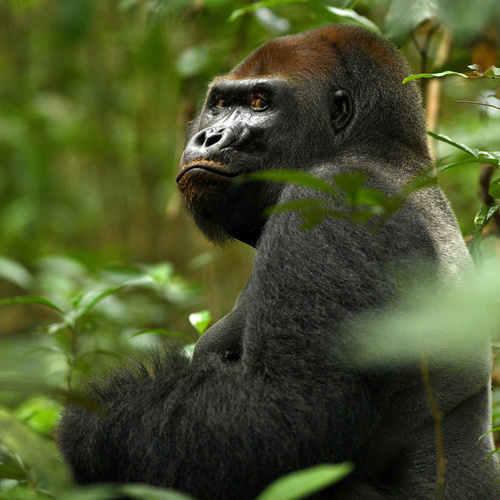
- aVery large black ape; mountain gorillas have long, thick, black hair
- bAdult males with a silver saddle on the back
- cMassive head with a prominent sagittal crest in males; broad nostrils
- dSigns: night nests on the ground with dung, trails of trampled vegetation and broken celery stems; knuckle prints
- Voice
- Chest-beating 'pok-pok' drumming, hoots, roars and soft, contented 'belch' grumbles between group members.
- Not to be confused with
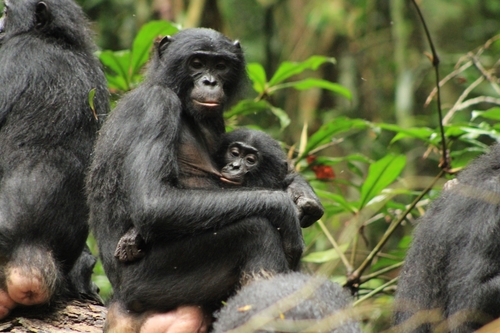
- Western gorillas (Gorilla gorilla) of West and Central Africa are browner-grey, with a reddish crown and shorter hair. Chimpanzees are much smaller, with large ears and long arms.
- Where to see it
- Volcanoes National Park (Rwanda); Bwindi Impenetrable and Mgahinga Gorilla national parks (Uganda); Virunga National Park (DR Congo); Kahuzi-Biega National Park (DR Congo, Grauer's gorilla)
- When
- Resident; trekking runs year-round, drier months June–September and December–February are easiest
Listen
Looking for field recordings…
Life & habits
- Diet
- Mainly leaves, stems, shoots and pith (wild celery, nettles, bamboo shoots); fruit when available; occasional ants
- Habitat
- Montane and bamboo forest (mountain gorillas, up to about 4,000 m) and lowland rainforest (Grauer's)
- Size
- Males 1.5–1.8 m standing, 140–220 kg; females about half as heavy
- Lifespan
- About 35–40 years in the wild
Lives in groups led by one or more silverbacks. Males display by standing upright and beating their chests with cupped hands, a sound carrying over 1 km.
Where it lives
Recorded sightings
—
geo-referenced records in GBIF, from museums, herbaria and field observers.
Native range
Virunga Mountains (Rwanda, Uganda, DR Congo), Bwindi Impenetrable Forest (Uganda) and eastern DR Congo lowland and montane forests
Drag the globe to turn it. Dots are where records exist, not a range map; darker means more records.
In the stacks
Searching the stacks…
Every page naming Gorilla beringei in the Biodiversity Heritage Library →
Marginalia
Dian Fossey founded the Karisoke Research Center in Rwanda in 1967 and wrote 'Gorillas in the Mist' (1983) before her murder in 1985. Rwanda's annual Kwita Izina ceremony names each newborn mountain gorilla.
Curiosity
The species is named for German officer Robert von Beringe, who shot two on Mount Sabyinyo in 1902, the first known to science.
Kinship



Photographs: iNaturalist contributors under the licences shown. Records: GBIF.org. Historical plates: Source Library (CC BY-SA 4.0; originals public domain). Summary text: Nature Library editors and Wikipedia (CC BY-SA). Medicinal and edibility notes are historical and educational, not advice. iNaturalist taxon 68790.