 NL·0549
Herbarium of the Nature Library
- Name
- Gulo gulo
- Family
- Mustelidae
- Native to
- Circumpolar: Scandinavia, northern Russia, Siberia, Alaska, Canada and the high Rockies and Cascades of the northwestern USA
- Habitat
- Boreal forest, Tundra, Alpine
Wolverine
Gulo gulo
Also calledJerv (Norwegian) · Ahma (Finnish) · Rosomakha (Russian) · Carcajou (Canadian French) · Glotón (Spanish) · Qavvik (Inuktitut)
A bear-like giant weasel of the far north, famous for its endurance and strength. Wolverines travel tens of kilometres a day over mountains, crunch frozen carcasses with powerful jaws and store food in snow and rock crevices.
The wolverine, also called the carcajou or quickhatch, is the largest land-dwelling member of the family Mustelidae. It is a muscular carnivore and a solitary animal. The wolverine has a reputation for ferocity and strength out of proportion to its size, with the documented ability to kill prey many times larger than itself. Wikipedia
What it can do
- iCrushes frozen meat and bone with a strong jaw and a molar turned sideways in the upper jaw
- iiCovers huge home ranges, over 1,000 km² for some males
- iiiClimbed some 1,500 m up Mount Cleveland, Glacier National Park, in about 90 minutes in winter (a radio-collared male)
In the field
Field marks
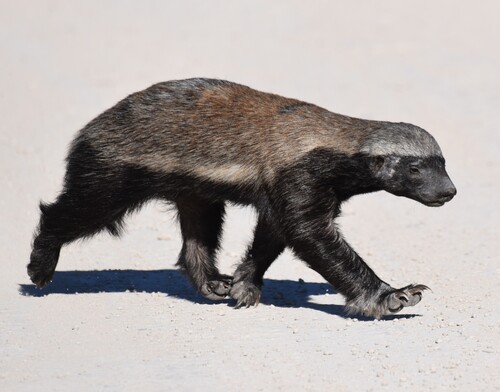
- aSilhouette: small bear-like body, arched back, short legs and bushy tail
- bDark brown coat with a pale buff band along each flank from shoulders to tail
- cPale mask across the forehead
- dTracks: five-toed, about 10–13 cm, often in a bounding '2–1–2' or '3–4' pattern in snow
- Not to be confused with
- Bear cubs lack the pale side-stripe and have smaller tails; badgers are greyer with a striped face; fishers and martens are slimmer and smaller.
- Where to see it
- Kuhmo and Lieksa wildlife hides, eastern Finland; Norwegian and Swedish mountains (e.g. Dovrefjell); Denali (Alaska); Kluane (Yukon)
- When
- Resident; hides in Finland give sightings April–September
Listen
Looking for field recordings…
Life & habits
- Diet
- Scavenged carcasses of reindeer, moose and other ungulates; also hunts hares, rodents, birds and sometimes reindeer in deep snow
- Habitat
- Remote tundra, taiga and alpine areas with deep spring snow cover for dens
- Size
- Males 11–18 kg, females 7–12 kg; body 65–105 cm
- Lifespan
- About 7–12 years in the wild
Solitary and wide-ranging. Females dig dens in deep snow to give birth in late winter.
Where it lives
Recorded sightings
—
geo-referenced records in GBIF, from museums, herbaria and field observers.
Native range
Circumpolar: Scandinavia, northern Russia, Siberia, Alaska, Canada and the high Rockies and Cascades of the northwestern USA
Drag the globe to turn it. Dots are where records exist, not a range map; darker means more records.
In the stacks
Searching the stacks…
Every page naming Gulo gulo in the Biodiversity Heritage Library →
Marginalia
Olaus Magnus, in his 1555 History of the Northern Peoples, claimed the 'gulo' gorged until it had to squeeze between two trees to empty its belly. Its Latin name means 'glutton'.
Curiosity
Wolverine fur resists frost, so Inuit and other northern peoples trimmed parka hoods with it.
Kinship




Photographs: iNaturalist contributors under the licences shown. Records: GBIF.org. Historical plates: Source Library (CC BY-SA 4.0; originals public domain). Summary text: Nature Library editors and Wikipedia (CC BY-SA). Medicinal and edibility notes are historical and educational, not advice. iNaturalist taxon 41852.