 NL·0480
Herbarium of the Nature Library
- Name
- Hemiscyllium ocellatum
- Family
- Hemiscylliidae
- Native to
- Shallow reefs of northern Australia and southern New Guinea
- Habitat
- Coral reef, Reef flats and lagoons, Tide pools
Epaulette shark
Hemiscyllium ocellatum
Also calledTiburón charretera (Spanish) · Requin-chabot ocellé (French)
A small, spotted reef shark that 'walks' across tide pools on its paired fins and survives hours of near-zero oxygen when the tide falls.
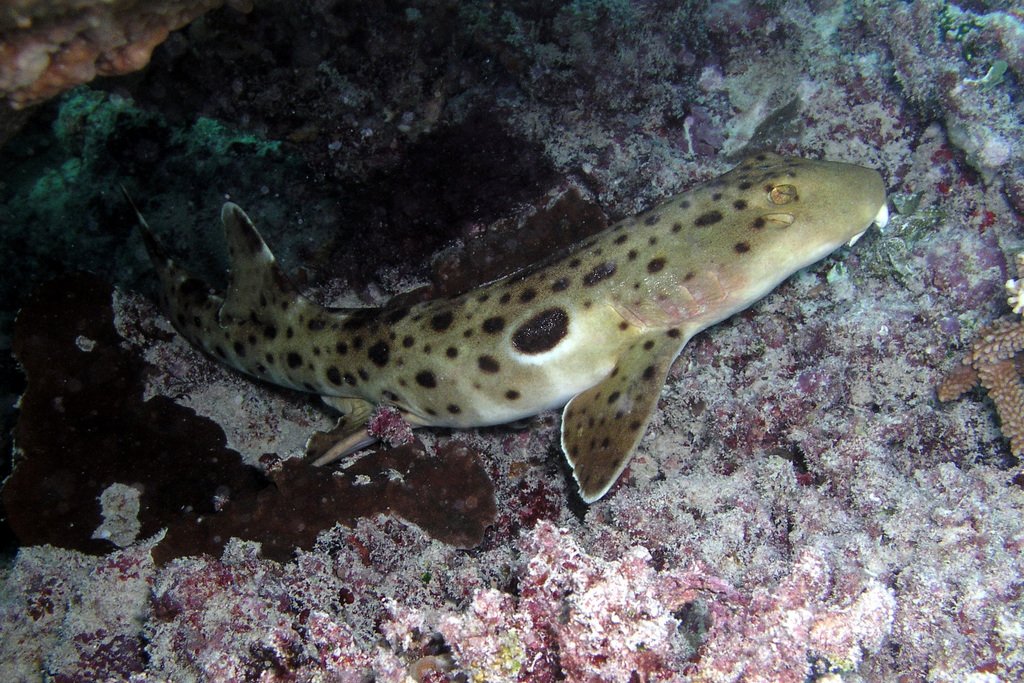
The epaulette shark is a species of longtailed carpet shark of the family Hemiscylliidae, found in shallow, tropical waters off Australia and New Guinea. The common name of this shark comes from the very large, white-margined black spot behind each pectoral fin, which are reminiscent of military epaulettes. A small species, the epaulette shark has a slender body with a short head and broad, paddle-shaped paired fins. The caudal peduncle comprises over half the shark's length. Adults are light brown above, with scattered darker spots and indistinct saddles. Wikipedia
What it can do
- iWalks on pectoral and pelvic fins between pools, even across exposed reef
- iiTolerates severe hypoxia for hours by shutting down non-essential brain activity
- iiiIs studied as a model for stroke and climate-related low-oxygen tolerance
In the field
Field marks
- aLarge black spot ringed in white behind each pectoral fin (the 'epaulette')
- bSlender body with a long tail
- cSmall scattered dark spots on a pale brown background
- dShort barbels near the nostrils
- Not to be confused with
- Other walking sharks (Hemiscyllium spp. of New Guinea and Indonesia) differ in spot pattern; brownbanded bamboo shark lacks the epaulette spot.
- Where to see it
- Heron Island and Lady Elliot Island (Great Barrier Reef) reef flats at low tide
- When
- Year-round; best at dusk low tides
Life & habits
- Diet
- Worms, crabs, shrimps and small fish
- Habitat
- Shallow reef flats and tide pools, rarely below 10 m
- Size
- Up to about 1 m; usually under 70 cm
- Lifespan
- Up to about 20–25 years
Hunts at dusk and night by poking its snout into sand and crevices; hides under coral by day.
Where it lives
Recorded sightings
—
geo-referenced records in GBIF, from museums, herbaria and field observers.
Native range
Shallow reefs of northern Australia and southern New Guinea
Drag the globe to turn it. Dots are where records exist, not a range map; darker means more records.
In the stacks
Searching the stacks…
Every page naming Hemiscyllium ocellatum in the Biodiversity Heritage Library →
Marginalia
Its common name refers to the military shoulder ornament its eyespot resembles.
Curiosity
Its fin-walking gait resembles that of salamanders, so it is studied for clues to how early vertebrates moved onto land.
Kinship





Photographs: iNaturalist contributors under the licences shown. Records: GBIF.org. Historical plates: Source Library (CC BY-SA 4.0; originals public domain). Summary text: Nature Library editors and Wikipedia (CC BY-SA). Medicinal and edibility notes are historical and educational, not advice. iNaturalist taxon 102601.