 NL·0491
Herbarium of the Nature Library
- Name
- Hoolock hoolock
- Family
- Hylobatidae
- Native to
- Northeast India south of the Brahmaputra, eastern Bangladesh and western Myanmar (west of the Chindwin River)
- Habitat
- Tropical evergreen forest, Semi-evergreen forest
Western hoolock gibbon
Hoolock hoolock
Also calledUlluk (Bengali) · Holou bāndor (Assamese) · Hoolock (Hindi)
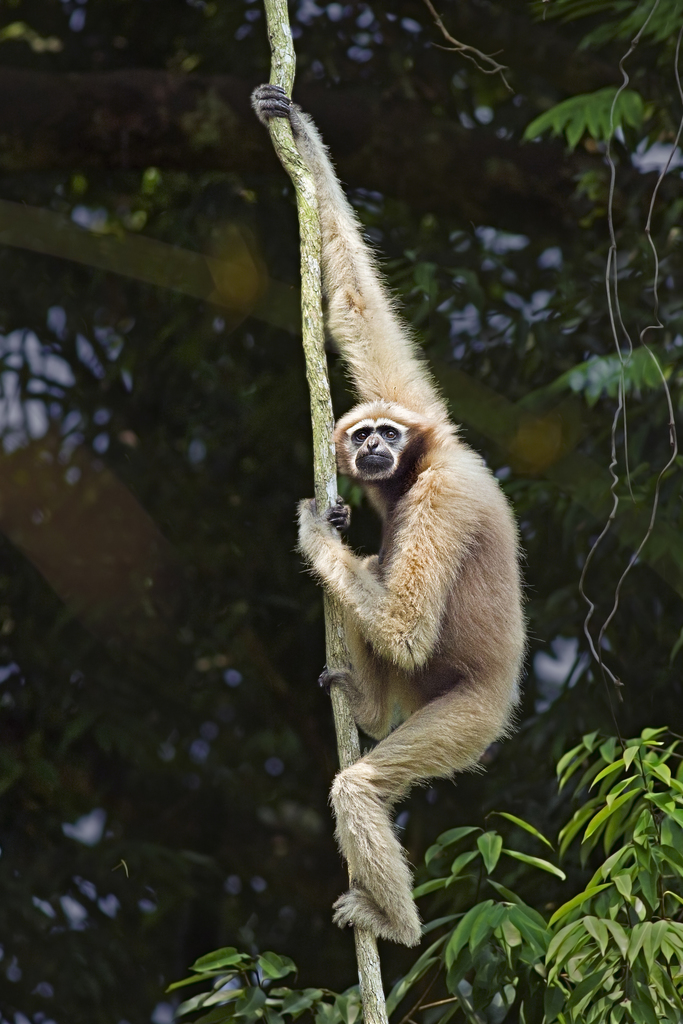
One of India's two apes (with the eastern hoolock), a long-armed gibbon of the forests of northeast India, Bangladesh and western Myanmar that swings through the canopy by its arms. Pairs greet each morning with loud duets that carry kilometres through the hills. Its range has shrunk sharply with forest clearance.
The western hoolock gibbon is a primate from the gibbon family, Hylobatidae. The species is found in Assam, Mizoram, and Meghalaya in India, Bangladesh, and Myanmar west of the Chindwin River. Wikipedia
What it can do
- iMoves by brachiation, swinging arm-over-arm and leaping gaps of several metres
- iiDuets can be heard about 1–2 km away
- iiiDisperses seeds of many forest fruit trees
In the field
Field marks
- aSilhouette in canopy: tailless ape with very long arms, swinging under branches
- bAdult males black with conspicuous white eyebrows
- cAdult females buff to golden-brown with a darker face ringed paler
- dSigns: loud morning duets, fruit drop under fig trees
- Voice
- Pairs duet in the early morning with escalating whooping calls, often rendered 'hoo-kau, hoo-kau', the female's notes rising into a climax.
- Not to be confused with
- Eastern hoolock gibbon (east of the Chindwin, and in Arunachal Pradesh) is very similar; males have separated white brows and females paler. Monkeys such as capped langurs have long tails.
- Where to see it
- Hollongapar Gibbon Sanctuary (Assam); Lawachara National Park (Bangladesh); Nokrek and Balpakram (Meghalaya); Dampa Tiger Reserve (Mizoram)
- When
- Resident; best heard in early mornings, especially in the dry season
Listen
Looking for field recordings…
Life & habits
- Diet
- Mainly ripe fruits, especially figs; also leaves, flowers and insects
- Habitat
- Tall evergreen and semi-evergreen forest with a continuous canopy
- Size
- Head and body about 60–90 cm; 6–9 kg; no tail
- Lifespan
- About 25 years in the wild
Lives in small family groups of a pair and their young, defending a territory with song. Almost never comes to the ground.
Where it lives
Recorded sightings
—
geo-referenced records in GBIF, from museums, herbaria and field observers.
Native range
Northeast India south of the Brahmaputra, eastern Bangladesh and western Myanmar (west of the Chindwin River)
Drag the globe to turn it. Dots are where records exist, not a range map; darker means more records.
In the old herbals & bestiaries
No plate in the Source Library names this exact species, so these show its closest relatives as the old naturalists drew them: same genus, or the same kind of animal. Click a plate to read the page it came from, with translation.

Sancai Tuhui (Vol. 92)
Relative · 王圻, 王思義 · 1609 · p.73

Sancai Tuhui, Juan 92 — Birds & Beasts (NCL Original)
Relative · 王圻、王思義 · 1609 · p.102

Sancai Tuhui, Juan 92 — Birds & Beasts (NCL Original)
Relative · 王圻、王思義 · 1609 · p.49

Jean Baptiste Audebert — Histoire naturelle des singes et des makis (1800)
Relative · Jean Baptiste Audebert · 1800 · p.45

Sancai Tuhui (Vol. 92)
Relative · 王圻, 王思義 · 1609 · p.22
In the stacks
Searching the stacks…
Every page naming Hoolock hoolock in the Biodiversity Heritage Library →
Marginalia
Richard Harlan described the species in 1834 from Assam, using a local name for the animal. In Meghalaya, community-protected sacred groves still shelter some hoolock groups.
Curiosity
Hoolocks have 38 chromosomes, the fewest of any gibbon (others have 44–52), which is one reason they were placed in their own genus, Hoolock, in 2005.
Kinship





Fact-checked: 2 corrections made to this sheet. Photographs: iNaturalist contributors under the licences shown. Records: GBIF.org. Historical plates: Source Library (CC BY-SA 4.0; originals public domain). Summary text: Nature Library editors and Wikipedia (CC BY-SA). Medicinal and edibility notes are historical and educational, not advice. iNaturalist taxon 74439.