 NL·0543
Herbarium of the Nature Library
- Name
- Monodon monoceros
- Family
- Monodontidae
- Native to
- Arctic waters of Canada, Greenland, Svalbard and Russia, mainly the Atlantic Arctic and Baffin Bay
- Habitat
- Polar seas, Sea ice, Fjords
Narwhal
Monodon monoceros
Also calledQilalugaq tuugaalik (Inuktitut) · Náhvalr, 'corpse whale' (Old Norse) · Narval (Spanish/French) · Ikkaku (Japanese) · Yījiǎojīng 一角鲸 (Chinese)
An Arctic whale whose males grow a spiralled tusk up to about 3 m long, which is actually a tooth that grows through the upper lip. Medieval Europeans sold these tusks as unicorn horns.
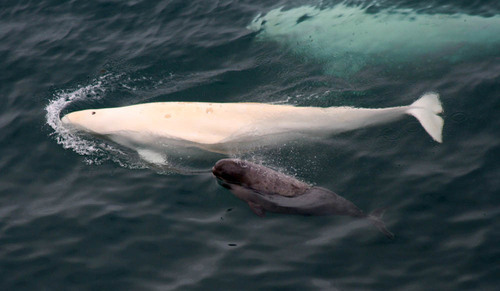
The narwhal is a species of toothed whale native to the Arctic. It is the only member of the genus Monodon and one of two living representatives of the family Monodontidae. The narwhal is a stocky cetacean with a relatively blunt snout, a large melon, and a shallow ridge in place of a dorsal fin. Males of this species have a spiralled tusk, which is a protruding left canine, that is 1.5–3.0 m (4.9–9.8 ft) long and thought to function as a secondary sexual characteristic, a weapon, a tool for feeding, or a sensory organ. Specially adapted slow-twitch muscles, along with the jointed neck vertebrae and shallow dorsal ridge allow for easy movement through the Arctic environment, where the narwhal spends extended periods at great depths. The narwhal's geographic range overlaps with that of the similarly built and closely related beluga whale, and the animals are known to interbreed. Wikipedia
What it can do
- iGrows a tusk, usually the left canine, that spirals counter-clockwise and can reach ~3 m
- iiThe tusk has nerve-linked channels that may sense changes in the surrounding water
- iiiDives to about 1,500 m or more, repeatedly, to hunt halibut in winter
- ivHunts and navigates under dense pack ice by echolocation
- vHas been filmed tapping Arctic cod with its tusk to stun them
In the field
Field marks
- aMottled grey whale
- bMales have a long, spiral tusk
- cNo dorsal fin
- dRounded head
- Voice
- Clicks, whistles and knocks
- Not to be confused with
- Beluga is white with no tusk.
- Where to see it
- Floe edge near Pond Inlet and Arctic Bay (Nunavut)
- When
- Floe edge Jun
Listen
Looking for field recordings…
Life & habits
- Diet
- Greenland halibut, Arctic and polar cod, squid, shrimp
- Habitat
- Deep fjords and offshore pack ice
- Size
- Body 4–5.5 m (not counting tusk); 800–1,600 kg
- Lifespan
- ~50 years, possibly longer
Narwhals migrate seasonally between summer fjords and winter feeding grounds under dense pack ice. Males sometimes rub tusks together ('tusking').
Where it lives
Recorded sightings
—
geo-referenced records in GBIF, from museums, herbaria and field observers.
Native range
Arctic waters of Canada, Greenland, Svalbard and Russia, mainly the Atlantic Arctic and Baffin Bay
Drag the globe to turn it. Dots are where records exist, not a range map; darker means more records.
In the old herbals & bestiaries
Woodcuts and engravings matched from the Source Library’s scanned books by name. Plates marked “relative” show a close kin rather than this exact species. Click a plate to read the page it came from, with translation.

Bestiary
Anonymous · 1240 · p.59

Treasury of Medical Matters of New Spain
Francisco Hernández · 1651 · p.865

Sacred Physics
Scheuchzer, Johan Jacob · 1728 · p.156

Noah's Ark
Athanasius Kircher · 1675 · p.105

Ortus sanitatis
1491 · p.584

Garden of Health
Jacob Meydenbach · 1491 · p.582

Ten Books of Exotic Things
Carolus Clusius · 1605 · p.163

The Subterranean World Volume Two
Athanasius Kircher · 1678 · p.77

Mundus Subterraneus
Athanasius Kircher · 1678 · p.527
In the stacks
Searching the stacks…
Every page naming Monodon monoceros in the Biodiversity Heritage Library →
Marginalia
The Danish kings' coronation throne at Rosenborg Castle (1660s) is made largely of narwhal tusk, then believed to be unicorn horn. An Inuit story tells of a cruel woman dragged into the sea by a harpooned narwhal, her twisted hair becoming its tusk.
Curiosity
About 1 in 500 males grows two tusks, and a few females grow one.
Kinship





Photographs: iNaturalist contributors under the licences shown. Records: GBIF.org. Historical plates: Source Library (CC BY-SA 4.0; originals public domain). Summary text: Nature Library editors and Wikipedia (CC BY-SA). Medicinal and edibility notes are historical and educational, not advice. iNaturalist taxon 41459.