 NL·0366
Herbarium of the Nature Library
- Name
- Natrix natrix
- Family
- Colubridae
- Native to
- Central and eastern Europe and Scandinavia, east to Lake Baikal and south to the Caucasus and Iran; western populations (Britain, France, western Germany) are now treated as the barred grass snake, Natrix helvetica
- Habitat
- Wetlands, Riverbanks, Meadows, Gardens
Grass snake
Natrix natrix
Also calledRingelnatter (German) · Žaltys (Lithuanian) · Uzhovka / Uzh (Russian) · Snok (Swedish/Dutch) · Couleuvre à collier (French)
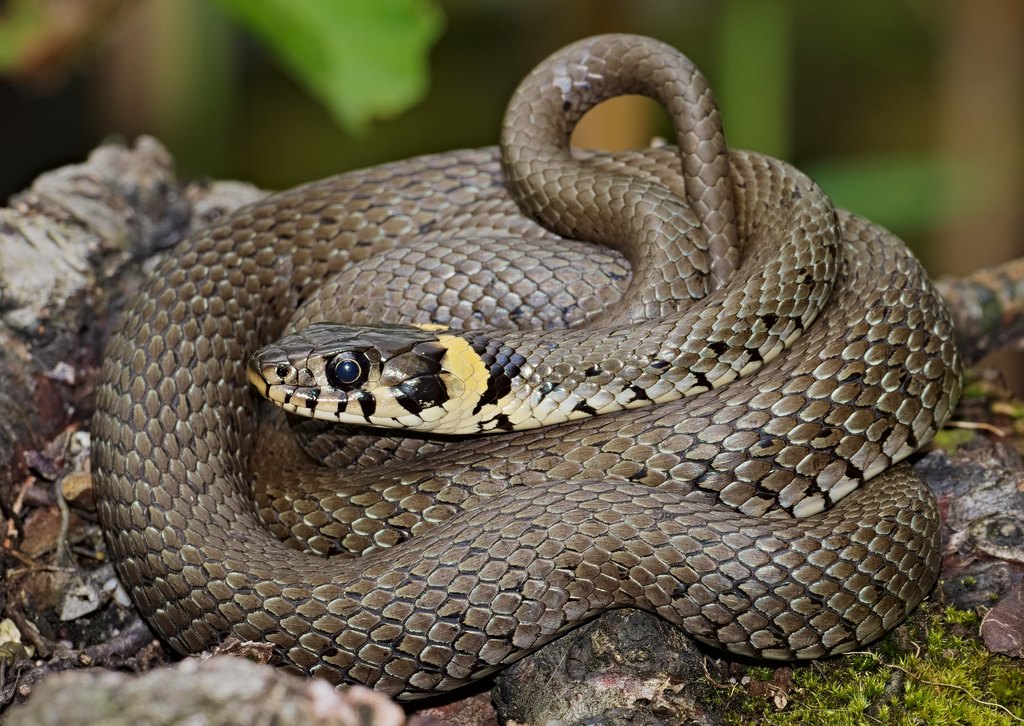
A harmless water-loving snake with a bright yellow collar, found across central and eastern Europe into Asia. It eats frogs and fish, plays dead when caught, and lays its eggs in compost heaps and manure, which act as natural incubators.
The grass snake, sometimes called the ringed snake or water snake, is a Eurasian semi-aquatic non-venomous colubrid snake. It is often found near water and feeds almost exclusively on amphibians. Wikipedia
What it can do
- iSwims and dives well, hunting frogs, newts and fish
- iiWhen grabbed, gives off a foul-smelling fluid and may 'play dead', going limp with its mouth open and tongue hanging
- iiiUses the heat of rotting vegetation to incubate its eggs
In the field
Field marks
- aYellow, cream or orange collar behind the head, with a black crescent behind it
- bOlive-grey to green body with small black bars along the sides
- cRound pupils, rounded head
- dChequered black-and-white belly
- Not to be confused with
- The adder (Vipera berus) is shorter and stockier, has a dark zigzag down its back, a V or X mark on its head, vertical pupils and no yellow collar. The dice snake (N. tessellata) has no collar and is blotched. In western Europe the barred grass snake (N. helvetica) is very similar but often has bolder side bars and a weaker collar; range is the best guide.
- Where to see it
- Lakes and wetlands across Poland, the Baltic states, Scandinavia and central Europe; often seen swimming in ponds on sunny days
- When
- Active April–October; hibernates in winter
Life & habits
- Diet
- Frogs, toads, newts, fish, occasionally small mammals
- Habitat
- Ponds, rivers, marshes, damp meadows and gardens
- Size
- Usually 70–120 cm; females larger
- Lifespan
- ~15–20 years
Rarely bites. When threatened it hisses and fake-strikes with its mouth closed, then plays dead. Females often lay their eggs together in the same compost heap.
Where it lives
Recorded sightings
—
geo-referenced records in GBIF, from museums, herbaria and field observers.
Native range
Central and eastern Europe and Scandinavia, east to Lake Baikal and south to the Caucasus and Iran; western populations (Britain, France, western Germany) are now treated as the barred grass snake, Natrix helvetica
Drag the globe to turn it. Dots are where records exist, not a range map; darker means more records.
In the old herbals & bestiaries
Woodcuts and engravings matched from the Source Library’s scanned books by name. Plates marked “relative” show a close kin rather than this exact species. Click a plate to read the page it came from, with translation.

In the stacks
Searching the stacks…
Every page naming Natrix natrix in the Biodiversity Heritage Library →
Marginalia
In Lithuania the žaltys was a household guardian, fed milk and kept in homes. The folk tale 'Eglė, Queen of Serpents' tells of a girl who marries a žaltys, the Serpent King.
Curiosity
In 2017 genetic work split the grass snake in two, so the familiar British grass snake is now the barred grass snake, Natrix helvetica.
Kinship


Photographs: iNaturalist contributors under the licences shown. Records: GBIF.org. Historical plates: Source Library (CC BY-SA 4.0; originals public domain). Summary text: Nature Library editors and Wikipedia (CC BY-SA). Medicinal and edibility notes are historical and educational, not advice. iNaturalist taxon 966787.