 NL·0568
Herbarium of the Nature Library
- Name
- Oceanites oceanicus
- Family
- Oceanitidae
- Native to
- Breeds in Antarctica and sub-Antarctic islands; winters across all oceans
- Habitat
- Marine, Antarctic coast
On eBird ↗
Wilson's Storm-Petrel
Live sightings near you, the range map, bar charts of when it is seen, and Macaulay Library photos and recordings.
Wilson's storm petrel
Oceanites oceanicus
Also calledPaíño de Wilson (Spanish) · Océanite de Wilson (French) · Mother Carey's chicken (sailors' English)
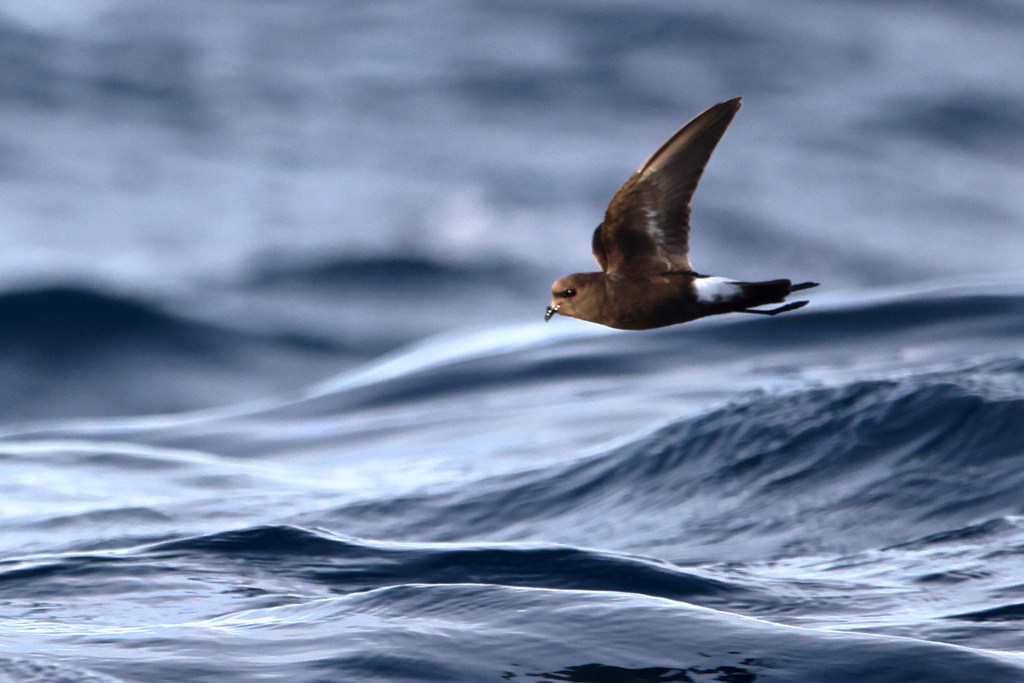
A sparrow-sized seabird that breeds in Antarctica and migrates to the North Atlantic. It is one of the most abundant birds on Earth and appears to 'walk' on water while feeding.
Wilson's storm petrel, also known as Wilson's petrel, is a small seabird of the austral storm petrel family Oceanitidae. It is one of the most abundant bird species in the world and has a circumpolar distribution mainly in the seas of the southern hemisphere but extending northwards during the summer of the northern hemisphere. The world population was estimated in 2022 as stable at 8–20 million birds. In 2010 it had been estimated at 12–30 million. A 1998 book had estimated more than 50 million pairs. The name commemorates the Scottish-American ornithologist Alexander Wilson. The genus name Oceanites refers to the mythical Oceanids, the three thousand daughters of Tethys. The species name is from Latin oceanus, "ocean". Wikipedia
What it can do
- iPats the water with its feet while hovering, appearing to walk on it
- iiMigrates from Antarctica to the North Atlantic each year
- iiiFinds food by smell
In the field
Field marks
- aDark sooty-brown body
- bWhite rump band
- cLong legs that project beyond the square tail
- dYellow webs between the toes
- Voice
- Silent at sea; chattering at nests.
- Not to be confused with
- Leach's storm petrel has a forked tail. European storm petrel has a white underwing bar.
- Where to see it
- Antarctic Peninsula; off North Carolina and Massachusetts in summer
- When
- Breeds Nov–March (Antarctica); Northern Hemisphere May–Sept
Listen
Looking for field recordings…
Life & habits
- Diet
- Krill, small fish, plankton
- Habitat
- Open ocean; breeds in rock crevices
- Size
- 15–19 cm; wingspan 38–42 cm
It dances over the waves with feet pattering the water as it feeds.
Where it lives
Recorded sightings
—
geo-referenced records in GBIF, from museums, herbaria and field observers.
Native range
Breeds in Antarctica and sub-Antarctic islands; winters across all oceans
Drag the globe to turn it. Dots are where records exist, not a range map; darker means more records.
In the old herbals & bestiaries
No plate in the Source Library names this exact species, so these show its closest relatives as the old naturalists drew them: same genus, or the same kind of animal. Click a plate to read the page it came from, with translation.


In the stacks
Searching the stacks…
Every page naming Oceanites oceanicus in the Biodiversity Heritage Library →
Marginalia
Sailors called storm petrels 'Mother Carey's chickens', thought to be from 'Mater Cara', the Virgin Mary.
Curiosity
The name 'petrel' is said to come from St Peter walking on water.
Kinship





Photographs: iNaturalist contributors under the licences shown. Records: GBIF.org. Historical plates: Source Library (CC BY-SA 4.0; originals public domain). Summary text: Nature Library editors and Wikipedia (CC BY-SA). Medicinal and edibility notes are historical and educational, not advice. iNaturalist taxon 4146.