 NL·0576
Herbarium of the Nature Library
- Name
- Oriolus oriolus
- Family
- Oriolidae
- Native to
- Breeds across Europe, northwest Africa, Turkey, the Middle East and Central Asia to western Siberia; winters in sub-Saharan Africa
- Habitat
- Temperate forest, Riparian woodland, Orchards
On eBird ↗
Eurasian Golden Oriole
Live sightings near you, the range map, bar charts of when it is seen, and Macaulay Library photos and recordings.
Eurasian golden oriole
Oriolus oriolus
Also calledSarıasma (Turkish) · Pirol (German) · Loriot d'Europe (French) · Oropéndola europea (Spanish) · Wielewaal (Dutch) · Ivolga (Russian)
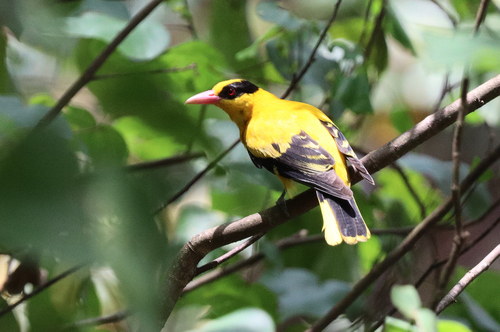
A brilliant yellow-and-black bird that is surprisingly hard to see, hidden in the leafy canopy of poplars and oaks. Its loud, fluting whistle betrays it long before a glimpse of gold.
The Eurasian golden oriole, also known as the common golden oriole, is a species of passerine bird, measuring approximately 24cm in length with a wingspan of 44-45cm, and the only Old World oriole breeding in Northern Hemisphere temperate regions. It is a summer migrant in Europe and the Palearctic and spends the winter season in central and southern Africa. Wikipedia
What it can do
- iBuilds a hammock-like nest slung between the forks of a high branch
- iiIts bright yellow plumage is remarkably well hidden among sunlit leaves
- iiiMigrates by night to wintering grounds in tropical Africa
- ivCan handle hairy caterpillars that many birds avoid
In the field
Field marks
- aMale bright golden-yellow with black wings and black centre to the tail
- bPink-red bill and black lores
- cFemale and young greenish-yellow with streaked whitish underparts
- dThrush-sized with a woodpecker-like undulating flight
- Voice
- A rich, fluting whistle often rendered 'weela-weeoo' or 'dee-dlee-o'; also a harsh, cat-like 'kweeaah'.
- Not to be confused with
- Female resembles green woodpecker in flight, but lacks red on the head. Indian golden oriole (South Asia) has black extending behind the eye. Yellow wagtail and yellowhammer are smaller and ground-living.
- Where to see it
- Poplar plantations and riverine woods in Spain, France, the Danube Delta, Turkey and the Central Asian river valleys; a rare spring migrant to eastern England, where it last bred in 2009.
- When
- Summer visitor May–Aug
Listen
Looking for field recordings…
Life & habits
- Diet
- Insects and caterpillars; fruit, cherries and berries in late summer
- Habitat
- Tall deciduous woods, riverine poplar groves, orchards and parks
- Size
- 22–25 cm; wingspan 44–47 cm; 50–79 g
- Lifespan
- Typically up to about 8 years
Moves through the canopy in swooping, undulating flights between trees, rarely coming low.
Where it lives
Recorded sightings
—
geo-referenced records in GBIF, from museums, herbaria and field observers.
Native range
Breeds across Europe, northwest Africa, Turkey, the Middle East and Central Asia to western Siberia; winters in sub-Saharan Africa
Drag the globe to turn it. Dots are where records exist, not a range map; darker means more records.
In the old herbals & bestiaries
Woodcuts and engravings matched from the Source Library’s scanned books by name. Plates marked “relative” show a close kin rather than this exact species. Click a plate to read the page it came from, with translation.

Historiae Animalium Liber III: De Avium Natura
Conrad Gesner · 1555 · p.725

Ornithology
Ulisse Aldrovandi · 1599 · p.895

The Natural History of Carolina, Florida and the Bahama Islands, Vol. 1
Mark Catesby · 1777 · p.164

Ornithology: The History of Birds
Ulisse Aldrovandi · 1599 · p.889

Ornithology
Ulisse Aldrovandi · 1599 · p.892

A voyage to the islands Madera Barbados Jamaica Vol. 1
Hans Sloane · 1707 · p.621
In the stacks
Searching the stacks…
Every page naming Oriolus oriolus in the Biodiversity Heritage Library →
Marginalia
Pliny the Elder reported the belief that a jaundice sufferer who looked at the 'icterus', a yellow bird usually identified as the oriole, would be cured while the bird died.
Curiosity
The German name 'Pirol' and Dutch 'wielewaal' are both imitations of its whistled song.
Kinship



Fact-checked: 1 correction made to this sheet. Photographs: iNaturalist contributors under the licences shown. Records: GBIF.org. Historical plates: Source Library (CC BY-SA 4.0; originals public domain). Summary text: Nature Library editors and Wikipedia (CC BY-SA). Medicinal and edibility notes are historical and educational, not advice. iNaturalist taxon 204556.