 NL·0619
Herbarium of the Nature Library
- Name
- Phoeniconaias minor
- Family
- Phoenicopteridae
- Native to
- East and southern Africa's Rift Valley and salt pans; West Africa; north-western India and Pakistan
- Habitat
- Soda lake, Salt pan, Lagoon
On eBird ↗
Lesser Flamingo
Live sightings near you, the range map, bar charts of when it is seen, and Macaulay Library photos and recordings.
Lesser flamingo
Phoeniconaias minor
Also calledKleinflamink (Afrikaans) · Flamant nain (French) · Heroe (Swahili)
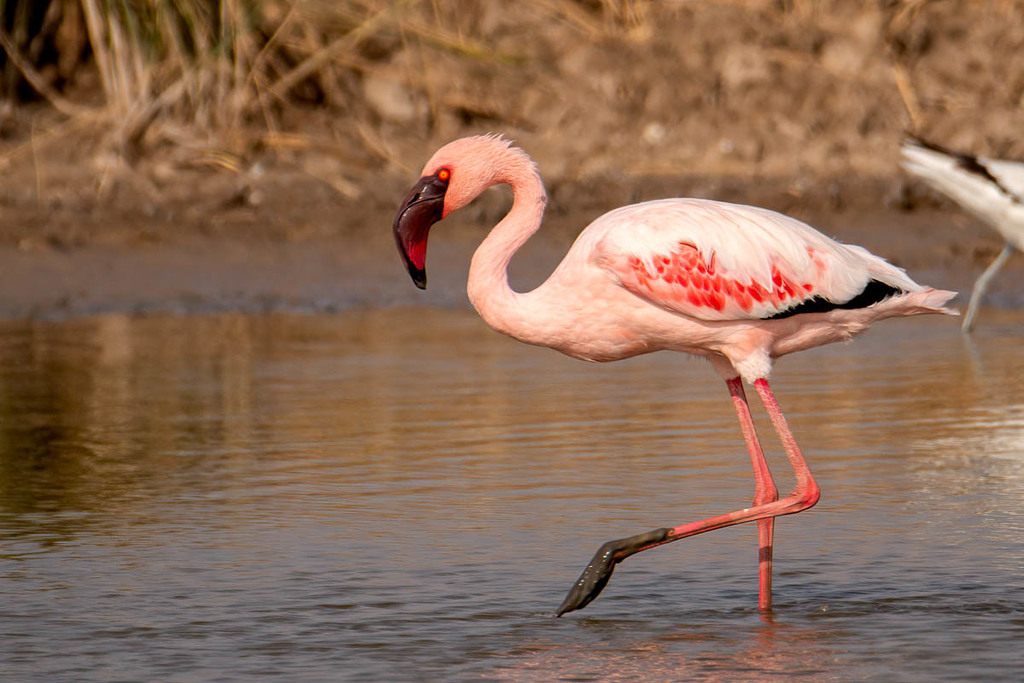
The smallest and by far the most numerous flamingo, gathering in pink rafts of hundreds of thousands on Africa's caustic soda lakes. It feeds almost entirely on microscopic cyanobacteria filtered from the surface water.
The lesser flamingo is a species of flamingo occurring in sub-Saharan Africa and western India. Birds are occasionally reported from farther north, but these are generally considered vagrants. Wikipedia
What it can do
- iFilters cyanobacteria (chiefly Arthrospira, 'spirulina') with a deep-keeled bill held upside down
- iiBreeds on the mudflats of hyperalkaline Lake Natron, where few predators can follow
- iiiIts pink colour comes from carotenoid pigments in its food
- ivFlocks move hundreds of kilometres between lakes, mostly at night, following food
In the field
Field marks
- aDeep pink plumage, often more strongly pink than the greater flamingo
- bDark carmine-red bill that looks black at a distance
- cDeep red eye and facial skin
- dCrimson wing coverts and black flight feathers in flight
- eNoticeably smaller than greater flamingo
- Voice
- A high, goose-like murmuring 'murr-err' from feeding flocks; flight calls higher-pitched than greater flamingo.
- Not to be confused with
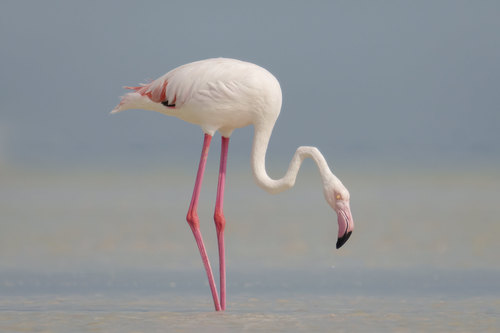
- Greater flamingo is taller and paler, with a pale pink bill with a clean black tip, and a yellow eye. Lessers look compact with a uniformly dark bill.
- Where to see it
- Lake Bogoria and Lake Nakuru (Kenya), Lake Natron (Tanzania), Etosha and Walvis Bay (Namibia), Kamfers Dam (South Africa), Little Rann of Kutch (India)
- When
- Present year-round in the Rift Valley, moving between lakes; breeds at Lake Natron mainly from August to November
Listen
Looking for field recordings…
Life & habits
- Diet
- Cyanobacteria and benthic diatoms
- Habitat
- Alkaline and saline lakes, lagoons and salt pans
- Size
- About 80–90 cm tall; 1.2–2.7 kg
- Lifespan
- Can exceed 40 years
Huge flocks perform synchronised 'marching' displays, heads raised and turning in unison, before breeding.
Where it lives
Recorded sightings
—
geo-referenced records in GBIF, from museums, herbaria and field observers.
Native range
East and southern Africa's Rift Valley and salt pans; West Africa; north-western India and Pakistan
Drag the globe to turn it. Dots are where records exist, not a range map; darker means more records.
In the old herbals & bestiaries
No plate in the Source Library names this exact species, so these show its closest relatives as the old naturalists drew them: same genus, or the same kind of animal. Click a plate to read the page it came from, with translation.

The Natural History of Carolina, Florida and the Bahama Islands, Vol. 1
Relative · Mark Catesby · 1777 · p.236

Jan Jonston — Naeukeurige beschryving van de natuur der viervoetige dieren (1660)
Relative · Jan Jonston · 1660 · p.221

Histoire Naturelle des Indes (The Drake Manuscript)
Relative · Anonymous (French) · 1586 · p.75

The Natural History of Carolina, Florida and the Bahama Islands, Vol. 1
Relative · Mark Catesby · 1777 · p.239
In the stacks
Searching the stacks…
Every page naming Phoeniconaias minor in the Biodiversity Heritage Library →
Marginalia
The lesser flamingo's main breeding site at Lake Natron was threatened by a proposed soda-ash plant in the 2000s, which its developer dropped in 2008 after international campaigns, although the idea has resurfaced since.
Curiosity
Lake Natron's water can reach a pH above 10 and temperatures over 40 °C, yet it hosts the largest lesser flamingo breeding colonies on Earth.
Kinship



Fact-checked: 1 correction made to this sheet. Photographs: iNaturalist contributors under the licences shown. Records: GBIF.org. Historical plates: Source Library (CC BY-SA 4.0; originals public domain). Summary text: Nature Library editors and Wikipedia (CC BY-SA). Medicinal and edibility notes are historical and educational, not advice. iNaturalist taxon 4259.