 NL·0791
Herbarium of the Nature Library
- Name
- Physarum polycephalum
- Family
- Physaraceae
- Native to
- Cosmopolitan in cool, moist temperate forests
- Habitat
- Temperate forest, Decaying wood, Leaf litter
Many-headed slime mould
Physarum polycephalum
Also calledLe blob (French) · Many-headed slime (English) · Nenkin 粘菌 (Japanese, slime mould)
A brilliant yellow, brainless single cell that can spread across a square metre with millions of nuclei. It finds the shortest path through a maze, and in a 2010 experiment it rebuilt something close to Tokyo's rail network. It is an amoebozoan, not a fungus.
Physarum polycephalum, an acellular slime mold, or myxomycete, is an amoeba with diverse cellular forms and broad geographic distribution. The "acellular" moniker derives from the plasmodial stage of the life cycle: the plasmodium is a bright yellow macroscopic multinucleate coenocyte shaped in a network of interlaced tubes. This stage of the life cycle, along with its preference for damp shady habitats, likely contributed to the original mischaracterization of the organism as a fungus. P. polycephalum is used as a model organism for research into motility, cellular differentiation, chemotaxis, cellular compatibility, and the cell cycle. It is commonly cultivated. Wikipedia
What it can do
- iSolves mazes, finding the shortest route between two food sources (Nakagaki et al., Nature 2000)
- iiBuilt transport networks linking oat flakes placed like Tokyo-area cities that matched the real rail system in efficiency (Tero et al., Science 2010)
- iiiLearns to cross bitter substances it once avoided, and can pass this habituation to another cell by fusing
- ivIts giant single cell (plasmodium) pumps cytoplasm back and forth about every 1–2 minutes
- vHas over 700 mating types
At the table
Not eaten.
Seed
Seed
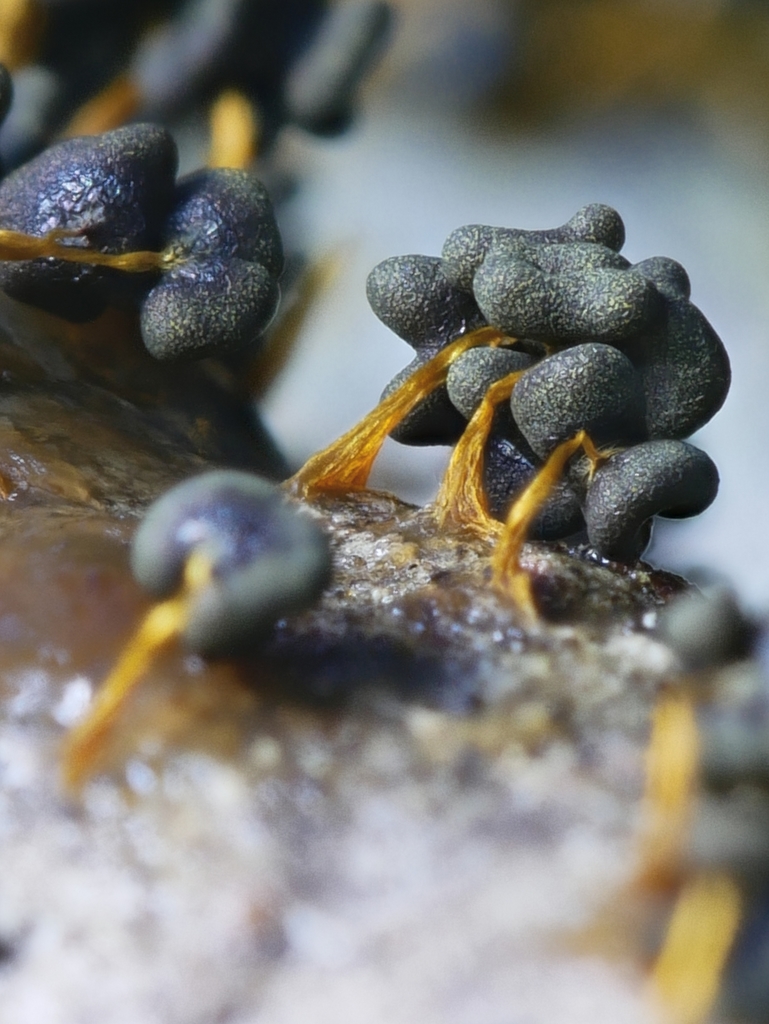
Spores (not seeds) black-brown, globose, spiny, about 9–11 µm, from stalked sporangia that form when food runs out
- Dispersal
- Wind-borne spores; it can also survive drought as a dry, hard sclerotium
How to grow it
Hardiness (USDA zones)
- Light
- Darkness (light triggers sporulation)
- Water
- Moist, not wet
- Soil
- Damp paper towel or agar in a Petri dish
- Propagation
- A piece of dried sclerotium or living plasmodium
- To harvest
- Spreads visibly within a day
- Climates
- Any (indoors)
- 1Place a dried sclerotium on damp paper towel or 2% agar in a covered dish
- 2Keep in the dark at about 20–25 °C
- 3Feed a few rolled oat flakes every day or two; remove mouldy oats
- 4To make a maze, place oats at the ends and watch it find the route
Where it lives
Recorded sightings
—
geo-referenced records in GBIF, from museums, herbaria and field observers.
Native range
Cosmopolitan in cool, moist temperate forests
Drag the globe to turn it. Dots are where records exist, not a range map; darker means more records.
In the stacks
Searching the stacks…
Every page naming Physarum polycephalum in the Biodiversity Heritage Library →
Marginalia
Japanese emperor Hirohito was an amateur slime-mould researcher, like the naturalist Minakata Kumagusu. Paris Zoological Park put 'le blob' on show in 2019, and French astronaut Thomas Pesquet took it to the International Space Station in 2021.
Curiosity
Researchers at Hokkaido University won an Ig Nobel Prize in 2008 and again in 2010 for showing that slime moulds can solve puzzles.
Kinship
Photographs: iNaturalist contributors under the licences shown. Records: GBIF.org. Historical plates: Source Library (CC BY-SA 4.0; originals public domain). Summary text: Nature Library editors and Wikipedia (CC BY-SA). Medicinal and edibility notes are historical and educational, not advice. iNaturalist taxon 1598948.