 NL·0633
Herbarium of the Nature Library
- Name
- Platanista minor
- Family
- Platanistidae
- Native to
- Indus River, Pakistan (mainly between Chashma and Kotri barrages); a remnant population in the Beas River, Punjab, India
- Habitat
- Large silty river, Freshwater
Indus river dolphin
Platanista minor
Also calledBhulan (Sindhi/Saraiki) · Susu (Urdu/Hindi)
A nearly blind river dolphin that navigates the silt-thick Indus entirely by echolocation, swimming on its side and trailing a flipper along the riverbed. Once spread through the whole Indus system, it is now trapped between irrigation barrages in a few stretches of the Indus in Pakistan, with a tiny remnant in India's Beas River. It was recognised as a separate species from the Ganges dolphin in 2021.
The Indus river dolphin is a freshwater dolphin in the family Platanistidae. It is endemic to the rivers of the Indus basin in Pakistan and northwestern India. It was the first discovered side-swimming cetacean. In Pakistan, it occurs in the Indus River, where five small sub-populations are separated by irrigation barrages. In India, a very small isolated population at a very high risk of extinction lives in the Beas River. It is the national mammal of Pakistan and the state aquatic animal of Punjab, India. Wikipedia
What it can do
- iIts eyes have no crystalline lens; it can probably sense only light and its direction, and relies on near-continuous echolocation clicks
- iiSwims on its side, sweeping its head and a pectoral flipper across the bottom to find prey in near-zero visibility
- iiiLong, narrow beak with interlocking needle teeth that remain visible when the mouth is closed
- ivUnfused neck vertebrae let it turn its head sharply, unlike most dolphins
In the field
Field marks
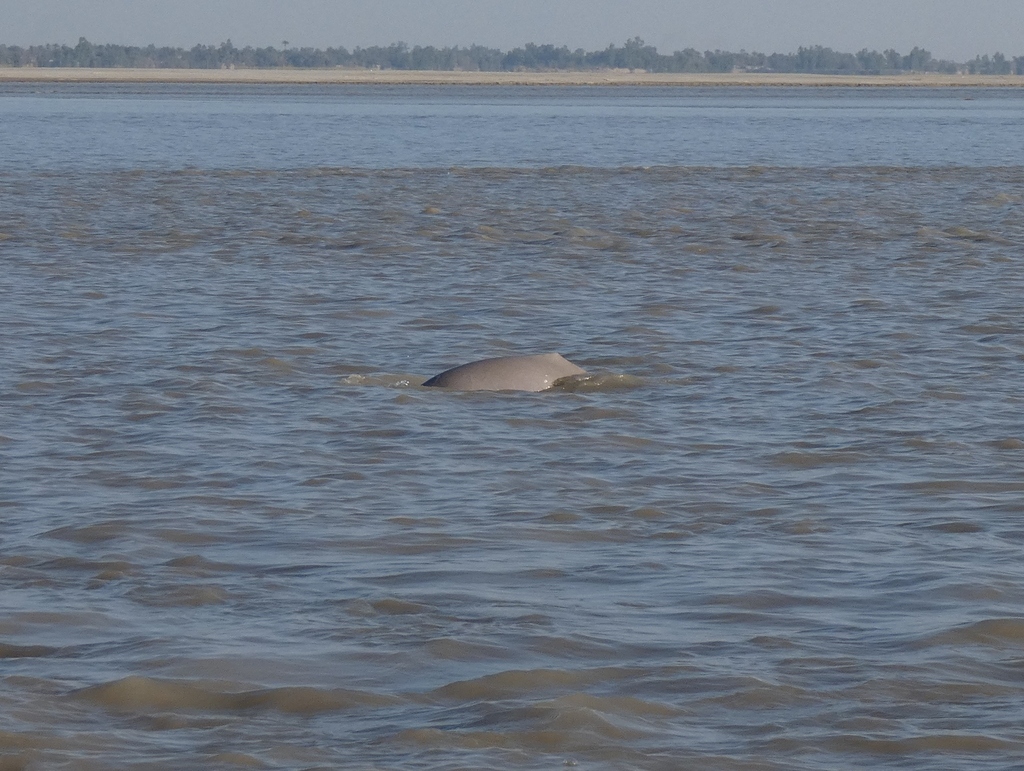
- aSilhouette at the surface: a brief low arc showing a long, thin beak, rounded melon and only a low triangular hump instead of a true dorsal fin
- bGrey-brown body, often pinkish on the belly; broad, paddle-like flippers
- cBlow is a short, audible puff with little visible spray
- dUsually seen in muddy main channels below or between barrages, often near confluences
- Not to be confused with
- The Ganges river dolphin (Platanista gangetica) looks almost identical but lives in the Ganges–Brahmaputra–Meghna and Karnaphuli systems; range alone separates them. No other dolphin occurs in the Indus.
- Where to see it
- Indus Dolphin Reserve between Guddu and Sukkur barrages, Sindh, Pakistan; the Taunsa Barrage Wildlife Sanctuary, Punjab; Beas Conservation Reserve near Harike, Punjab, India
- When
- Resident year-round; easiest to see in the low-water months of winter and early spring, when dolphins concentrate in deeper channels
Listen
Looking for field recordings…
Life & habits
- Diet
- Fish and freshwater prawns, taken from the riverbed and mid-water
- Habitat
- Deep channels, confluences and eddies of the turbid main Indus; needs water depth through the dry season
- Size
- About 1.5–2.5 m long; females larger than males; roughly 70–110 kg
- Lifespan
- Up to roughly 30 years (poorly known)
Surfaces every minute or two with a brief, low roll and a sneeze-like blow, then vanishes; it rarely leaps or bow-rides. Usually seen singly or in loose groups at channel junctions.
Where it lives
Recorded sightings
—
geo-referenced records in GBIF, from museums, herbaria and field observers.
Native range
Indus River, Pakistan (mainly between Chashma and Kotri barrages); a remnant population in the Beas River, Punjab, India
Drag the globe to turn it. Dots are where records exist, not a range map; darker means more records.
In the stacks
Searching the stacks…
Every page naming Platanista minor in the Biodiversity Heritage Library →
Marginalia
In Sindhi folklore the bhulan was once a woman, turned into a blind dolphin after she was cursed by a holy man. Since 1992 the Sindh Wildlife Department and WWF-Pakistan have run a programme rescuing dolphins stranded in irrigation canals.
Curiosity
Surveys counted around 1,800–2,000 Indus dolphins in recent years, almost all in a stretch of river shorter than 1,000 km.
Kinship




Fact-checked: 1 correction made to this sheet. Photographs: iNaturalist contributors under the licences shown. Records: GBIF.org. Historical plates: Source Library (CC BY-SA 4.0; originals public domain). Summary text: Nature Library editors and Wikipedia (CC BY-SA). Medicinal and edibility notes are historical and educational, not advice. iNaturalist taxon 1453948.