 NL·0504
Herbarium of the Nature Library
- Name
- Scarus vetula
- Family
- Labridae
- Native to
- Western Atlantic from Florida and the Bahamas through the Caribbean to Brazil
- Habitat
- Coral reef, Seagrass
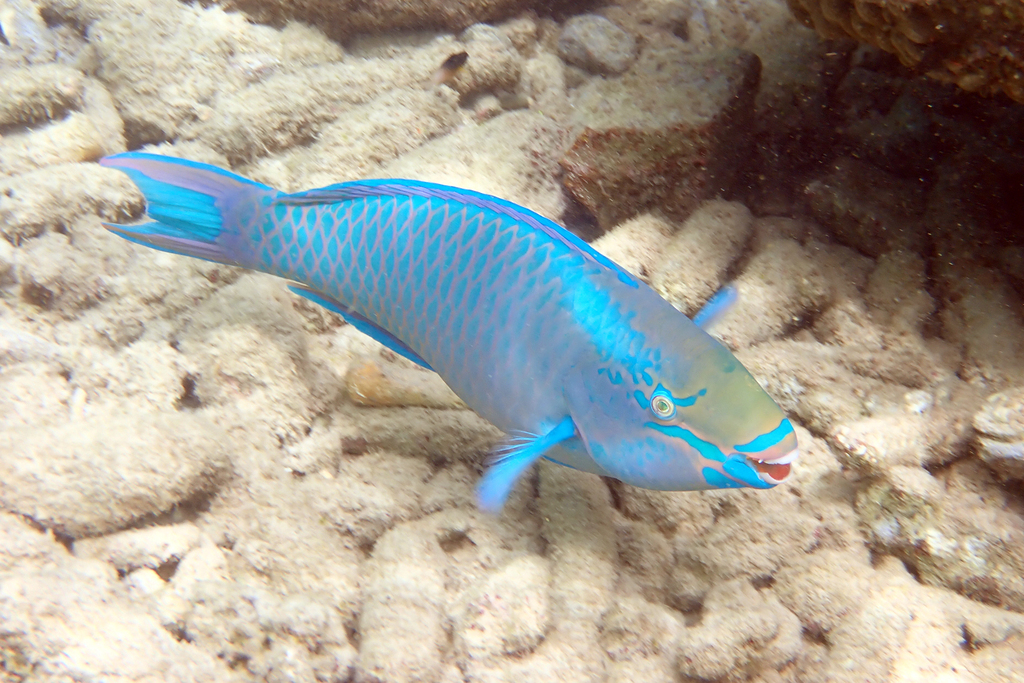
Queen parrotfish
Scarus vetula
Also calledLoro reina / Vieja (Spanish) · Perroquet royal (French) · Budião-papagaio (Portuguese)
A Caribbean parrotfish whose fused beak grazes algae off coral, keeping reefs from being smothered. Like many parrotfishes, it sleeps in a mucus cocoon and can change sex from female to male.
The queen parrotfish, is a species of parrotfish or marine ray-finned fish that belongs to the family Labridae, part of the subfamily Scarinae. It is found on reefs in the tropical West Atlantic Ocean and the Caribbean Sea. Other common names include blownose, blue chub, blue parrotfish, blueman, joblin crow parrot, moontail, okra peji and slimy head. The initial phase is female, displaying a reddish-brown color, and quite different in appearance from the bluish-green color of the final phase male. This is a common species throughout its range and the International Union for Conservation of Nature has rated its conservation status as "least concern". Wikipedia
What it can do
- iFused teeth form a parrot-like beak that scrapes algae from dead coral
- iiGrinds ingested rock in a pharyngeal mill; parrotfishes produce much of the white sand on Caribbean beaches
- iiiSecretes a mucus 'sleeping bag' at night that may protect against parasites
- ivProtogynous hermaphrodite: some females become brilliant blue-green terminal males
In the field
Field marks
- aInitial phase dark grey-brown with a broad white stripe along the lower side
- bTerminal males blue-green with orange-edged scales and orange-and-green facial stripes
- cBeak-like fused teeth
- dTail of terminal males lunate with elongated lobes
- Not to be confused with
- Stoplight parrotfish (Sparisoma viride) terminal males have a yellow spot on the gill cover and an orange tail bar; princess parrotfish initial phase has a white-black striped pattern.
- Where to see it
- Bonaire, Cozumel, Belize Barrier Reef, Florida Keys
- When
- Year-round
Life & habits
- Diet
- Algae scraped from reef surfaces
- Habitat
- Coral reefs and adjacent seagrass, 3–25 m
- Size
- Up to about 61 cm
- Lifespan
- Several years; poorly known
Terminal males guard harems of several females and patrol a territory on the reef.
Where it lives
Recorded sightings
—
geo-referenced records in GBIF, from museums, herbaria and field observers.
Native range
Western Atlantic from Florida and the Bahamas through the Caribbean to Brazil
Drag the globe to turn it. Dots are where records exist, not a range map; darker means more records.
In the old herbals & bestiaries
Woodcuts and engravings matched from the Source Library’s scanned books by name. Plates marked “relative” show a close kin rather than this exact species. Click a plate to read the page it came from, with translation.

Books on Marine Fishes
Guillaume Rondelet · 1554 · p.190

History of Animals, Book II: On Oviparous Quadrupeds
Conrad Gessner · 1586 · p.732

Ortus sanitatis
1491 · p.693

History of Animals, Book II: On Oviparous Quadrupeds
Conrad Gessner · 1586 · p.381

Hōrou Apollōnos Neilōou Hieroglyphika eklekta = : Hori Apollinis selecta hieroglyphica, sive sacrae notae Aegyptiorum, & insculptae imagines
Horapollo · 1597 · p.250

Ten Books of Exotic Things
Carolus Clusius · 1605 · p.515

De Indiae utriusque re naturali et medica
Willem Piso · 1658 · p.475

Hōrou Apollōnos Neilōou Hieroglyphika eklekta = : Hori Apollinis selecta hieroglyphica, sive sacrae notae Aegyptiorum, & insculptae imagines
Horapollo · 1597 · p.251
In the stacks
Searching the stacks…
Every page naming Scarus vetula in the Biodiversity Heritage Library →
Marginalia
Bonaire banned the fishing of parrotfish in 2010 to protect its reefs; Belize had protected parrotfish the year before.
Curiosity
Female and initial-phase queen parrotfish look so different from terminal males that they were once described as separate species.
Kinship

Photographs: iNaturalist contributors under the licences shown. Records: GBIF.org. Historical plates: Source Library (CC BY-SA 4.0; originals public domain). Summary text: Nature Library editors and Wikipedia (CC BY-SA). Medicinal and edibility notes are historical and educational, not advice. iNaturalist taxon 112169.