 NL·0752
Herbarium of the Nature Library
- Name
- Tichodroma muraria
- Family
- Tichodromidae
- Native to
- High mountains from the Cantabrians, Pyrenees and Alps through the Balkans, Turkey, the Caucasus and Iran to Central Asia, the Himalaya and western China
- Habitat
- Mountains, Cliffs, Gorges
On eBird ↗
Wallcreeper
Live sightings near you, the range map, bar charts of when it is seen, and Macaulay Library photos and recordings.
Wallcreeper
Tichodroma muraria
Also calledDuvar tırmaşıkkuşu (Turkish) · Mauerläufer (German) · Tichodrome échelette (French) · Treparriscos (Spanish) · Picchio muraiolo (Italian)
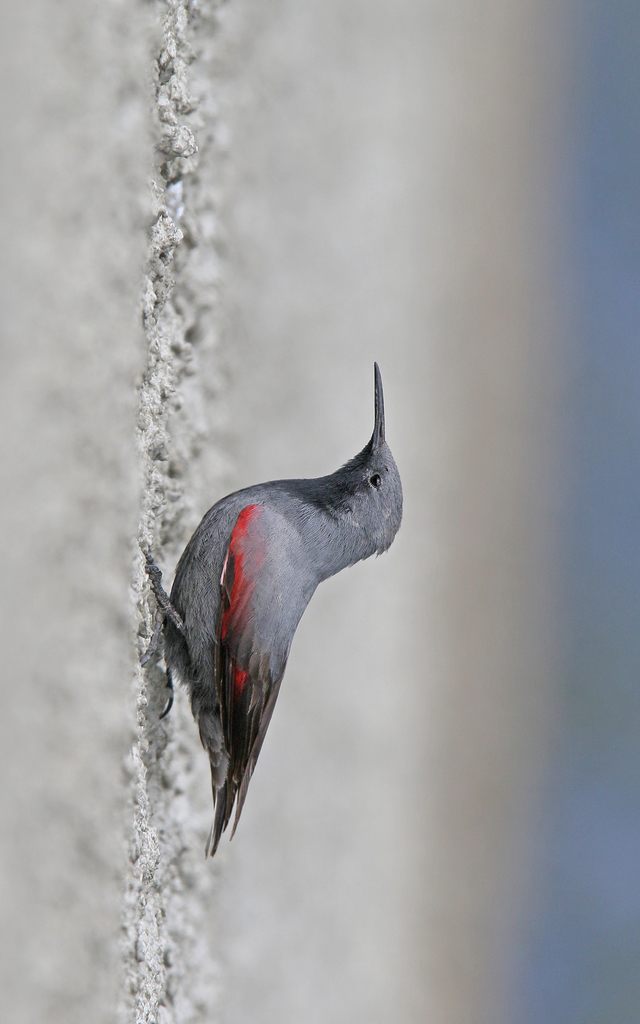
A small grey cliff-dweller that flicks open its wings to flash crimson patches like a butterfly while it creeps up sheer rock faces. It is the only member of its family and one of the most sought-after birds in Europe.
The wallcreeper is a small passerine bird found throughout the high mountains of the Palearctic from southern Europe to central China. It is the only extant member of both the genus Tichodroma and the family Tichodromidae. Wikipedia
What it can do
- iClimbs vertical rock faces using long claws and constant wing-flicking
- iiProbes cracks for spiders and insects with a long, fine, down-curved bill
- iiiDescends to lower cliffs, quarries and even old buildings in winter
- ivSole living species of the family Tichodromidae
In the field
Field marks
- aAsh-grey body and short black tail
- bBroad, rounded wings with large crimson patches and white spots
- cLong, thin, down-curved black bill
- dBreeding male has a black throat; white in winter
- Voice
- Song a series of thin, rising whistles, 'tu-tu-tueee'; mostly silent otherwise.
- Not to be confused with
- No other bird looks the same. In flight at distance it can suggest a large butterfly or a hoopoe, but the hoopoe is much larger and has a crest.
- Where to see it
- Gorges in the Pyrenees (Ordesa), Swiss and Italian Alps, Picos de Europa, the Taurus Mountains and the Caucasus; winter at castles and quarries in southern Europe.
- When
- Resident at altitude; moves lower in winter (Oct–Mar)
Listen
Looking for field recordings…
Life & habits
- Diet
- Spiders, insects and their larvae from rock crevices
- Habitat
- Damp cliffs and gorges, often near waterfalls, from about 1,000 m to over 3,000 m
- Size
- 15.5–17 cm; 15–19 g
Moves up a cliff in jerky hops with wings half-open, then drops back down in fluttering flight to start again.
Where it lives
Recorded sightings
—
geo-referenced records in GBIF, from museums, herbaria and field observers.
Native range
High mountains from the Cantabrians, Pyrenees and Alps through the Balkans, Turkey, the Caucasus and Iran to Central Asia, the Himalaya and western China
Drag the globe to turn it. Dots are where records exist, not a range map; darker means more records.
In the old herbals & bestiaries
Woodcuts and engravings matched from the Source Library’s scanned books by name. Plates marked “relative” show a close kin rather than this exact species. Click a plate to read the page it came from, with translation.

François Le Vaillant — Histoire naturelle des promerops et des guêpiers (1807)
François Le Vaillant · 1807 · p.169

Historiae Animalium Liber III: De Avium Natura
Conrad Gesner · 1555 · p.724

François Le Vaillant — Histoire naturelle des promerops et des guêpiers (1807)
François Le Vaillant · 1807 · p.166

History of Animals, Book I: On Viviparous Quadrupeds
Conrad Gessner · 1554 · p.869

Ornithologiae: de avibus historiae libri XII
Ulisse Aldrovandi · 1599 · p.871

Ornithology
Ulisse Aldrovandi · 1599 · p.887

Jean Baptiste Audebert — Histoire naturelle des grimpereaux et des oiseaux de paradis (1802)
Jean Baptiste Audebert · 1802 · p.262

Ornithologiae: de avibus historiae libri XII
Ulisse Aldrovandi · 1599 · p.870
In the stacks
Searching the stacks…
Every page naming Tichodroma muraria in the Biodiversity Heritage Library →
Marginalia
Its scientific name, coined by Johann Illiger in 1811, combines Greek 'teichos' (wall) and 'dromos' (runner), and Linnaeus had placed it among the treecreepers as Certhia muraria.
Curiosity
Unlike treecreepers and nuthatches, it does not use its tail as a prop when climbing.
Kinship
Photographs: iNaturalist contributors under the licences shown. Records: GBIF.org. Historical plates: Source Library (CC BY-SA 4.0; originals public domain). Summary text: Nature Library editors and Wikipedia (CC BY-SA). Medicinal and edibility notes are historical and educational, not advice. iNaturalist taxon 14840.