 NL·0753
Herbarium of the Nature Library
- Name
- Torpedo marmorata
- Family
- Torpedinidae
- Native to
- Eastern Atlantic from the North Sea to South Africa, and the Mediterranean
- Habitat
- Sandy seabeds, Seagrass, Rocky reef, Continental shelf
Marbled electric ray
Torpedo marmorata
Also calledTremielga / Torpedo (Spanish) · Torpille marbrée (French) · Torpedine marezzata (Italian) · Ra''ād (Arabic, 'thunderer') · Narke (Ancient Greek)
A round, marbled ray that stuns prey with shocks of up to about 200 volts from paired electric organs. The ancient Greeks and Romans used it to numb pain, and its electric organs later helped scientists discover how nerves signal.
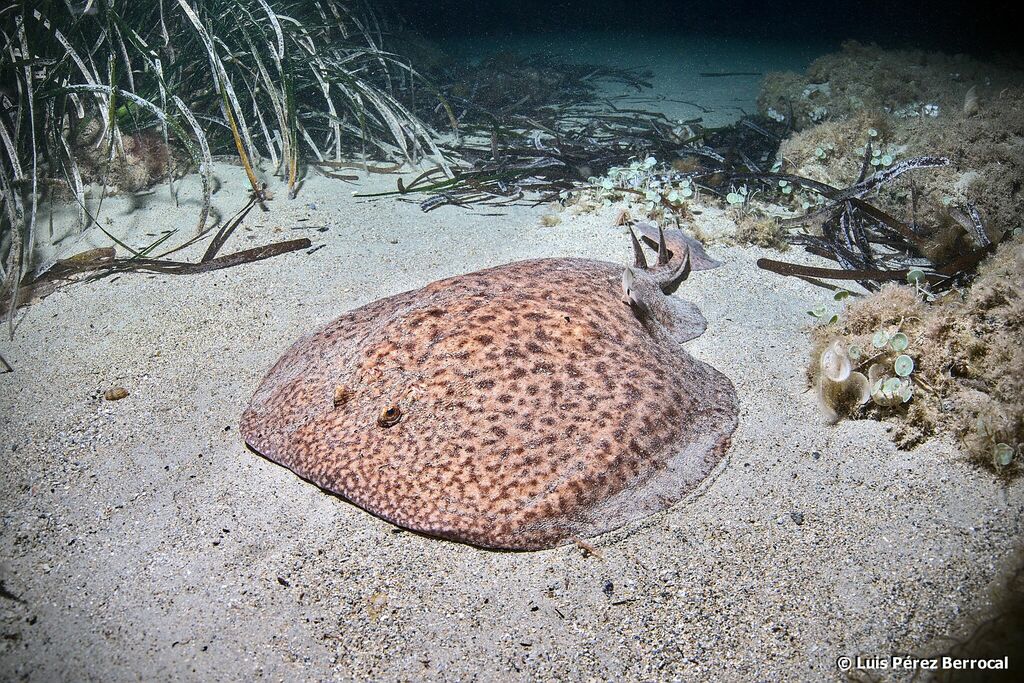
The marbled electric ray is a species of electric ray in the family Torpedinidae found in the coastal waters of the eastern Atlantic Ocean from the North Sea to South Africa. This benthic fish inhabits rocky reefs, seagrass beds, and sandy and muddy flats in shallow to moderately deep waters. It can survive in environments with very little dissolved oxygen, such as tidal pools. The marbled electric ray has a nearly circular pectoral fin disc and a muscular tail that bears two dorsal fins of nearly equal size and a large caudal fin. It can be identified by the long, finger-like projections on the rims of its spiracles, as well as by its dark brown mottled color pattern, though some individuals are plain-colored. Males and females typically reach 36–38 cm (14–15 in) and 55–61 cm (22–24 in) long respectively. Wikipedia
What it can do
- iKidney-shaped electric organs in the disc generate shocks of about 70–200 V
- iiWraps its disc around prey and shocks it into paralysis
- iiiBuries itself in sand by day to ambush fish at night
- ivElectric organs are rich in acetylcholine receptors, which made them a key source for neuroscience research
In the field
Field marks
- aNearly circular, soft disc with a short thick tail
- bBrown, mottled or marbled upper side
- cTwo small dorsal fins near the tail and a broad tail fin
- dSpiracles behind the eyes with small finger-like papillae on the rim
- Not to be confused with
- Common torpedo (T. torpedo) has five blue-black eyespots; black torpedo (Tetronarce nobiliana) is uniformly dark and much larger.
- Where to see it
- Mediterranean seagrass dives (Croatia, Greece, Balearics), Canary Islands, Portuguese coast
- When
- Year-round
Life & habits
- Diet
- Small bottom fishes, such as gobies, hake and mullets
- Habitat
- Soft sandy or muddy bottoms, seagrass meadows and reefs, 10–100 m
- Size
- Up to about 1 m; usually under 60 cm
- Lifespan
- Uncertain; probably around 12–15 years
Lies motionless and buried; when a fish passes overhead it lunges upward and releases a burst of electric pulses.
Where it lives
Recorded sightings
—
geo-referenced records in GBIF, from museums, herbaria and field observers.
Native range
Eastern Atlantic from the North Sea to South Africa, and the Mediterranean
Drag the globe to turn it. Dots are where records exist, not a range map; darker means more records.
In the old herbals & bestiaries
Woodcuts and engravings matched from the Source Library’s scanned books by name. Plates marked “relative” show a close kin rather than this exact species. Click a plate to read the page it came from, with translation.

Athanasii Kircheri Societatis Jesu Magnes sive de arte magnetica opus tripartium quo universa magnetis natura, eiusque in omnibus scientiis & artibus usus, nova medthodo explicatur, ac praeterae e viribus & prodigiosis effectibus magneticarum, aliarumque abditarum naturae motionum in elementis, lapidibus, plantis, animalibus, elucescentium, multa hucusque incognita natureae arcana, per physica, medica, chymica, & mathematica omnis generis experimenta recluduntur
Kircher, Athanasius · 1654 · p.555

History of Animals, Book II: On Oviparous Quadrupeds
Conrad Gessner · 1586 · p.494

History of Animals, Book II: On Oviparous Quadrupeds
Conrad Gessner · 1586 · p.495

Books on Marine Fishes
Guillaume Rondelet · 1554 · p.383

Books on Marine Fishes
Guillaume Rondelet · 1554 · p.383

Commentaries on the Six Books of Dioscorides
Pietro Andrea Mattioli · 1560 · p.309

Commentaries on the Six Books of Dioscorides on Medical Matter
Pietro Andrea Mattioli · 1563 · p.294

Commentaries on the Six Books of Pedanius Dioscorides on Medical Matter
Pietro Andrea Mattioli · 1565 · p.494

Hōrou Apollōnos Neilōou Hieroglyphika eklekta = : Hori Apollinis selecta hieroglyphica, sive sacrae notae Aegyptiorum, & insculptae imagines
Horapollo · 1597 · p.245
In the stacks
Searching the stacks…
Every page naming Torpedo marmorata in the Biodiversity Heritage Library →
Marginalia
The Roman physician Scribonius Largus (1st century CE) prescribed shocks from a live torpedo for headaches and gout; Plato's Meno compares Socrates to the numbing narke.
Curiosity
The word 'narcotic' traces to the Greek narke, 'numbness', the same root as the Greek name for electric rays.
Kinship



Photographs: iNaturalist contributors under the licences shown. Records: GBIF.org. Historical plates: Source Library (CC BY-SA 4.0; originals public domain). Summary text: Nature Library editors and Wikipedia (CC BY-SA). Medicinal and edibility notes are historical and educational, not advice. iNaturalist taxon 114244.