 NL·0755
Herbarium of the Nature Library
- Name
- Trichechus manatus
- Family
- Trichechidae
- Native to
- Southeastern USA (Florida, occasionally north to Virginia and the Gulf coast), Gulf of Mexico, Caribbean, Central America and northeastern South America to Brazil
- Habitat
- Seagrass beds, Rivers, Springs, Mangrove, Estuaries
West Indian manatee
Trichechus manatus
Also calledManatí (Spanish, from Taíno/Carib) · Peixe-boi-marinho (Portuguese) · Lamantin (French Caribbean) · Sea cow · Florida manatee / Antillean manatee (subspecies)
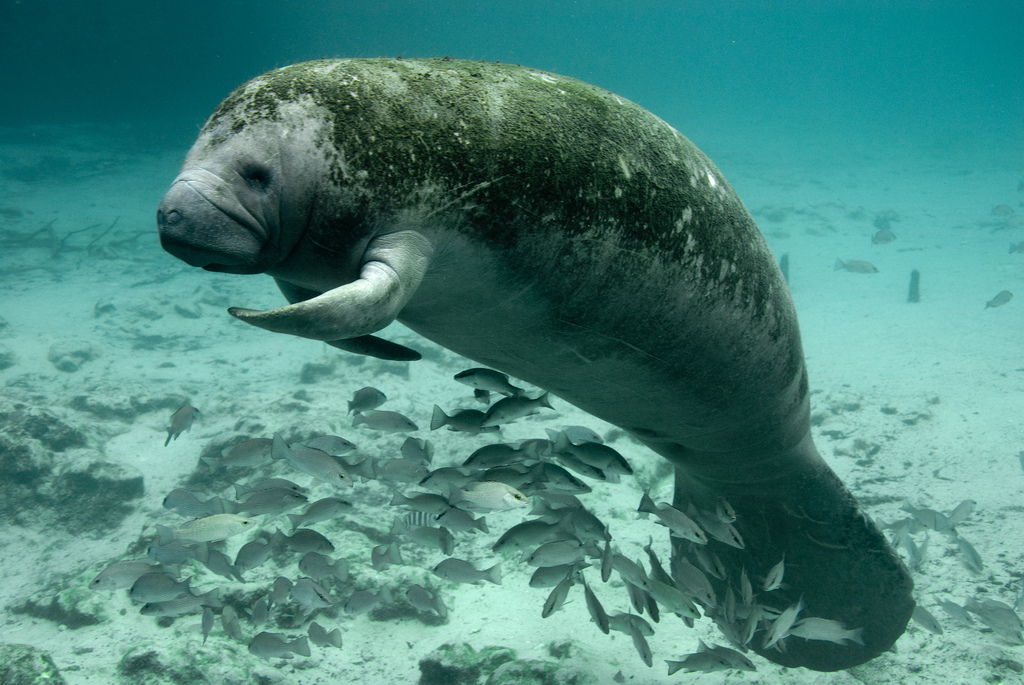
A slow, gentle aquatic grazer of warm coasts and rivers from Florida to Brazil, related more closely to elephants than to seals. Manatees cannot tolerate cold water, so Florida's population crowds into warm springs and power-plant outflows each winter. Boat strikes and seagrass loss are its main threats.
The West Indian manatee, also known as the North American manatee, is a large, aquatic mammal native to warm coastal areas of the Caribbean, from the Eastern United States to northern Brazil. Living alone or in herds, it feeds on underwater plants and uses its whiskers to navigate. It is divided into two subspecies, the Florida manatee in the United States and the Antillean manatee in the Caribbean, both of which are endangered and face pressure from habitat loss, pollution, and other human activity. The West Indian manatee is the largest living member of the sirenians, a group of large aquatic mammals that includes the dugong, other manatees, and the extinct Steller's sea cow. Wikipedia
What it can do
- iMolars are replaced continuously from the back, moving forward like a conveyor belt as worn teeth fall out
- iiEats about 10% of its body weight in plants each day
- iiiMoves freely between fresh and salt water
- ivPrehensile split upper lip grasps vegetation
In the field
Field marks
- aLarge, grey-brown, wrinkled body, often scarred by boat propellers and coated with algae
- bBroad, rounded, paddle-shaped tail
- cFlippers with three or four fingernails
- dSigns: 'footprints' (smooth circles of water) on the surface as the tail pushes down, and a nose-only breath
- Not to be confused with
- Dugong (Indo-Pacific only) has a whale-like fluked tail. Amazonian manatee (fresh water only) lacks nails and usually has a white chest patch. West African manatee is very similar but lives only off West Africa.
- Where to see it
- Crystal River and Three Sisters Springs, Blue Spring State Park and Manatee Lagoon (Florida); Swallow Caye (Belize); Puerto Rico; Laguna de Términos (Mexico)
- When
- Florida springs November–March (cold fronts bring the biggest gatherings); year-round in the Caribbean
Listen
Looking for field recordings…
Life & habits
- Diet
- Seagrasses, freshwater plants, algae and mangrove leaves
- Habitat
- Shallow coastal waters, rivers, estuaries and springs warmer than about 20 °C
- Size
- 2.7–3.5 m; 400–550 kg (exceptionally 1,500 kg)
- Lifespan
- Up to about 60 years
Mostly solitary or in mother–calf pairs, but aggregates in warm-water refuges. Surfaces every few minutes to breathe, more often when active.
Where it lives
Recorded sightings
—
geo-referenced records in GBIF, from museums, herbaria and field observers.
Native range
Southeastern USA (Florida, occasionally north to Virginia and the Gulf coast), Gulf of Mexico, Caribbean, Central America and northeastern South America to Brazil
Drag the globe to turn it. Dots are where records exist, not a range map; darker means more records.
In the old herbals & bestiaries
Woodcuts and engravings matched from the Source Library’s scanned books by name. Plates marked “relative” show a close kin rather than this exact species. Click a plate to read the page it came from, with translation.


In the stacks
Searching the stacks…
Every page naming Trichechus manatus in the Biodiversity Heritage Library →
Marginalia
In January 1493 Columbus recorded seeing three 'sirens' off Hispaniola that were 'not as pretty as they are painted'. Taíno peoples carved manatee bone into ritual objects such as vomiting spatulas.
Curiosity
A manatee's lungs lie along its back and help it control buoyancy, letting it hang motionless in the water.
Kinship




Photographs: iNaturalist contributors under the licences shown. Records: GBIF.org. Historical plates: Source Library (CC BY-SA 4.0; originals public domain). Summary text: Nature Library editors and Wikipedia (CC BY-SA). Medicinal and edibility notes are historical and educational, not advice. iNaturalist taxon 46316.