- Animals
- ›Chordates
- ›Vertebrates
- ›Ray-finned Fishes
- ›Spiny-rayed fishes
- ›Perches, Scorpionfishes, Sticklebacks, and Allies
- ›Perches, groupers and allies
- ›Groupers
- ›Epinephelus
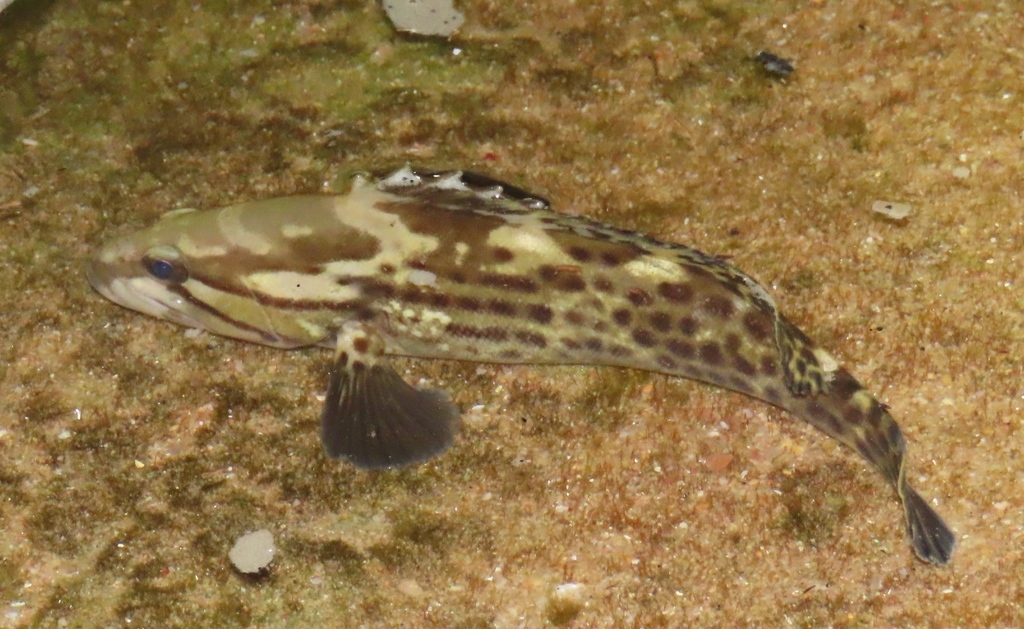
Catface Grouper
Epinephelus andersoni
Epinephelus andersoni, the catface grouper, brown-spotted grouper, catface rockcod or brown spotted rockcod, is a species of marine ray-finned fish, a grouper from the subfamily Epinephelinae which is part of the family Serranidae, which also includes the anthias and sea basses. It is found in the southwestern Indian Ocean where it is associated with reefs.
From the article Epinephelus andersoni on Wikipedia (CC BY-SA), quoted section by section
Description
Epinephelus andersoni' has an elongate body with a relatively shallow body depth which fits into its standard length 3.2 to 3.7 times. The preopercle is angular and the serrations at its and are somewhat enlarged. The dorsal fin contains 11 spines and 13–15 soft rays while the anal fin has 3 spines and 8 soft rays. The caudal fin is clearly rounded. There are 66–74 scales in the lateral line. The background colour of the head, body, and fins is brown, the body, caudal fin and dorsal fins are densely marked with irregular, small, dark brown spots. There are 2 dark brown stripes one of which runs from the eye across the gill cover while the other runs from the from maxillary groove to the lower margin of the preopercle. The juveniles are marked with horizontal dark stripes which dissolve into spots as they approach the caudal peduncle. They also have a black blotch at base of rearmost spines in the dorsal fin and 2 small black spots at base of soft-rayed part of the dorsal fin with a third spot on the upper part of the caudal peduncle. Between each of these black blotches there are 4 or 5 white spots. The maximum recorded total length is 87 centimetres (34 in) and the maximum recorded weight is 9.4 kilograms (21 lb).
Range & habitat
Epinephelus andersoni is endemic to the southwestern Indian Ocean where it occurs off the coast of southeastern Africa. Its distribution extends from Zavala, Mozambique to the Western Cape Province of South Africa. It has been recorded as far south as the De Hoop Marine Protected Area but it is rare south of Knysna.
Wikipedia: “Distribution”
Where it lives
Recorded sightings
—
geo-referenced records in GBIF, from museums, herbaria and field observers.
Drag the globe to turn it. Dots are where records exist, not a range map; darker means more records.
In the stacks
Searching the stacks…
Every page naming Epinephelus andersoni in the Biodiversity Heritage Library →
This page is assembled live from iNaturalist, GBIF, Wikipedia, the Source Library and the Internet Archive. It is not yet part of the hand-edited codex. iNaturalist taxon 100076.