- Animals
- ›Chordates
- ›Vertebrates
- ›Ray-finned Fishes
- ›Spiny-rayed fishes
- ›Perches, Scorpionfishes, Sticklebacks, and Allies
- ›Perches, groupers and allies
- ›Groupers
- ›Epinephelus
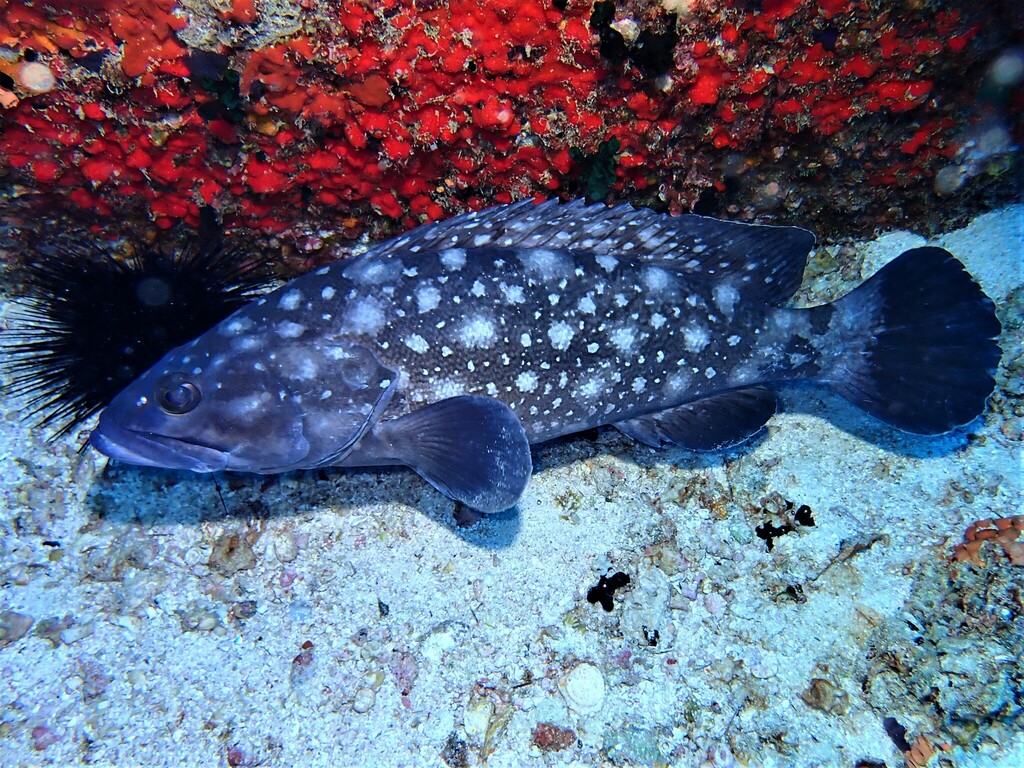
Whitespotted Grouper
Epinephelus coeruleopunctatus
The whitespotted grouper (Epinephelus coeruleopunctatus), also known as the rankin cod, ocellated rockcod, small-spotted cod, white-spotted reef-cod or whitespotted rockcod, is a species of marine ray-finned fish, a grouper from the subfamily Epinephelinae which is part of the family Serranidae, which also includes the anthias and sea basses. It has an Indo-Pacific distribution . It is closely related to two other species of white spotted groupers in the genus Epinephelus.
From the article Whitespotted grouper on Wikipedia (CC BY-SA), quoted section by section
Description
The whitespotted grouper is a moderately deep-bodied fish growing to a maximum length of about 76 cm (30 in). There are three to five rows of teeth in the lower jaw. The dorsal fin has eleven spines and about sixteen soft rays and the anal fin has three spines and eight soft rays. The pelvic fins are short and the caudal fin is rounded. The top edge of the opercular cover is only slightly convex and the posterior edge curves at an acute angle. The head, body and dorsal fin are dark brownish-grey, spotted with large white blotches. In large adults, over about 30 cm (12 in), the white patches tend to merge into wavy bands or mottling.
Range & habitat
The whitespotted grouper is found in shallow water in the Indo-Pacific region. Its range extends from the coast of East Africa and the Persian Gulf eastwards to Japan, China, Indonesia, Australia, Fiji and Tonga.
Wikipedia: “Distribution”
What it does
The whitespotted grouper is a demersal, shallow-water, reef-associated fish. It is generally found in rocky areas, or near where coral is growing in deep lagoons, or on outer reef slopes or channels, often near or in caves. It is not a schooling fish and is usually seen singly. It feeds on small fish and crustaceans, with crustaceans making up the greatest part of its diet. Little is known about its reproduction and life history.
Wikipedia: “Ecology”
Where it lives
Recorded sightings
—
geo-referenced records in GBIF, from museums, herbaria and field observers.
Drag the globe to turn it. Dots are where records exist, not a range map; darker means more records.
In the stacks
This page is assembled live from iNaturalist, GBIF, Wikipedia, the Source Library and the Internet Archive. It is not yet part of the hand-edited codex. iNaturalist taxon 100088.