 NL·0434
Herbarium of the Nature Library
- Name
- Epinephelus itajara
- Family
- Epinephelidae
- Native to
- Western Atlantic from Florida to southern Brazil, Gulf of Mexico and Caribbean; eastern Atlantic populations off West Africa are now often split as E. quinquefasciatus
- Habitat
- Mangrove, Rocky reef, Shipwrecks, Coral reef
Atlantic goliath grouper
Epinephelus itajara
Also calledMero guasa (Spanish) · Mero (Portuguese, Brazil) · Jewfish (former English name) · Itajara (Tupi)
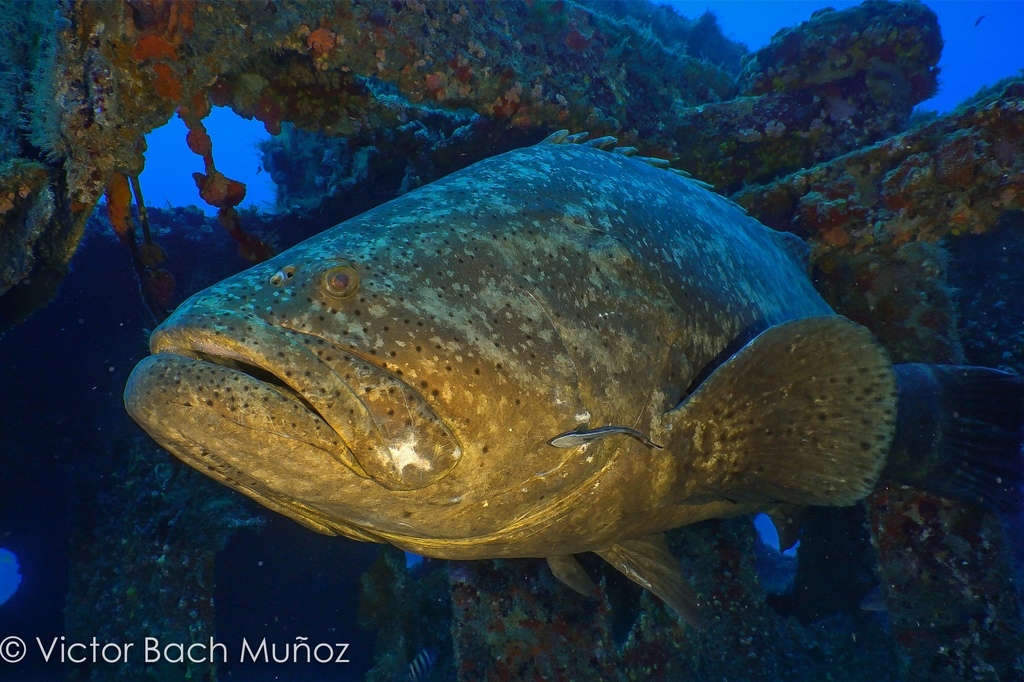
A house-sized grouper of Atlantic mangroves and wrecks that can top 360 kg. Nearly fished out by the 1980s, it has recovered in Florida after full protection in 1990.
The Atlantic goliath grouper, the jewfish or itajara, is a saltwater fish of the grouper family and one of the largest species of bony fish. The species can be found in the West Atlantic ranging from northeastern Florida, south throughout the Gulf of Mexico and the Caribbean Sea, and along South America to Brazil. In the East Pacific it ranges from Mexico to Peru. In the East Atlantic, the species ranges in West Africa from Senegal to Cabinda. The species has been observed at depths ranging from 1 to 100 meters. Wikipedia
What it can do
- iProduces loud booming sounds with its swim bladder to warn intruders and during spawning
- iiJuveniles spend years in mangrove estuaries before moving offshore
- iiiGathers at the same wreck spawning sites each year in late summer
- ivSwallows prey, including small sharks and sea turtles, by powerful suction
In the field
Field marks
- aEnormous, robust body with a broad flat head
- bSmall eyes and large mouth
- cBrownish-yellow to grey with small dark spots on head and fins
- dFaint irregular dark vertical bars, more distinct in young
- eRounded tail; first dorsal spines shorter than soft rays
- Not to be confused with
- Warsaw grouper (Hyporthodus nigritus) is darker, deeper-living and has a tall second dorsal spine; giant grouper (E. lanceolatus) is Indo-Pacific.
- Where to see it
- Jupiter and Palm Beach wrecks, Florida (spawning Aug–Sep); Florida Keys; Brazil's Abrolhos
- When
- Resident; Florida spawning aggregations Aug–Oct
Life & habits
- Diet
- Crustaceans (especially spiny lobsters), fish, stingrays, octopus, occasionally young sea turtles
- Habitat
- Inshore shallow waters to about 50 m: mangroves, ledges, reefs and wrecks
- Size
- Up to about 2.5 m and 360 kg or more
- Lifespan
- At least 37 years
Territorial around a home cave or wreck; tens to over a hundred gather at spawning aggregation sites around the new moon in Aug–Sep.
Where it lives
Recorded sightings
—
geo-referenced records in GBIF, from museums, herbaria and field observers.
Native range
Western Atlantic from Florida to southern Brazil, Gulf of Mexico and Caribbean; eastern Atlantic populations off West Africa are now often split as E. quinquefasciatus
Drag the globe to turn it. Dots are where records exist, not a range map; darker means more records.
In the old herbals & bestiaries
No plate in the Source Library names this exact species, so these show its closest relatives as the old naturalists drew them: same genus, or the same kind of animal. Click a plate to read the page it came from, with translation.

Historia naturalis Brasiliae
Relative · Willem Piso / Georg Marcgraf · 1648 · p.298

The Natural History of Carolina Florida and Bahama Islands Vol. 2
Relative · Mark Catesby · 1743 · p.22

Louis Renard — Poissons, ecrevisses et crabes (1754)
Relative · Louis Renard · 1754 · p.71

Louis Renard — Poissons, ecrevisses et crabes (1754)
Relative · Louis Renard · 1754 · p.85

Compendium of Materia Medica: Illustrated Volume, Middle of the Lower Part
Relative · 李時珍 · 1596 · p.76
In the stacks
Searching the stacks…
Every page naming Epinephelus itajara in the Biodiversity Heritage Library →
Marginalia
Its Brazilian name 'itajara' comes from the Tupi language; the US banned all harvest in 1990, and Florida only reopened a tiny lottery-permitted harvest in 2023.
Curiosity
It was renamed from 'jewfish' to goliath grouper by the American Fisheries Society in 2001.
Kinship






Photographs: iNaturalist contributors under the licences shown. Records: GBIF.org. Historical plates: Source Library (CC BY-SA 4.0; originals public domain). Summary text: Nature Library editors and Wikipedia (CC BY-SA). Medicinal and edibility notes are historical and educational, not advice. iNaturalist taxon 100110.