- Animals
- ›Chordates
- ›Vertebrates
- ›Ray-finned Fishes
- ›Spiny-rayed fishes
- ›Perches, Scorpionfishes, Sticklebacks, and Allies
- ›Perches, groupers and allies
- ›Groupers
- ›Epinephelus
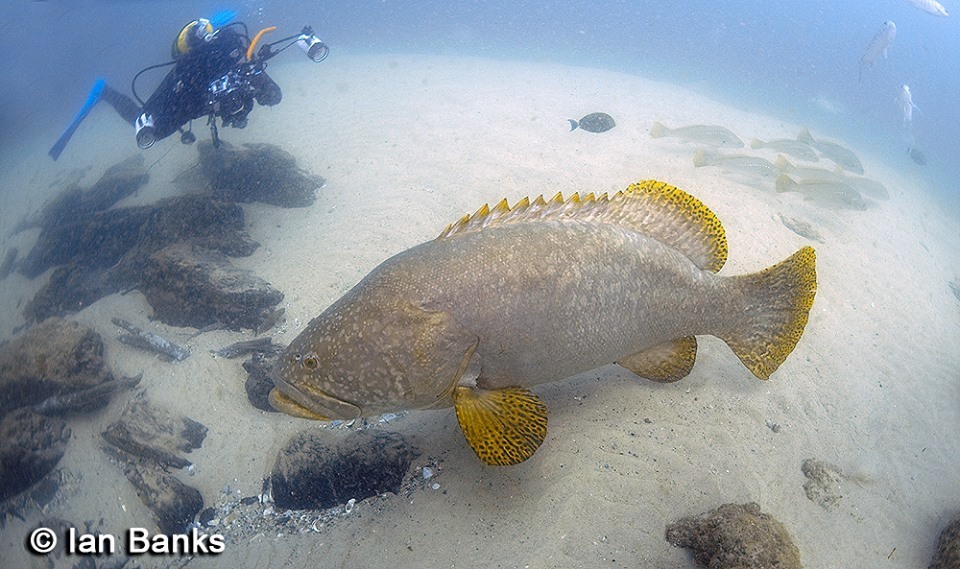
Giant Grouper
Epinephelus lanceolatus
The giant grouper (Epinephelus lanceolatus), also known as the brindlebass, brown spotted cod, or bumblebee grouper, and as the Queensland groper in Australia, is the largest bony fish found in coral reefs, and the aquatic emblem of Queensland. It is found from near the surface to depths of 100 m (330 ft) at reefs throughout the Indo-Pacific region, with the exception of the Persian Gulf. It also enters estuaries, such as the lowermost part of the Brisbane River....
From the article Giant grouper on Wikipedia (CC BY-SA), quoted section by section
Description
The giant grouper has a robust body which has a standard length equivalent to 2.4 to 3.4 times its depth. The dorsal profile of the head and the intraorbital area are convex. The preopercle has a rounded corner and a finely serrated margin. The gill cover has a convex upper margin. There are 11 spines and 14–16 soft rays in the dorsal fin while the anal fin has 3 spines and 8 soft rays. The caudal fin is slightly rounded. There are 54 to 62 scales in its lateral line. The adults are grayish-brown in colour overlain with a mottled pattern and with darker fins. The small juveniles are yellow with wide, dark irregular bars and irregular dark spots on their fins. The giant grouper can grow to huge size with the maximum recorded standard length being 270 centimetres (110 in), although they are more common around 180 centimetres (71 in), and a maximum published weight of 400 kilograms (880 lb).
Range & habitat
The giant grouper has a wide Indo-Pacific distribution, it is the most widely distributed species of grouper in the world. It occurs from the Red Sea and the eastern coasts of Africa as far south as Algoa Bay in South Africa and across the Indian Ocean into the Western Pacific Ocean as far east as the Pitcairn Islands and Hawaii. They occur as far north as southern Japan and as far south as Australia. In Australia it is found from Rottnest Island in Western Australia north and east along the tropical coasts of Australia, including offshore reefs, and then south along the eastern coast to Woy Woy, New South Wales. It also occurs around Christmas Island and Cocos (Keeling) Islands and the Elizabeth and Middleton Reefs Marine National Park Reserve in the Tasman Sea. There have also been reports from the Younghusband Peninsula in South Australia and north eastern New Zealand. It is absent from the Persian Gulf but it is present off the coast of Pakistan and southern Oman. It has been listed as a potential invasive species in the Bahamas but its presence in that region requires verification.
Wikipedia: “Distribution”
What it does
Like most groupers, giant groupers are protogynous hermaphrodites. They spawn on a lunar cycle, with spawns lasting about 7 days. They are aggregative broadcast spawners, usually with several females per male. Studies in captive populations suggest that the dominant male and female begin the spawning event as nearly the only spawners for the first day or two, but other members of the aggregation fertilize more eggs as the event progresses, with even the most recently turned males fathering offspring. Giant groupers are diandric protogynous hermaphrodites, meaning that although some males develop from reproductively functional females other males start to produce sperm without ever having gone through a phase as a reproductive female.
Wikipedia: “Reproduction”
Where it lives
Recorded sightings
—
geo-referenced records in GBIF, from museums, herbaria and field observers.
Drag the globe to turn it. Dots are where records exist, not a range map; darker means more records.
In the stacks
Searching the stacks…
Every page naming Epinephelus lanceolatus in the Biodiversity Heritage Library →
This page is assembled live from iNaturalist, GBIF, Wikipedia, the Source Library and the Internet Archive. It is not yet part of the hand-edited codex. iNaturalist taxon 100111.