- Animals
- ›Chordates
- ›Vertebrates
- ›Ray-finned Fishes
- ›Spiny-rayed fishes
- ›Perches, Scorpionfishes, Sticklebacks, and Allies
- ›Perches, groupers and allies
- ›Groupers
- ›Epinephelus
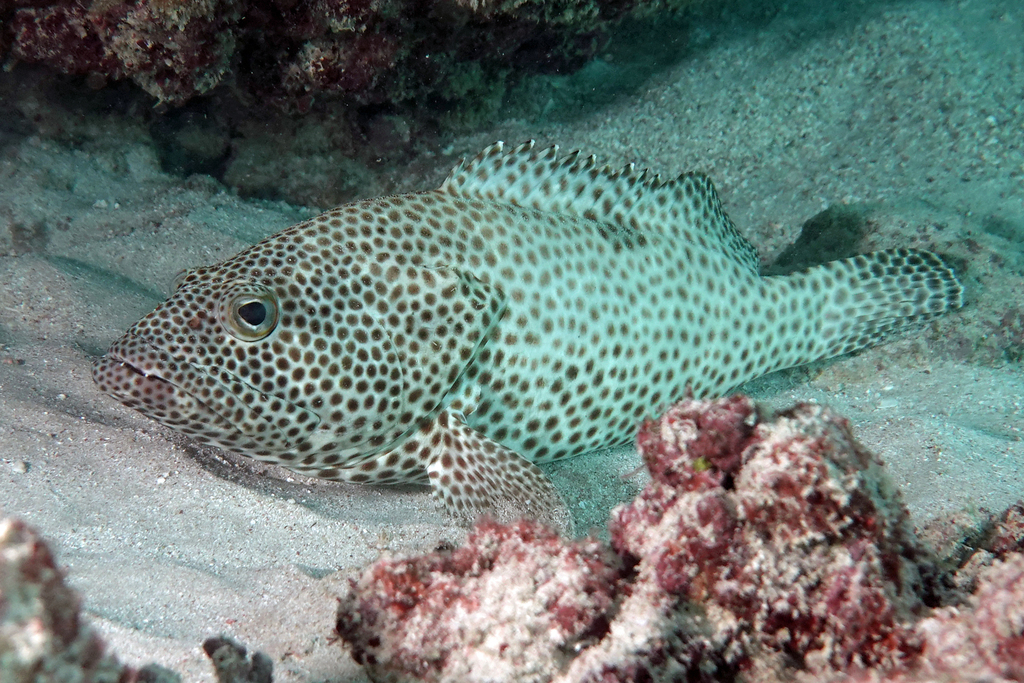
Oneblotch Grouper
Epinephelus melanostigma
Epinephelus is a genus of marine ray-finned fish, groupers from the subfamily Epinephelinae, part of the family Serranidae, which also includes the anthias and sea basses. They are predatory fish, largely associated with reefs and are found in tropical and subtropical seas throughout the world. They are important target species for fisheries.
From the article Epinephelus on Wikipedia (CC BY-SA), quoted section by section
Description
The fishes in the genus Epinephelus have elongated, subcylindrical bodies, which may be oblong or deep and compressed in shape. The depth of the body varies between 2.3 and 3.7 times the standard length and the head is usually around the same length as the body is deep. The preopercle can be rounded or angular and has a serrated rear edge with the serrations at the angle being enlarged to a lesser or greater extent. In a small number of species, serrations are small, and on the lower edge, they are covered by skin. Caniform teeth are found at the front of jaws, although these can be rather small in a few species. They do not have any obviously enlarged caniform teeth in the middle of the lower jaw. Teeth are on the roof of the mouth. In adults, the maxilla does not have a noticeable bony protrusion on the lower rear angle, although it can have a deep step or hook-like process, which is hidden by the upper lips, on the rear part of its lower edge. The dorsal fin normally contains 9 spines, although some species have 10, as well as 12 to 19 rays. The origin of the dorsal fin sits above the opercle and the soft rayed part is shorter than the spiny part. The anal fin contains three distinct spines and 7 to 10 soft rays. The pectoral fin is rounded, with its middle rays being longer than the others. …
Wikipedia: “Characteristics”
Range & habitat
Epinephelus groupers are occur mainly on coral or rocky reefs, although a small number of species have been recorded over substrates consisting of sand, silt, or mud. A few species are found in deep water, down to at least 525 m (1,722 ft), but the majority occur between 10 and 200 m (33 and 656 ft). The two largest members of the genus, E. itajara and E. lanceolatus, may attain a length in excess of 2 m (6.6 ft) and a weight greater than 400 kg (880 lb), and frequently have been recorded in estuaries and harbours. Most of the species in the genus Epinephelus are predatory fish that feed on larger invertebrates, mostly crustaceans, and other fishes taken on or close to the substrate. E. undulosus is an unusual grouper species distinguished by having many, long gill rakers, and this species has been reported to feed on pelagic tunicates, at least on occasion. Only a few species have had their reproductive biology studied, and many species appear to be protogynous hermaphrodites. In some species, though, males in the populations are smaller than some of the females, suggesting a more complex biology, which suggests that some females do not change sex, and that some males may not have a undergone a functional female stage.
Wikipedia: “Habitat and biology”
Where it lives
Recorded sightings
—
geo-referenced records in GBIF, from museums, herbaria and field observers.
Drag the globe to turn it. Dots are where records exist, not a range map; darker means more records.
In the stacks
Searching the stacks…
Every page naming Epinephelus melanostigma in the Biodiversity Heritage Library →
This page is assembled live from iNaturalist, GBIF, Wikipedia, the Source Library and the Internet Archive. It is not yet part of the hand-edited codex. iNaturalist taxon 100120.