- Animals
- ›Chordates
- ›Vertebrates
- ›Ray-finned Fishes
- ›Spiny-rayed fishes
- ›Perches, Scorpionfishes, Sticklebacks, and Allies
- ›Perches, groupers and allies
- ›Groupers
- ›Epinephelus
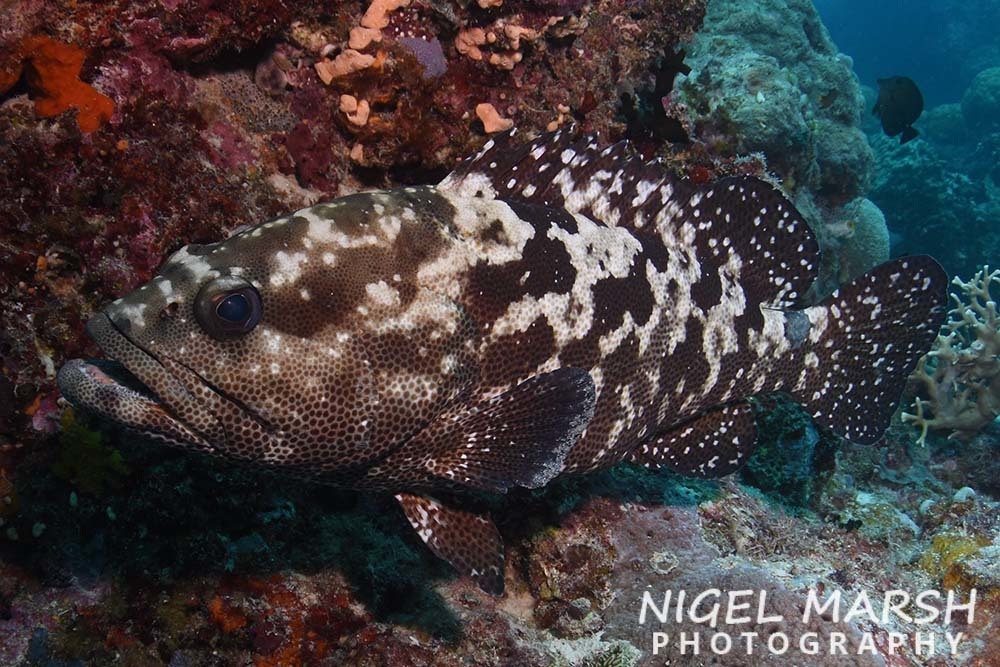
Camouflage Grouper
Epinephelus polyphekadion
The camouflage grouper (Epinephelus polyphekadion), also known as the blue-tailed cod, camouflage rockcod, small-toothed rockcod, smooth flowery rock-cod, snout-spot grouper or snout-spot rock-cod, is a species of marine ray-finned fish, a grouper from the subfamily Epinephelinae which is part of the family Serranidae, which also includes the anthias and sea basses. It has a wide Indo-Pacific distribution where it is associated with reefs. There is actually a French documentary called Le Mystère Mérou ("The Grouper Mystery") about the spawning and behavior of these fish shot in the Atol of Fakarava in French Polynesia.
From the article Camouflage grouper on Wikipedia (CC BY-SA), quoted section by section
Description
The camouflage grouper has a body which has a standard length that is 2.7 to 3.1 times its depth. The area between the eyes is flat while the dorsal profile of the head is convex. The preopercle rounded with the serrations at its corner slightly enlarged and the gill cover has a distinctly convex upper edge. The dorsal fin has 11 spines and 14-15 soft rays while the anal fin contains 3 spines and 8 soft rays. The fourth spine in the dorsal fin is longer than the others and the membranes between the dorsal fin spines are slightly notched. The caudal fin is rounded in shape. This is a pale brown species which is covered in small dark brown spots. The upper body is whitish, with the white being broken up by large dark blotches which resemble diagonal bands. There is a dark saddle-like blotch on the upper part of the base of the caudal fin. This species is frequently misidentified, the confusion species being Epinephelus fuscoguttatus. The camouflage grouper attains a maximum total length of 90 centimetres (35 in).
Range & habitat
The camouflage grouper has a wide Indo-Pacific distribution. Its range extends from the coast of East Africa from the Red Sea south to Mozambique, eastwards across the Indian Ocean where it is found around the Comoros, British Indian Ocean Territory, Mauritius and the Seychelles and east into the Pacific Ocean as far as French Polynesia. In the Pacific its range extends north to southern Japan and south as far as Australia. In Australia it is found from Shark Bay and Scott Reef in Western Australia around the northern coast to One Tree Island in Queensland. It is also found around reefs and islands in the Coral Sea and the Tasman Sea.
Wikipedia: “Distribution”
Where it lives
Recorded sightings
—
geo-referenced records in GBIF, from museums, herbaria and field observers.
Drag the globe to turn it. Dots are where records exist, not a range map; darker means more records.
In the stacks
Searching the stacks…
Every page naming Epinephelus polyphekadion in the Biodiversity Heritage Library →
This page is assembled live from iNaturalist, GBIF, Wikipedia, the Source Library and the Internet Archive. It is not yet part of the hand-edited codex. iNaturalist taxon 100127.