- Animals
- ›Chordates
- ›Vertebrates
- ›Jawless Fishes
- ›Hagfishes
- ›Hagfishes
- ›Hagfishes
- ›Eptatretine Hagfishes
- ›Eptatretus
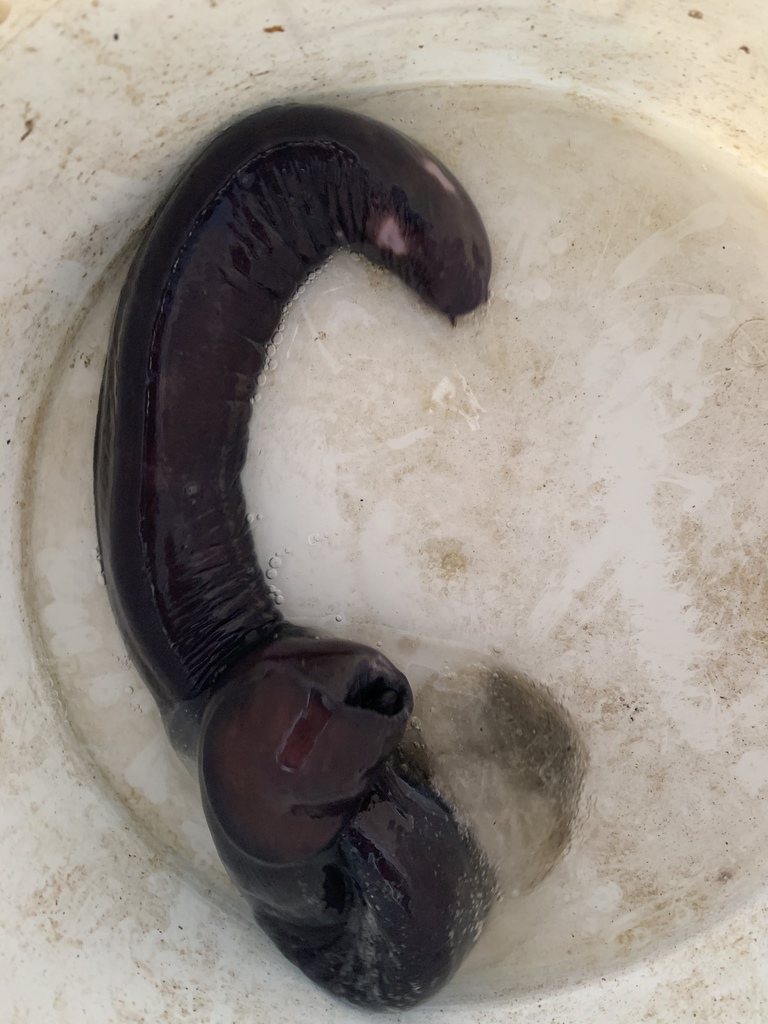
Black Hagfish
Eptatretus deani
Eptatretus deani, the black hagfish, is a species of hagfish.
Common to other species of hagfish, their unusual feeding habits and slime-producing capabilities have led members of the scientific and popular media to dub the hagfish as the most "disgusting" of all sea creatures. Although hagfish are sometimes called "slime eels", they are not eels at all.
From the article Eptatretus deani on Wikipedia (CC BY-SA), quoted section by section
Description
This eel-like species is uniform black, or dark brown. It can also appear prune-colored, and often piebald with light spots. The edges of the ventral finfolds and caudal may have a light colour. Unlike the Pacific hagfish, the black hagfish does not have a white ring around their gill pores. It has no true fins, but instead, one dorsal finfold, far back on its body. It has a moderately broad and round caudal, with ray-like markings. The ventral finfold is very low. The black hagfish is scaleless, and ranges from 30–89 cm (12–35 in), with an average maximum overall length of 64 cm (25 in). This species has four hearts, and 10 to 14 pairs of gill pores. They also have rudimentary eyes. Although they have poor vision, they have a highly developed sense of smell and touch. The head of this species has one, large nostril, and eight barbels that surround the mouth and nostril. They have two parallel rows of horny teeth.
Range & habitat
Black hagfish are strictly marine, and are found in the Eastern Pacific from southeastern Alaska to central Baja California, and Mexico. These Bathydemersal fish live in the mesopelagic to abyssal Pacific Ocean, near the ocean floor between depths of 103 and 2,743 metres (338 and 8,999 ft).
Wikipedia: “Distribution”
What it does
Like other hagfish, this species attacks hook-caught or trap-caught fish. They burrow into the prey's body to consume the flesh and viscera within. They also feed on carcases of fish that have died and sunk to the ocean floor.
Wikipedia: “Behaviour”
At the table
In many parts of the world, including the US, hagfish skin is used for clothing, belts, or other accessories. In the United States, the black hagfish has been trapped for commercial purposes. Trapping in Oregon began in October, 1988 in Newport. The hagfish are frozen whole, at sea, and then shipped to South Korea. Recent studies have shown that hagfish slime has similar properties of spider silk, strong and light. If hagfish slime could be replicated in laboratories it could replace artificial materials, like nylon, in women's stockings and workout pants. This would ultimately be better for the environment since nylon is produced from petroleum, and hagfish slime threads could be implanted into bacterium and grown with no harm to the environment.
Wikipedia: “Uses”
Where it lives
Recorded sightings
—
geo-referenced records in GBIF, from museums, herbaria and field observers.
Drag the globe to turn it. Dots are where records exist, not a range map; darker means more records.
In the stacks
Searching the stacks…
Every page naming Eptatretus deani in the Biodiversity Heritage Library →
This page is assembled live from iNaturalist, GBIF, Wikipedia, the Source Library and the Internet Archive. It is not yet part of the hand-edited codex. iNaturalist taxon 100238.