- Animals
- ›Chordates
- ›Vertebrates
- ›Reptiles
- ›Snakes and Lizards
- ›Lizards
- ›Wall lizards, amphisbaenians, and allies
- ›Wall Lizards
- ›Eremiadinae
- ›Eremias
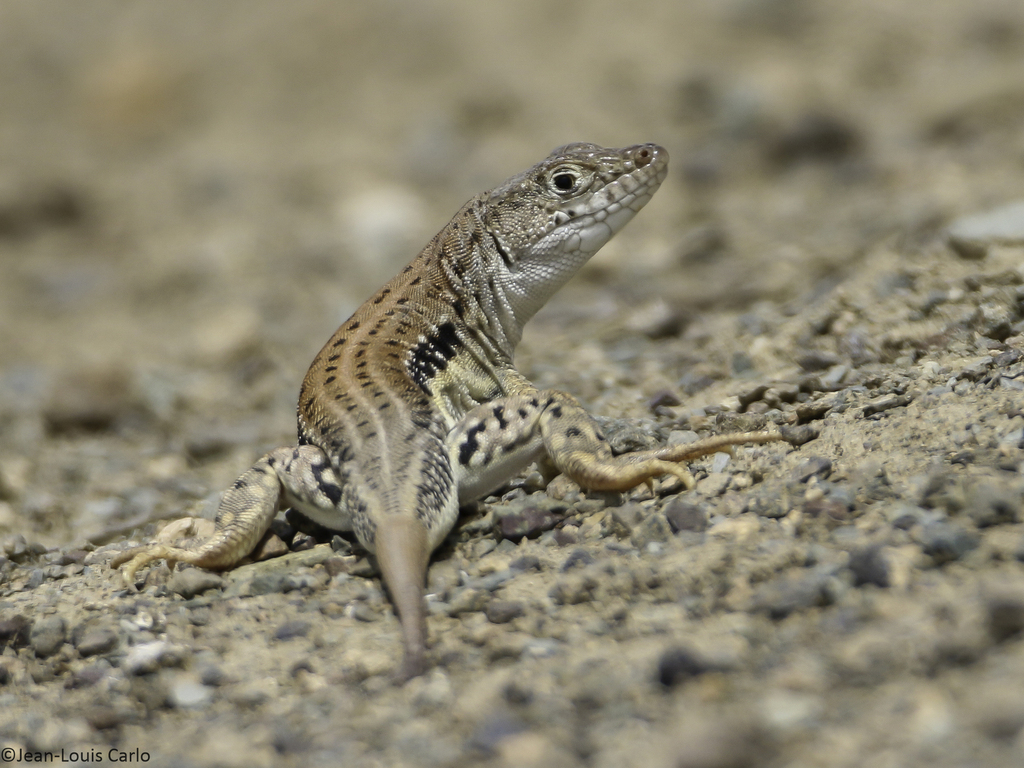
Black-sided Racerunner
Eremias persica
Eremias persica, the Aralo-Caspian racerunner or Persian racerunner, is a species of lizard native to southern Azerbaijan, most of Iran, southern Turkmenistan, Afghanistan, and western Pakistan. Eremias intermedia is also known as the Aralo-Caspian racerunner.
From the article Eremias persica on Wikipedia (CC BY-SA), quoted section by section
Description
It is most closely related to Eremias velox, of which it was previously treated as a subspecies, and they share several attributes such as having a wide range distribution across the Iranian Plateau, as well as the number of and shape of their scales. It can be morphologically distinguished from E. velox based on several characteristics, including:
continuous dorsolateral black stripes (vs. E. velox with interrupted, forming ocelli with white spots), the stripes strongly contrasting with the base pattern (vs. not strongly contrasting), juveniles with 4 dark stripes on the back between dorsolateral white-spotted stripes (vs. 3 dark stripes), and juveniles with ventral surface of tail not red (vs. carmine red in E. velox). Like many other lacertid lizards, the juveniles are more easily distinguished from other species than the adults. Other closely related species of Eremias racerunners include E. kopetdaghica, E. isfahanica, E. lalezharica, E. montana, E. papenfussi, E. strauchi, and E. suphani.
Range & habitat
The Persian racerunner occurs in Iran, southern Azerbaijan, southern Turkmenistan, Afghanistan, and western Pakistan. In Iran, Eremias persica has a broad distribution in the central plateau south of the Alborz Mountains, including the Zagros Mountains, but it is absent from the central deserts Dasht-e Lut and Dasht-e Kavir. It is found in open plains and slopes, typically in areas of low vegetation and gravel surfaces. It is also found on mixed sand or silt and gravel.
== References ==
Wikipedia: “Distribution and habitat”
Where it lives
Recorded sightings
—
geo-referenced records in GBIF, from museums, herbaria and field observers.
Drag the globe to turn it. Dots are where records exist, not a range map; darker means more records.
In the stacks
Searching the stacks…
Every page naming Eremias persica in the Biodiversity Heritage Library →
This page is assembled live from iNaturalist, GBIF, Wikipedia, the Source Library and the Internet Archive. It is not yet part of the hand-edited codex. iNaturalist taxon 100324.