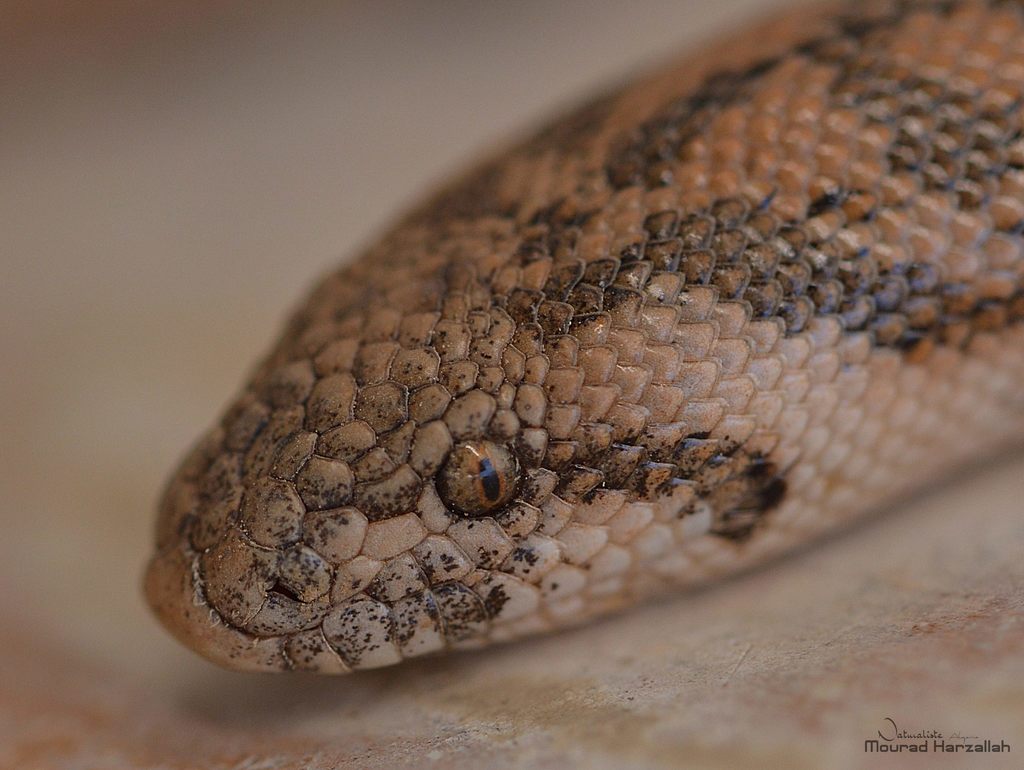
Javelin Sand Boa
Eryx jaculus
Eryx jaculus, known commonly as the javelin sand boa, is a species of snake in the Boidae family. It is the type species of the genus Eryx.
From the article Eryx jaculus on Wikipedia (CC BY-SA), quoted section by section
Description
Scientists from Razi university describe it as "brownish-green or gray, with darker blotches, belly white or yellowish, uniform or speckled darker" (Rhadi, Pouyani et al.) The species is rather uniform in body thickness, a trait commonly seen in the Eryx genus.
Range & habitat
Eryx jaculus is found in Eastern Europe and Balkans, the Caucasus, the Middle East, and North-Africa. In September 2014 the snake was rediscovered in Romania near the Danube after being extinct in the country since 1937, when the last specimen was seen near Cochirleni. In late 2015 the snake was rediscovered near Licata on the south coast of Sicily after not having been officially recorded in Italy for eighty years. The snake has also been found in India, Sri Lanka and Mongolia. The Mongolian name of the snake is "batra" which can be translated to "father". Their diet consists of lizards, small mammals and other snake species.
Wikipedia: “Geographic range”
What it does
The javelin sand boa exhibits a broader defensive repertoire than previously recognized. In addition to passive defenses such as remaining immobile, balling the body to conceal the head, retreating, and defecation, individuals may display active defensive behaviors when threatened. These include mock biting, full-body dorsolateral flattening, and, rarely, actual biting. Dorsolateral flattening increases the apparent body size of the snake and is frequently combined with mock biting, forming a conspicuous threat display. Mock biting is the most common active defensive response and is typically triggered during close-range encounters or handling, whereas true biting appears to be exceptionally rare. The expression of defensive behaviors is context-dependent: active displays are more common in exposed situations, while individuals in sheltered locations often remain motionless and rely on crypsis. These observations suggest that E. jaculus employs a flexible and hierarchical antipredator strategy in which concealment, postural displays, bluffing, and, only as a last resort, physical aggression are used according to the level of perceived threat.
Wikipedia: “Behaviour”
Where it lives
Recorded sightings
—
geo-referenced records in GBIF, from museums, herbaria and field observers.
Drag the globe to turn it. Dots are where records exist, not a range map; darker means more records.
In the stacks
Searching the stacks…
Every page naming Eryx jaculus in the Biodiversity Heritage Library →
This page is assembled live from iNaturalist, GBIF, Wikipedia, the Source Library and the Internet Archive. It is not yet part of the hand-edited codex. iNaturalist taxon 100411.