- Animals
- ›Chordates
- ›Vertebrates
- ›Ray-finned Fishes
- ›Spiny-rayed fishes
- ›Perches, Scorpionfishes, Sticklebacks, and Allies
- ›Perches, groupers and allies
- ›Perches, Darters, and allies
- ›Darters
- ›Etheostoma
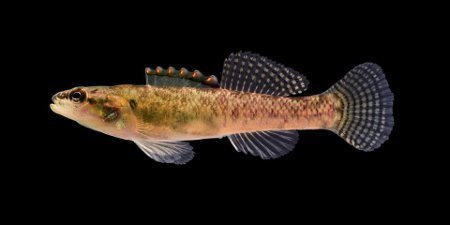
Stripetail Darter
Etheostoma kennicotti
The stripetail darter (Etheostoma kennicotti) is a species of freshwater ray-finned fish, a darter from the subfamily Etheostomatinae, part of the family Percidae, which also contains the perches, ruffes and pikeperches. It is endemic to the eastern United States. It is found in small rivers and streams in the states of Tennessee, Ohio, Kentucky, Illinois, Alabama, Georgia, and Mississippi. Males are a golden-orange color with black barring on the fins, and grow to a length of about 2.8 in (7 cm). This fish feeds on midge larvae and other small invertebrates. It breeds in the spring; eggs are attached to the substrate, often under slab rocks, where they are guarded by the male. The population trend of this fish seems to be stable and it is a common species with numerous sub-populations over a wide range, and the International Union for Conservation of Nature has assessed its conservation status as being of "least concern".
From the article Stripetail darter on Wikipedia (CC BY-SA), quoted section by section
Description
The stripetail darter males are golden orange and as adults can grow up to 2.8 inches (7.1 cm) long. It also has black bands present on the caudal fins and soft dorsal fins.
Range & habitat
The stripetail darter is a small, benthic freshwater fish that inhabits river tributaries. Historic or native geographic range of the stripetail darter is likely similar to its current range. Currently, the stripetail darter inhabits tributaries of the Ohio, Tennessee, Cumberland, and Paint Rock river systems. The Green River drainage in Kentucky also contains a population of stripetail darters. The Paint Rock river system and Ohio River systems hold the largest populations of the species and it is less common throughout the Tennessee River system. The stripetail darter inhabits states including Tennessee, Ohio, Kentucky, Illinois, Alabama, Georgia, and Mississippi. The stripetail darter's distribution is typically spotty throughout its range with multiple subpopulations; however, the species is still abundant overall. Page and Smith discovered that the species also varies slightly depending on where the subpopulation of the species occurs. This isolation of the populations could be due to climate effects such as low temperatures and low water levels. The current estimated population is over 10,000 individuals through the range of this fish. The population is stable.
Wikipedia: “Distribution and habitat”
What it does
The diet of the stripetail darter includes mayflies, fishflies, midge larvae, isopods, stoneflies, and cladocerans. Stripetail darters are able to live in a wide range of pH levels and water temperatures. Typically these darters also live in slab pools in streams and headwaters, as well as creeks and small slow-flowing rivers with rocky substrate and rubble, in riffles, under stones and under overhanging banks in pools; it often occurs among emergent vegetation.
Wikipedia: “Ecology”
In human culture
The breeding season for the stripetail darter in lower Ohio River tributaries begins in late March to early April and continues until late May. Stripetails breed in water between 57 and 68 °F (14 and 20 °C). Stripetail darter eggs are small, between 0.075 to 0.098 inches (1.9 to 2.5 mm) in diameter, spherical and adhesive. The eggs are usually laid under slabrocks in medium-sized or smaller streams that feed into larger bodies of water. The slabrocks provide shelter and protection for the eggs and allow males to guard them more efficiently. The stripetail also prefers overhanging vegetation to be present near the spawning sites and gravel or sandy bottoms. The stripetail darter lays anywhere from 50 to 400 eggs at a time. Newly hatched stripetail darters are typically around .16 to .19 inches (4.1 to 4.8 mm) in length and have fully developed pectoral fins with 12 incipient rays. Stripetails reach sexual maturity one year after birth. The maximum lifespan of this fish is 3 years.
Wikipedia: “Life history”
Where it lives
Recorded sightings
—
geo-referenced records in GBIF, from museums, herbaria and field observers.
Drag the globe to turn it. Dots are where records exist, not a range map; darker means more records.
In the stacks
Searching the stacks…
Every page naming Etheostoma kennicotti in the Biodiversity Heritage Library →
This page is assembled live from iNaturalist, GBIF, Wikipedia, the Source Library and the Internet Archive. It is not yet part of the hand-edited codex. iNaturalist taxon 100494.