- Animals
- ›Chordates
- ›Vertebrates
- ›Ray-finned Fishes
- ›Spiny-rayed fishes
- ›Perches, Scorpionfishes, Sticklebacks, and Allies
- ›Perches, groupers and allies
- ›Perches, Darters, and allies
- ›Darters
- ›Etheostoma
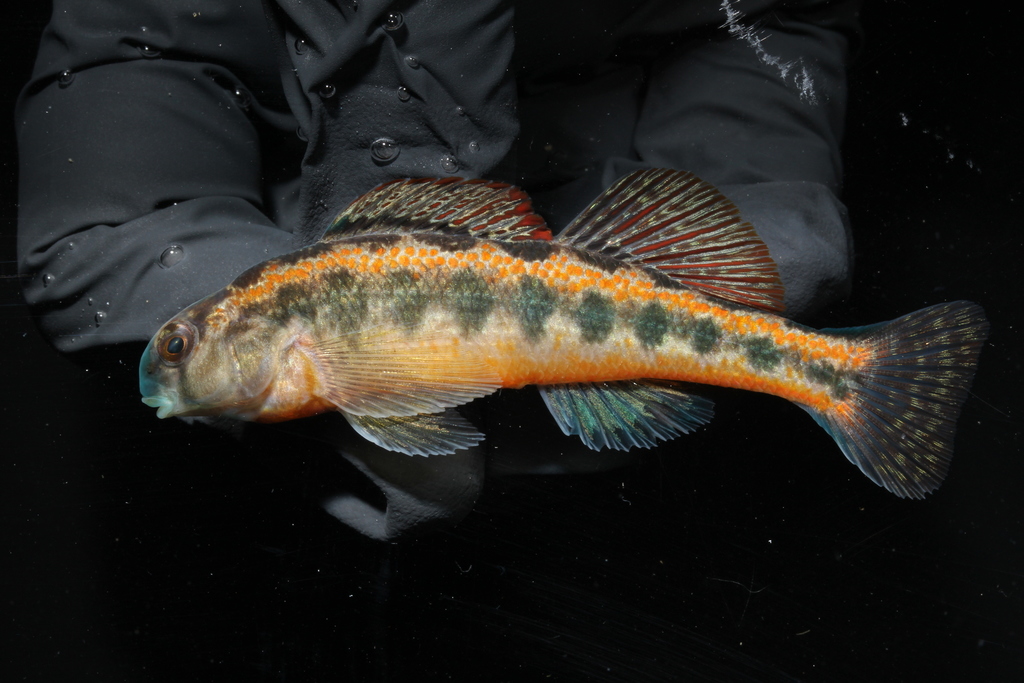
Tennessee Snubnose Darter
Etheostoma simoterum
The snubnose darter (Etheostoma simoterum) is a species of freshwater ray-finned fish, a darter from the subfamily Etheostomatinae, part of the family Percidae, which also contains the perches, ruffes and pikeperches. It is endemic to the southeastern United States.
The snubnose darter currently has no recognized subspecies, though there used to be two. A former subspecies, the Cumberland snubnose darter, has been promoted to a full species as E. atripinne. Intergradation between the two subspecies occurs in the lower Tennessee River unit. The mean length of snubnose darters is 45 millimetres (1.8 in), the reported average clutch size is 152, and the maximum age is less than two years. The snubnose darter inhabits riffles and rock-bottomed pools in streams with low turbidity. As of 2000, the snubnose darter was listed as currently stable, meaning it is widespread and not in need of any immediate conservation action.
From the article Snubnose darter on Wikipedia (CC BY-SA), quoted section by section
Range & habitat
The snubnose darter is native to the Tennessee and Cumberland River drainages of Tennessee, Virginia, Kentucky, North Carolina, Georgia and Alabama. Warren et al. described the distribution of the freshwater fish native to the Southern United States by drainage basin. The historical range of the Tennessee snubnose darter (E. s. simoterum) includes the Upper and Lower Tennessee River drainage units, and it has been introduced into both the Licking Big Sandy Creek River and the Kanawha-New-Guyandotte-Little Kanawha River. The historical range of the Cumberland snubnose darter (E. atripinne) includes the Lower Tennessee River and Cumberland River drainages. Intergradation between the two subspecies occurs in the Lower Tennessee River unit.
Wikipedia: “Distribution”
What it does
Snubnose darters inhabit flowing bedrock or gravel-bottomed pools with moderate current in small to medium streams. They have been observed spawning in streams with water temperature ranging from 11 to 18 °C (52 to 64 °F). Etheostoma simoterum prefers a habitat with no vegetation or light algae. Snubnose darters are rarely found in water with high turbidity or where the substrate has been silted, and human activities such as dam building or destruction of riparian buffers may lead to increased siltation, thereby threatening darter populations. Adults and juveniles are invertivorous. Examination of the stomach contents of 45 individuals broken into four size classes showed midge larvae of the family Chironomidae made up the bulk of their diets. Depending on size class, between 80% and 100% of examined stomachs contained midge larvae. Mayfly naiads, caddisfly larvae, copepods, and cladocerans were also major contributors to overall stomach contents. Consumption of food is highest in April, corresponding with the peak of spawning, while it is much lower during months of temperature extremes and decreased activity, such as January and July. Large darters are susceptible to internal parasitism by flukes and nematodes. External parasites such as black spot disease caused by Metacercariae flukes and piscicolid leeches also affect snubnose darters.
Wikipedia: “Ecology”
Where it lives
Recorded sightings
—
geo-referenced records in GBIF, from museums, herbaria and field observers.
Drag the globe to turn it. Dots are where records exist, not a range map; darker means more records.
In the stacks
Searching the stacks…
Every page naming Etheostoma simoterum in the Biodiversity Heritage Library →
This page is assembled live from iNaturalist, GBIF, Wikipedia, the Source Library and the Internet Archive. It is not yet part of the hand-edited codex. iNaturalist taxon 100541.