- Animals
- ›Chordates
- ›Vertebrates
- ›Cartilaginous Fishes
- ›Sharks and Rays
- ›Sharks
- ›Squalean Sharks
- ›Squaliform Sharks
- ›Lantern Sharks
- ›Etmopterus
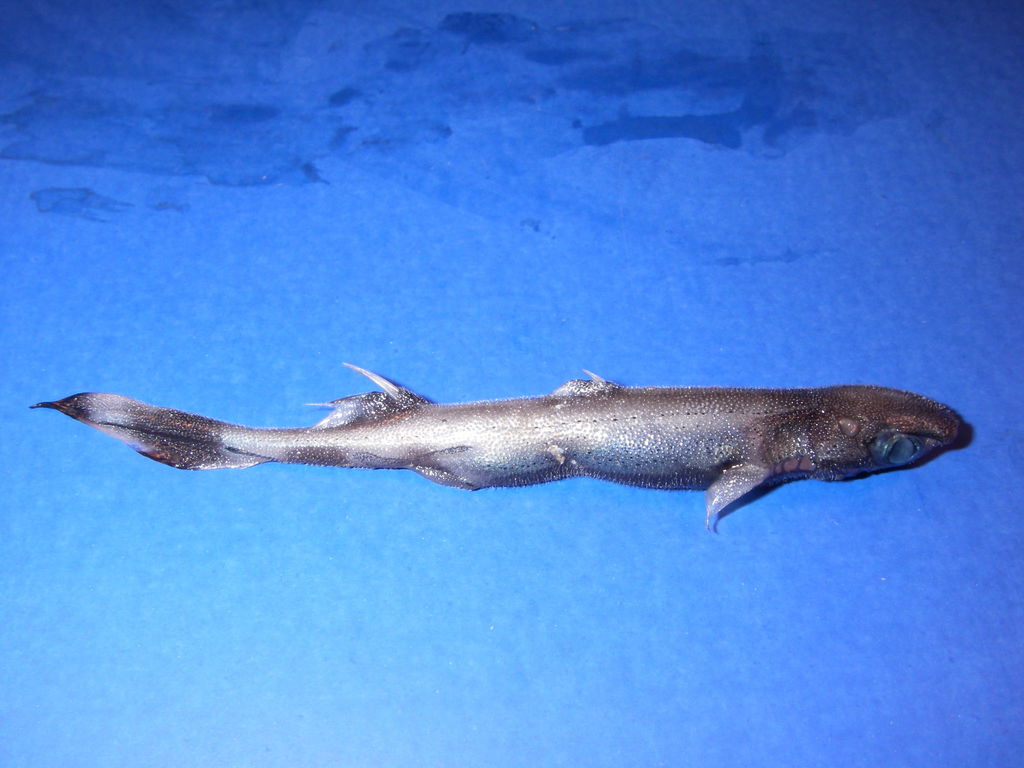
Fringefin Lantern Shark
Etmopterus schultzi
The fringefin lanternshark (Etmopterus schultzi) is a shark of the family Etmopteridae found in the western central Atlantic from Texas to Florida, northern Gulf of Mexico, and Mexico. It is endemic to this area. It is a deep water shark and is found about 220 to 915 meters below the surface, on the upper continental slopes of the Gulf. E. schultzi is a small shark, about 27–30 cm long and feeds on squid. It is also bioluminescent, which counter-illuminates it and helps with intraspecific interaction. Due to its limited range and the difficulty of collecting deep water species, it has not been evaluated by the IUCN Red List, but due to recent oil spills in the Gulf of Mexico, it is likely that fringefin lanternsharks have decreased in population.
From the article Fringefin lanternshark on Wikipedia (CC BY-SA), quoted section by section
Description
E. schultzi males are about 27 cm long, while females are 28–30 cm long. The upper part of their bodies is light brown and their bellies are dusky grey. They have a dark mark behind and above the pelvic fins at the base of their tail. The edges of their fins are given their characteristic fringed appearance by naked ceratotrichia, the filaments that run through fish fins. Their denticles are hooked and mostly cover the snout. Their gill openings are short and their second dorsal fin, the fin located closer to the tail, is about twice the size of the first dorsal fin, which is located closer to the head. Like all shark species, they have heterocercal caudal fins, where the upper part is longer than the lower.
Range & habitat
E. shultzi lives at a depth of about 220 to 915 meters below the surface, predominantly on the upper continental slopes of the Gulf of Mexico. It is endemic to the Gulf, and its range extends from the continental slopes of Eastern Mexico, Southern United States, and Western Florida.
Wikipedia: “Distribution and habitat”
What it does
E. schultzi is known to feed on squid. It has also been suggested that these lanternsharks school in order to hunt food, but very little research has been done on their feeding behaviors and methods.
Wikipedia: “Feeding”
In human culture
Fringefin lanternsharks likely use the species-specific bioluminescent patterns on their ventral side to find mates. Although fringefin lanternshark reproduction has not been directly studied, due to their close association with other lanternshark species, fringefin lanternsharks are presumably ovoviviparous. Ovoviviparity is a method of reproduction in which there is internal fertilization and the developing young feed on the egg yolk. The mother then gives birth to live, fully developed young. This method is different from viviparous species like mammals because in mammals the developing young are connected to the mother via a placenta and receive nutrients directly from her.
Wikipedia: “Life history”
Where it lives
Recorded sightings
—
geo-referenced records in GBIF, from museums, herbaria and field observers.
Drag the globe to turn it. Dots are where records exist, not a range map; darker means more records.
In the stacks
Searching the stacks…
Every page naming Etmopterus schultzi in the Biodiversity Heritage Library →
This page is assembled live from iNaturalist, GBIF, Wikipedia, the Source Library and the Internet Archive. It is not yet part of the hand-edited codex. iNaturalist taxon 100595.