- Animals
- ›Chordates
- ›Vertebrates
- ›Cartilaginous Fishes
- ›Sharks and Rays
- ›Sharks
- ›Squalean Sharks
- ›Squaliform Sharks
- ›Lantern Sharks
- ›Etmopterus
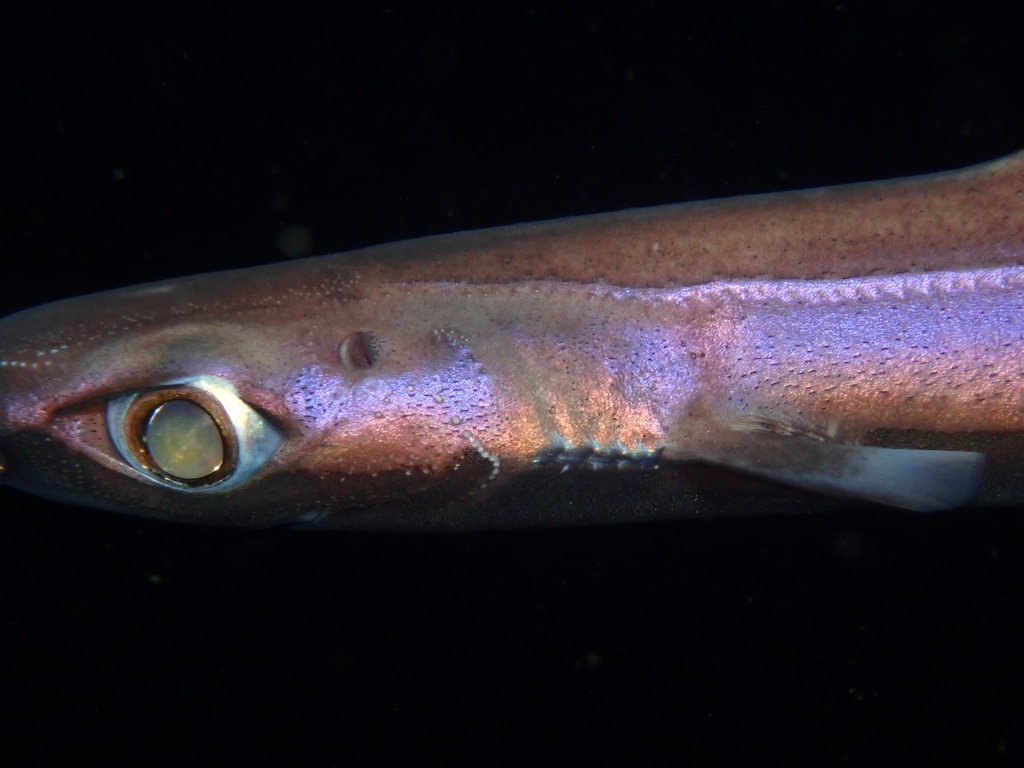
Velvet Belly Lantern Shark
Etmopterus spinax
The velvet belly lanternshark (or simply velvet belly) (Etmopterus spinax) is a species of dogfish shark in the family Etmopteridae. One of the most common deepwater sharks in the northeastern Atlantic Ocean, the velvet belly is found from Iceland and Norway to Gabon and South Africa at a depth of 20–2,490 m (66–8,169 ft). A small shark generally no more than 45 cm (18 in) long, the velvet belly is so named because its black underside is abruptly distinct from the brown coloration on the rest of its body. The body of this species is fairly stout, with a moderately long snout and tail, and very small gill slits. Like other lanternsharks, the velvet belly is bioluminescent, with light-emitting photophores forming a species-specific pattern over its flanks and abdomen. The ventral photophores are thought to function in counter-illumination, which camouflages the shark against predators and prey. The bioluminescent flank markings may play a role in intraspecific communication.
Young velvet bellies feed mainly on krill and small bony fish, transitioning to squid and shrimp as they grow larger. There is evidence that individuals also move into deeper water as they age. This species exhibits a number of adaptations to living in the deep sea, such as specialized T-cells and liver proteins for dealing with the higher concentrations of heavy metals found there. Velvet bellies often carry a heavy parasite load. It is ovoviviparous, giving birth to litters of six to 20 young every two to three years.
From the article Velvet belly lanternshark on Wikipedia (CC BY-SA), quoted section by section
Description
The velvet belly is a robustly built shark with a moderately long, broad, flattened snout. The mouth has thin, smooth lips. The upper teeth are small, with a narrow central cusp and usually fewer than three pairs of lateral cusplets. The lower teeth are much larger, with a strongly slanted, blade-like cusp at the top and interlocking bases. The five pairs of gill slits are tiny, comparable in size to the spiracles. Both dorsal fins bear stout, grooved spines at the front, with the second much longer than the first and curved. The first dorsal fin originates behind the short and rounded pectoral fins; the second dorsal fin is twice the size of the first and originates behind the pelvic fins. The anal fin is absent. The tail is slender, leading to a long caudal fin with a small lower lobe and a low upper lobe with a prominent ventral notch near the tip. The dermal denticles are thin with hooked tips, arranged without a regular pattern well-separated from one another. The coloration is brown above, abruptly transitioning to black below. There are thin black marks above and behind the pelvic fins, and along the caudal fin. The velvet belly possesses numerous photophores that emit a blue-green light visible from 3–4 m (9.8–13.1 ft) away. …
Range & habitat
The range of the velvet belly is in the eastern Atlantic, extending from Iceland and Norway to Gabon, including the Mediterranean Sea, the Azores, the Canary Islands, and Cape Verde. It has also been reported off Cape Province, South Africa. This shark mainly inhabits the outer continental and insular shelves and upper slopes over mud or clay, from close to the bottom to the middle of the water column. It is most common at a depth of 200–500 m (660–1,640 ft), though in the Rockall Trough, it is only found at a depth of 500–750 m (1,640–2,460 ft). This species has been reported from as shallow as 20 m (66 ft), and as deep as 2,490 m (8,170 ft).
Wikipedia: “Distribution and habitat”
What it does
Along with the blackmouth catshark (Galeus melastomus) and the Portuguese dogfish (Centroscymnus coelolepis), the velvet belly is one of the most abundant deep-sea sharks in the northeastern Atlantic. It is found individually or in small shoals. Samplings in the Mediterranean have found females outnumbering males across all ages; this imbalance increases in the older age classes. In the Rockall Trough and the Catalan Sea, large adults are found in deeper waters than juveniles, which may serve to reduce competition between the two groups. However, this pattern has not been observed at other sites in the eastern Mediterranean. The velvet belly's liver accounts for 17% of its body mass, three-quarters of which is oil, making it nearly neutrally buoyant. To deal with the higher concentrations of heavy metals in the deep sea, the velvet belly has T-cells in its bloodstream that can identify and mark toxic compounds for elimination. These T-cells are produced by a lymphomyeloid gland in its esophagus called a "Leydig's organ", which is also found in some other sharks and rays. In its liver, specialized proteins are also capable of detoxifying cadmium, copper, mercury, zinc, and other toxic contaminants. The velvet belly's bioluminescence is thought to function in counter-illumination, which eliminates the shark's silhouette and camouflages it from upward-looking predators. …
Wikipedia: “Biology and ecology”
Where it lives
Recorded sightings
—
geo-referenced records in GBIF, from museums, herbaria and field observers.
Drag the globe to turn it. Dots are where records exist, not a range map; darker means more records.
In the stacks
Searching the stacks…
Every page naming Etmopterus spinax in the Biodiversity Heritage Library →
This page is assembled live from iNaturalist, GBIF, Wikipedia, the Source Library and the Internet Archive. It is not yet part of the hand-edited codex. iNaturalist taxon 100597.