- Animals
- ›Chordates
- ›Vertebrates
- ›Reptiles
- ›Snakes and Lizards
- ›Lizards
- ›Skinks and allies
- ›Skinks
- ›Sphenomorphine Skinks
- ›Eulamprus
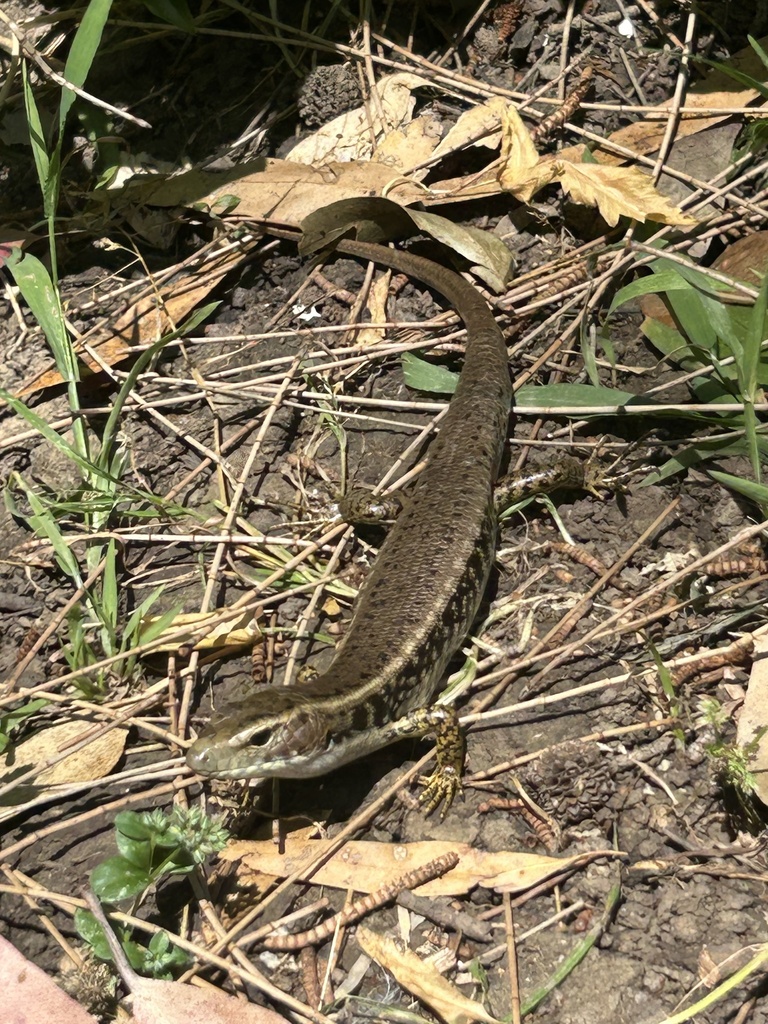
Eastern Water Skink
Eulamprus quoyii
Eulamprus quoyii, more commonly known as the eastern water skink, eastern water-skink, or golden water skink, is a viviparous species of diurnal skink. Eulamprus quoyii belongs to the family Scincidae and is considered a common garden animal in Australia. The skink is endemic to Australia and found only along the east coast of the country. It makes its home in creekside habitats along the east coast of Australia and in urban garden areas with high amounts of moisture. The species can be identified by the twin, long yellow stripes that run along its body from the top of the eye, as well as by several more specific character derived states. The pale yellow dorsolateral stripes are most likely where its common name, the golden water skink, is derived. Like other ectotherms, the skink can often be seen basking in the sun on rocky outcroppings in order to regulate its body temperature. Its diet mainly consists of both aquatic and terrestrial insects, tadpoles and small amounts of plant matter. The skink both hunts for food and scavenges when necessary and is considered an opportunistic feeder. It is prey to larger lizards, snakes, cats and birds and so will often be seen moving quickly into hiding when other organisms are present.
From the article Eulamprus quoyii on Wikipedia (CC BY-SA), quoted section by section
Description
Eulamprus quoyii is a large water skink that can grow to approximately 115mm in snout-vent length (SVL). They have sharply defined, narrow, pale-yellow dorsolateral stripes that start from above the eye and extend down the body but lack the typical black vertebral stripe of other species in the genus. Its body is medium-sized and has a long slender tail. It has a blackish upper lateral zone with pale spots and its head and snout are moderately acute. Each of its two front limbs have five fingers while the two back limbs have five toes. Its ventral area is cream in colour with some randomly scattered darker spots that differ between individuals. Its throat is white with darker black patches. There is minor sexual dimorphism within the species resulting in the females having a slightly longer snout-vent length and the males to have proportionately longer limbs and heads. The difference in SVL between females and males is not statistically significant. There is a significant difference in shape between sexes of both adult and neonate E. quoyii. In adult male water skinks the distance between the forelimbs and hindlimbs, or the trunk length, are typically shorter than females. Males are known to have longer limbs, wider heads and a greater mass than females of the species. In male E. …
Range & habitat
The Eastern Water Skink can be found in creekside habitats, estuaries or near small to medium-sized bodies of water as well as in moist urban garden areas along Australia's East Coast cities. Outside of the urban environment, E. quoyii population densities are highest in open, rocky creek areas compared to creek or water areas with thick vegetation or cool forest conditions. Areas with rocky outcroppings and high availability of sunlight have a direct correlation with the abundance of E. quoyii populations. E. quoyii habitat selection is not chosen through abundance or lack of outcroppings and vegetation, but is selected through substrate temperature and necessary thermoregulation factors for the species.
Wikipedia: “Habitat”
What it does
When Eulamprus quoyii breed, male and females of the species mate in Spring and will give birth to up to nine babies per clutch in the Summer. Unlike many other reptile species, the Eastern Water Skink is a viviparous species and will give birth to live young following their long gestation periods. Due to the length of these gestation periods, it is common for female E. quoyii individuals to mate only once a year. Male individuals differ from the females in that they can be classified into two categories: Territorial/Resident males and Floater Males. Resident males are suspected to be more active over a longer period, producing clutches with a higher yield of offspring. Floater males are predicted to have larger home ranges and move greater distances while active, leading to fewer clutches and offspring per year. Sexual selection in the E. quoyii species is not believed to have a direct correlation to performance and fitness traits such as bite force or speed as it does in other lizard species. Previous research has shown that there does seem to be a correlation between SVL and sexual selection in E. quoyii, however, due to the adoption of alternate reproductive tactics (ART) in the species, there is the chance that specific performance traits are correlated with other unmeasured behavioural, morphological or physiological traits.
Wikipedia: “Breeding and reproduction”
In human culture
The genus name Eulamprus is derived from the Latin meaning "good-beautiful". The specific name, quoyii, is in honor of French zoologist Jean René Constant Quoy.
Wikipedia: “Etymology”
Where it lives
Recorded sightings
—
geo-referenced records in GBIF, from museums, herbaria and field observers.
Drag the globe to turn it. Dots are where records exist, not a range map; darker means more records.
In the stacks
Searching the stacks…
Every page naming Eulamprus quoyii in the Biodiversity Heritage Library →
This page is assembled live from iNaturalist, GBIF, Wikipedia, the Source Library and the Internet Archive. It is not yet part of the hand-edited codex. iNaturalist taxon 100709.