- Animals
- ›Chordates
- ›Vertebrates
- ›Mammals
- ›Therians
- ›Placental Mammals
- ›Primates, Rodents, and Allies
- ›Primates
- ›Lemurs, Lorises, and Allies
- ›Lemurs
- ›Lemurs
- ›Typical Lemurs
- ›Eulemur
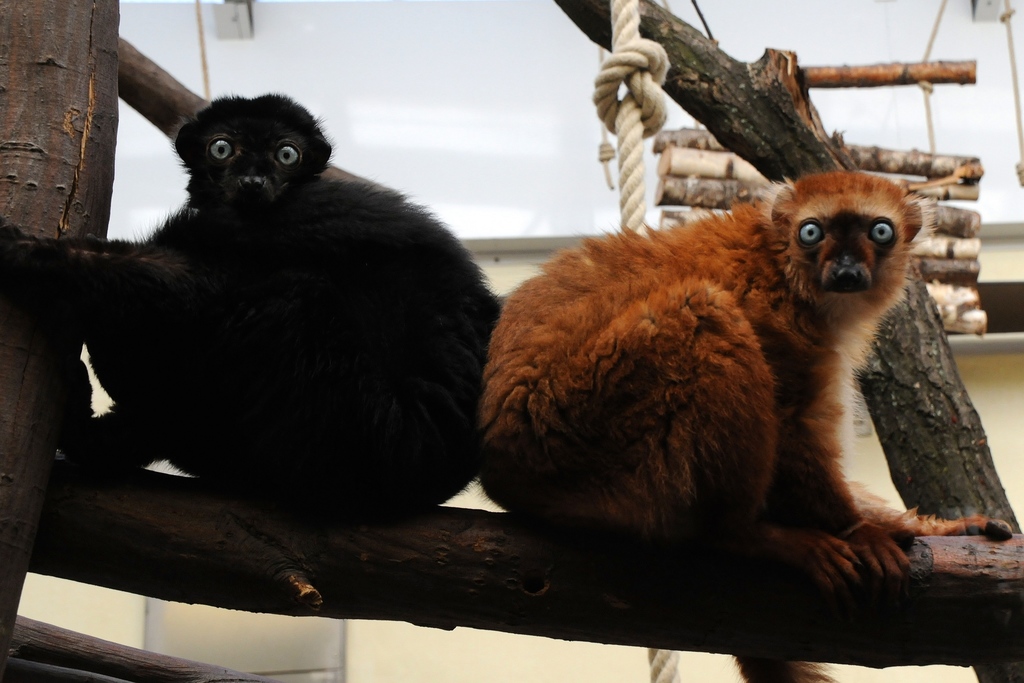
Blue-eyed Black Lemur
Eulemur flavifrons
The blue-eyed black lemur (Eulemur flavifrons), also known as the Sclater's lemur, is a species of true lemur. It can attain a body length of 39–45 cm (15–18 in), a tail length of 51–65 cm (20–26 in), a total length of 90–100 cm (35–39 in), and a weight of 1.8–1.9 kg (4.0–4.2 lb). Being a primate, it has strong hands with palms like a human, which have a rubbery texture to give it a firm grip on branches. Its tail is longer than its body and is non-prehensile.
Like many of the species in the genus Eulemur, the blue-eyed black lemur is sexually dichromatic. Males are solid black in color, with the hairs sometimes tinged brown at the roots. Females are reddish-brown in color with their underside and outline of their face a lighter tan. They have a dark brown or gray muzzle and the back of their hands and feet are a similar dark color. Both sexes have blue eyes, hence the common name, and are one of the only primates other than humans to consistently have blue eyes. The eyes can range in color from a shocking electric blue, a light sky-blue, or a softer gray-blue.
From the article Blue-eyed black lemur on Wikipedia (CC BY-SA), quoted section by section
Range & habitat
The blue-eyed black lemur inhabits primary and secondary sub-tropical moist and dry forests in the northwestern tip of Madagascar. Its range extends from the Andranomalaza River in the north, to the Maevarano River in the south. Some areas where it can readily be seen are in the forests south of Maromandia near Antsiranana. It may also be seen in the remaining forest patches of the Sahamalaza Peninsula, such as the Ankarafa forest.
Wikipedia: “Habitat”
What it does
The species has not been studied intensively in the wild, but it is known to be fairly social. Group sizes vary from four to eleven individuals on average. Females are dominant as in most lemur species, and there are usually more males than females in each social group. The blue-eyed black lemur is thought to be polygynous. Females give birth to one or two offspring in June or July, after a gestation of 120 to 129 days. The young are weaned after about 5–6 months, and reach maturity at about 2 years of age. It may live between 15 and 30 years in captivity, with little data recorded on their longevity in the wild. It demonstrates a cathemeral activity pattern, being awake sporadically throughout the day. The occasional nighttime activities are thought to be based on the intensity of the moonlight. The blue-eyed black lemur communicates with scent-marking, vocalizations, and perhaps some facial expressions. Scent marking is an important means of communication as with most lemur species. Both genders will mark on trees with anogenital glands, while males will also mark using wrist and palm glands by rubbing and twisting them against leaves, twigs or branches. …
Wikipedia: “Behavior”
Listen
Looking for field recordings…
Where it lives
Recorded sightings
—
geo-referenced records in GBIF, from museums, herbaria and field observers.
Drag the globe to turn it. Dots are where records exist, not a range map; darker means more records.
In the stacks
Searching the stacks…
Every page naming Eulemur flavifrons in the Biodiversity Heritage Library →
This page is assembled live from iNaturalist, GBIF, Wikipedia, the Source Library and the Internet Archive. It is not yet part of the hand-edited codex. iNaturalist taxon 100710.