- Animals
- ›Chordates
- ›Vertebrates
- ›Reptiles
- ›Snakes and Lizards
- ›Lizards
- ›Skinks and allies
- ›Skinks
- ›Mabuyas
- ›Eutropis
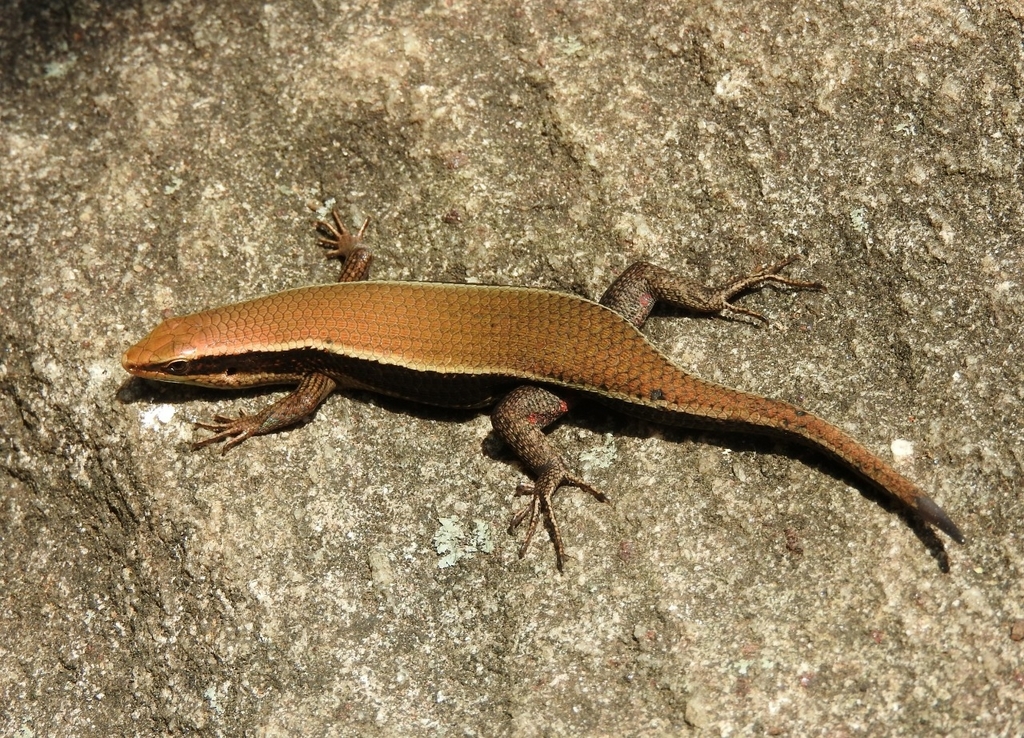
Sri Lanka Bronze Skink
Eutropis madaraszi
Eutropis madaraszi, also known commonly as the Sri Lanka bronze mabuya, the Sri Lanka bronze skink, or (ambiguously) the spotted skink, is a species of lizard in the family Scincidae. The species is endemic to the island of Sri Lanka.
From the article Eutropis madaraszi on Wikipedia (CC BY-SA), quoted section by section
Description
The body of E. madaraszi is slender, with 32 midbody scale rows. The dorsum is brown, with a dark line along the flank. The venter is creamy and unpatterned.
Range & habitat
A widespread terrestrial skink, E. madaraszi has been reported from both wet and dry zones. Known localities include Colombo, as well as around Kala Wewa, and Madatugama.
Wikipedia: “Habitat and distribution”
What it does
E. madaraszi is found at elevations up to 800 m (2,600 ft), in rock crevices, under leaf litter or under logs, and seen basking at midday.
Wikipedia: “Ecology and diet”
In human culture
The specific name, madaraszi, is in honor of Hungarian ornithologist Gyula Madarász of the Hungarian National Museum.
Wikipedia: “Etymology”
Where it lives
Recorded sightings
—
geo-referenced records in GBIF, from museums, herbaria and field observers.
Drag the globe to turn it. Dots are where records exist, not a range map; darker means more records.
In the stacks
Searching the stacks…
Every page naming Eutropis madaraszi in the Biodiversity Heritage Library →
This page is assembled live from iNaturalist, GBIF, Wikipedia, the Source Library and the Internet Archive. It is not yet part of the hand-edited codex. iNaturalist taxon 100813.