- Animals
- ›Chordates
- ›Vertebrates
- ›Ray-finned Fishes
- ›Spiny-rayed fishes
- ›Rivulines, Killifishes, and Livebearers
- ›Cyprinodontoidei
- ›Topminnows
- ›Fundulus
- ›Zygonectes
- ›Fundulus notatus
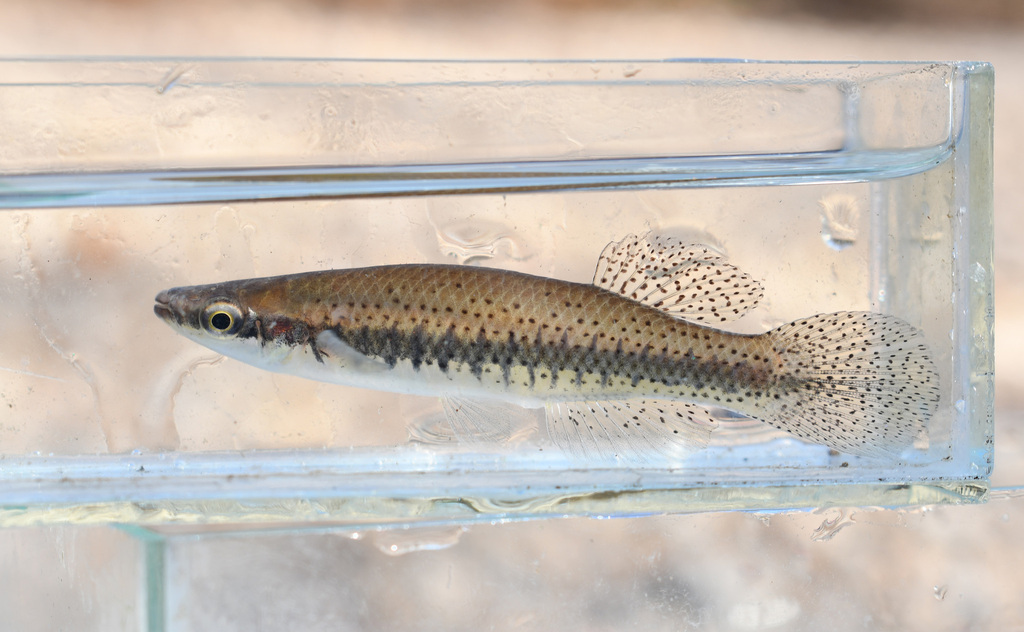
Blackspotted Topminnow
Fundulus olivaceus
The blackspotted topminnow, Fundulus olivaceus, is a species of fish in the family Fundulidae: the topminnows and North American killifishes. It is native to the south-central United States, where it is known from the drainages of the Mississippi River from Illinois to the Gulf of Mexico and as far west as Galveston Bay.
This species lives in clear streams with fast currents and sand or gravel substrates. It can often be found near the thick vegetation along the banks of the streams. It is omnivorous, consuming some plant matter along with a main diet of insects and other arthropods.
From the article Fundulus olivaceus on Wikipedia (CC BY-SA), quoted section by section
Description
The blackspotted topminnow has an elongate body up to 9.7 centimetres (3.8 in) long. It is brownish yellow to olive green on its upper side and has a wide, dark lateral band and distinct dark spots. The male has longer fins than the female and the fins of the male may take on a yellowish color during breeding. This species is very similar to the blackstripe topminnow (Fundulus notatus), which also has a dark lateral band. It can be distinguished from F. notatus by its darker, more numerous spots. The two may hybridize. In Fundulus olivaceus, the gill slit extends the dorsal to the uppermost pectoral fin ray. The distance from the origin of the dorsal fin to the end of the hypural plate is less than the distance from the origin of the dorsal fin to the preopercle or occasionally about equal to that distance. The mouth is sightly supraterminal.
Range & habitat
This species occurs near the surface in quiet or flowing, relatively clear, sand-gravel bottom headwaters, creeks, and small rivers; often occurring along margins near thick stands of emergent vegetation.
Wikipedia: “Habitat”
What it does
Spawning season for the blackspotted topminnow stretches from March to early September, with peak spawning occurring in May. On occasion, large males have been observed keeping an open territory of three square meters, Males seldom tolerate females in the wild, except during morning or evening spawning activities. In the aquarium, however, thus fish loses its wild traits, and becomes less aggressive. When spawning approaches, though, the males start to reveal their wild, aggressive traits. The males will approach each other head-on, and exhibit flaring opercula and gular areas—very similar to cichlid or betta behavior. They will then begin to slap and bite each other's flanks until one backs down. Ripe eggs are an average of 2.14 mm in diameter. The outer egg membrane has filaments that tend to be restricted to one area forming a tuft. The eggs hatch in 10–14 days while the fish lives for about 3 years.
Wikipedia: “Reproduction and life cycle”
In human culture
The scientific name of the blackspotted topminnow can be broken down in order to understand its meaning. The genus name Fundulus, is from the Latin name Fundus, meaning "bottom". The species name olivaceus means "olive-colored".
== References ==
Wikipedia: “Etymology”
Where it lives
Recorded sightings
—
geo-referenced records in GBIF, from museums, herbaria and field observers.
Drag the globe to turn it. Dots are where records exist, not a range map; darker means more records.
In the stacks
Searching the stacks…
Every page naming Fundulus olivaceus in the Biodiversity Heritage Library →
This page is assembled live from iNaturalist, GBIF, Wikipedia, the Source Library and the Internet Archive. It is not yet part of the hand-edited codex. iNaturalist taxon 101066.