- Animals
- ›Chordates
- ›Vertebrates
- ›Ray-finned Fishes
- ›Carps, Characins, Catfishes and Allies
- ›Minnows, Suckers, Carps, and Loaches
- ›Carps and Minnows
- ›Cyprinids
- ›Labeonines
- ›Garra
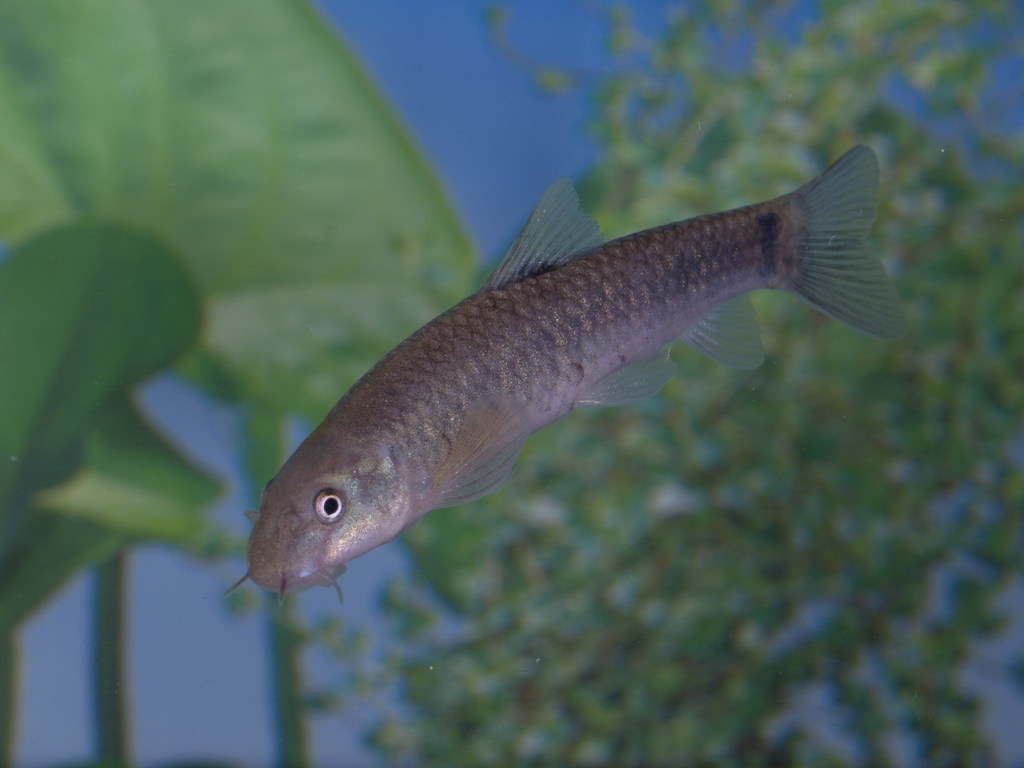
Oman Garra
Garra barreimiae
Garra barreimiae, the Oman garra, is a species of ray-finned fish in the family Cyprinidae. It is found in the mountains of northern Oman and in the United Arab Emirates. Most populations inhabit wadis, streams, pools and springs, but one population which lives in a cave system, is known as Omani blind cave fish, and has lost its sight and pigmentation. The only other cave fish in the Arabian Peninsula is the Tawi Atair garra (G. dunsirei), but it has normal eyes.
From the article Garra barreimiae on Wikipedia (CC BY-SA), quoted section by section
Description
Garra barreimiae is a small, slender fish, somewhat flattened on the underside. It grows to a length of about 7–8 cm (2.8–3.1 in). The head is wedge-shaped and has a suction plate on the lower jaw and a blunt snout. This fish is a fairly dark colour and is speckled; it has a paler transverse band just behind the head. An unpigmented form with fewer scales and no external eyes has been found living underground. Juveniles of this form are sighted at first, but as they get older, skin grows over their eyes.
Range & habitat
This species is endemic to the mountainous eastern region of the United Arab Emirates and northern region of Oman. It is often the most common fish species in its range. In both countries it is present on the western side of the mountains and in Oman, it is also present on the east side. This fish typically lives in wadis, in gravel or rock pools, in springs, in small streams and in slow-moving water. The blind form is only known from the Hoti cave systems in the Al Hamra region of the Jebel Akhdar Mountains in Oman.
Wikipedia: “Distribution and habitat”
What it does
Garra barreimiae is a shoaling fish and is quick to dart away if it feels threatened. It is a hardy and adaptable species. If the water body in which it is living is starting to dry up, it may be able to survive buried in wet gravel. It has also been known to skitter across wet rocks in order to move to another pool, and to make its way up steep wet rocks and beside waterfalls. It can tolerate brackish water and a wide range of temperatures. The fish feeds on the bottom, eating algae which it scrapes off rocks and detritus. Examination of the stomach contents of one individual showed that it had consumed both single-celled and filamentous algae, rotifers, nematodes and small crustaceans. Breeding takes place when there is sufficient water and may be sparked by a downpour. The tiny eggs are deposited among the gravel.
== References ==
Wikipedia: “Ecology”
Where it lives
Recorded sightings
—
geo-referenced records in GBIF, from museums, herbaria and field observers.
Drag the globe to turn it. Dots are where records exist, not a range map; darker means more records.
In the stacks
Searching the stacks…
Every page naming Garra barreimiae in the Biodiversity Heritage Library →
This page is assembled live from iNaturalist, GBIF, Wikipedia, the Source Library and the Internet Archive. It is not yet part of the hand-edited codex. iNaturalist taxon 101227.