On eBird ↗
Green Oropendola
Live sightings near you, the range map, bar charts of when it is seen, and Macaulay Library photos and recordings.
Green Oropendola
Psarocolius viridis
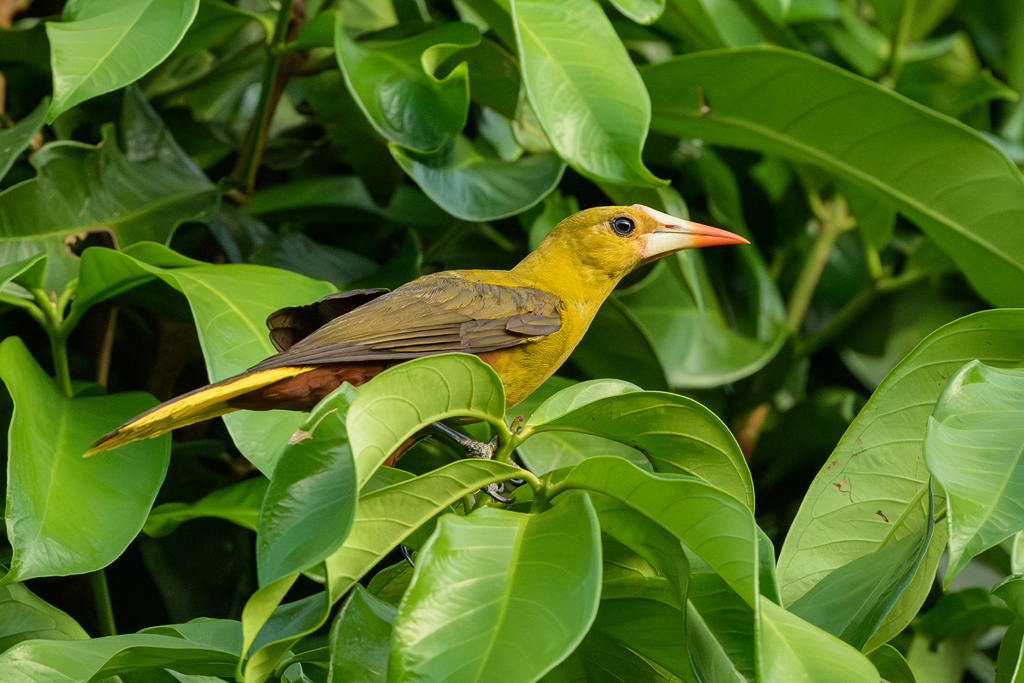
The green oropendola (Psarocolius viridis) is a species of bird in the family Icteridae. It is found in wooded habitats in the Amazon basin and Guianas of South America, and is generally common. Uniquely among the oropendolas, the green oropendola has a pale bill with an orange tip. Male oropendola weigh around 400 grams, while females are in the 200 gram range. This is a common species and the International Union for Conservation of Nature has...
From the article Green oropendola on Wikipedia (CC BY-SA), quoted section by section
Description
Male green oropendolas average 48.5 cm (19 in) long and females 37 cm (15 in). Males average 405 g (14 oz) and females 215 g (7.6 oz). Adult males have long feathers on their nape that form a crest. Females lack the crest but are otherwise like males. Adults are mostly yellowish olive. They are pink to dull orange on the lores and around their eye. Their wings are dusky olive and their rump, uppertail coverts, belly, thighs, and crissum are chestnut. Their central pair of tail feathers are dusky olive and the rest yellow with dusky olive outer edges on the outermost pair. Both sexes have a large bill with a swollen casque; the bill's inner half is pea-green and its outer half orange-red. They have a pale blue iris and blackish legs and feet. Juveniles are similar to adults but duller; their eyes are dark brown, they have less extensive chestnut, and their underparts have a grayish wash.
Range & habitat
The green oropendola is a bird of the Amazon Basin. It is found in approximately the southeastern third of Colombia and into the western part of southern Venezuela's Amazonas state. It also occurs from eastern Venezuela's Monagas, Delta Amacuro, and Bolívar states east through the Guianas. From Colombia its range continues south through eastern Ecuador and northern Peru's Amazonas and Loreto departments into extreme northern Bolivia. There is also a small disjunct population in central Peru's Pasco Department. From Colombia, Ecuador, and Peru its range continues east through most of Amazonian Brazil. There its southern border is a line approximately Acre-central Rondônia-southwestern Pará-northern Maranhão. The green oropendola mostly inhabits humid primary forest including várzea, terra firme, gallery, and lower montane forest types. It is rare in forest that has been disturbed. In elevation it reaches 1,100 m (3,600 ft) in Venezuela, 500 m (1,600 ft) in Colombia, 600 m (2,000 ft) in Ecuador, and 500 m (1,600 ft) in Brazil.
Wikipedia: “Distribution and habitat”
What it does
The green oropendola appears to feed mostly on insects and other arthropods. It also feeds on fruit and nectar but details are lacking. It forages in flocks and usually in the forest canopy. At least in French Guiana it is an important seed disperser. The species has been observed following a small group of red-throated caracaras (Ibycter americanus) through the canopy. The caracaras are specialist predators of wasp nests, and the oropendolas followed the group for several hours, feeding independently and not necessarily at the same level in the canopy nor on the same items of diet.
Wikipedia: “Feeding”
Listen
Looking for field recordings…
Where it lives
Recorded sightings
—
geo-referenced records in GBIF, from museums, herbaria and field observers.
Drag the globe to turn it. Dots are where records exist, not a range map; darker means more records.
In the stacks
Searching the stacks…
Every page naming Psarocolius viridis in the Biodiversity Heritage Library →
This page is assembled live from iNaturalist, GBIF, Wikipedia, the Source Library and the Internet Archive. It is not yet part of the hand-edited codex. iNaturalist taxon 10127.