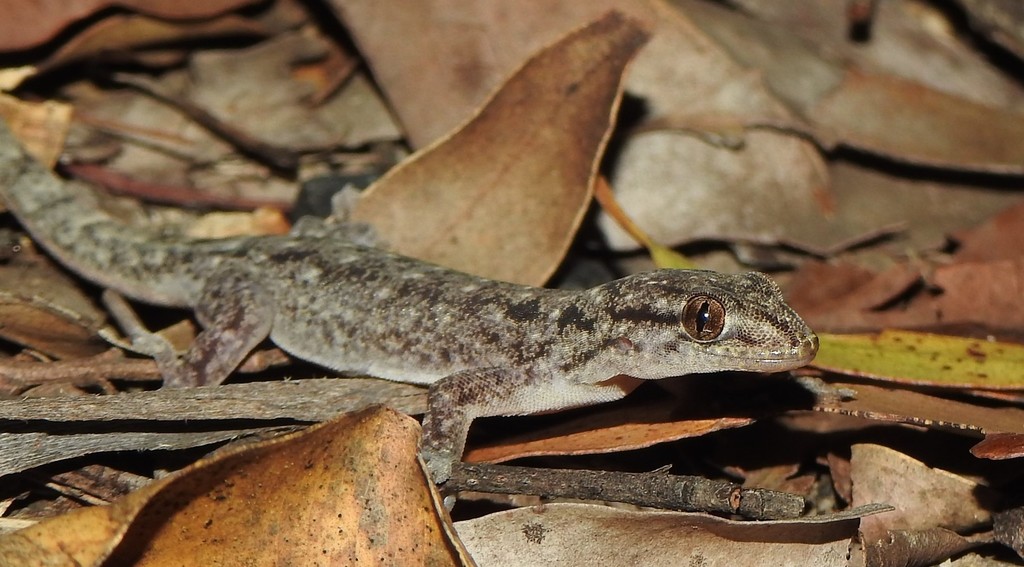
Dubious Dtella
Gehyra dubia
The dubious dtella, native Australian house gecko, or dubious four-clawed gecko (Gehyra dubia) is a species of gecko in the genus Gehyra, native to northeastern Australia (Queensland and northern New South Wales as well as islands of the Great Barrier Reef and the Torres Strait). The lizard is found in a variety of habitats, including acacia and eucalyptus woodlands, and in human-developed habitats, such as house walls in urban areas. Its urban presence makes it known as a common house gecko in Queensland. These geckos are often confused with the Asian common house gecko, which was introduced to Australia from Indonesia, but G. dubia has distinct rounded feet and quieter calls.
From the article Dubious dtella on Wikipedia (CC BY-SA), quoted section by section
Range & habitat
In the 1800s, G. dubia were abundant in southeast Asia, Pacific Islands, and northern Australia. Now, G. dubia is widespread across Eastern Australia only. Since it is often confused with other geckos, many reports say they are present in island archipelagos north of Australia and in New Guinea. However, scholars limit its true range to just Australia.
Wikipedia: “Range”
What it does
Native house geckos are nocturnal, and therefore mostly feed and forage in the nighttime. Although G. dubia are habitat generalists, they are dietary specialists. The diet of G. dubia consists mainly of invertebrates. They have a preference for larger invertebrates such as scorpions, spiders, and beetles. When G. dubia stomachs were examined, all specimens were demonstrated to have been digesting cockroaches or spiders, as these invertebrates stay in the stomach longer before digestion. The abundance of night insects, such as ones crowding around light in human settlements, could explain the prevalence of G. dubia in the households. Their preference for dark, dry spaces explains their often being found in dimly lit corners of houses at night Furthermore G. dubia has been known to feed on plant nectar and sap as well. Sap is a fast and easily digestible source of sugar and nutrients, so these arboreal animals spend a lot of time licking the sap of the Acacia tree. Diet does not vary significantly between the sexes.
Wikipedia: “Diet”
Where it lives
Recorded sightings
—
geo-referenced records in GBIF, from museums, herbaria and field observers.
Drag the globe to turn it. Dots are where records exist, not a range map; darker means more records.
In the stacks
Searching the stacks…
Every page naming Gehyra dubia in the Biodiversity Heritage Library →
This page is assembled live from iNaturalist, GBIF, Wikipedia, the Source Library and the Internet Archive. It is not yet part of the hand-edited codex. iNaturalist taxon 101296.