- Animals
- ›Chordates
- ›Vertebrates
- ›Ray-finned Fishes
- ›Spiny-rayed fishes
- ›Butterflyfishes, Angelfishes, and Allies
- ›Drums
- ›Genyonemus
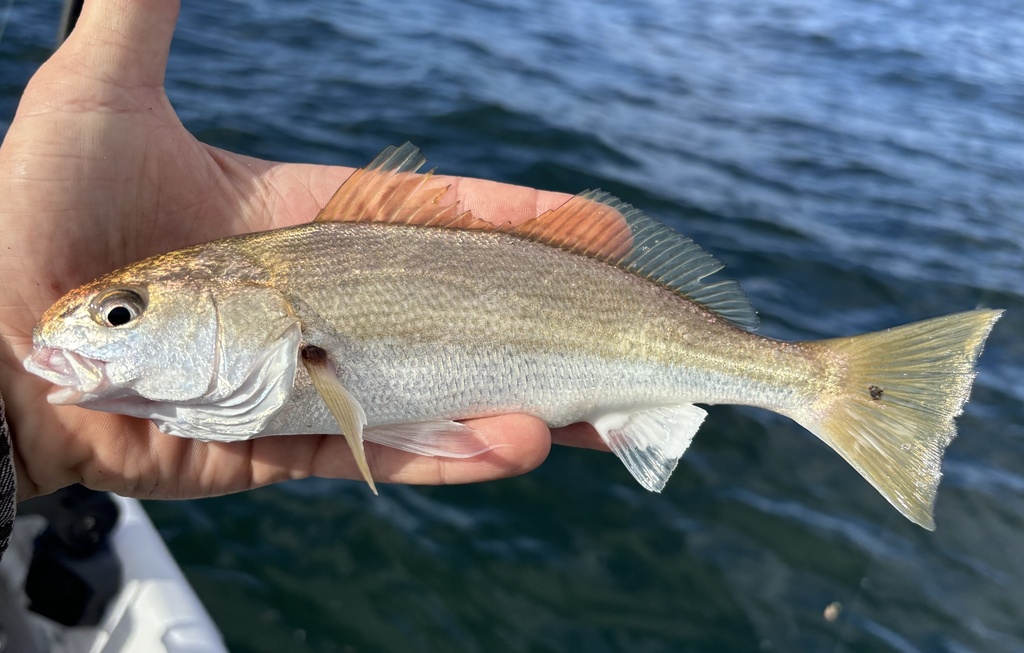
White Croaker
Genyonemus lineatus
White croaker (Genyonemus lineatus) is a species of croaker occurring in the Eastern Pacific. White croakers have been taken from Magdalena Bay, Baja California Sur, to Vancouver Island, British Columbia, but are not abundant north of San Francisco. White croakers swim in loose schools at or near the bottom of sandy areas. Sometimes they aggregate in the surf zone or in shallow bays and lagoons. Most of the time they are found in offshore areas at depths of 3 to 30 meters (10 to 100 ft). On rare occasions they are fairly abundant at depths as great as 200 meters (660 feet).
The white croaker is the only species of in the genus Genyonemus. A fossil relative, G. whistleri, is known from the Late Miocene-aged Puente Formation of the Los Angeles Basin. Other common names for the fish include Pasadena trout, tommy croaker, and little bass.
From the article White croaker on Wikipedia (CC BY-SA), quoted section by section
Description
The body of the white croaker is elongate and somewhat compressed. The head is oblong and bluntly rounded, with a mouth that is somewhat underneath the head. The color is incandescent brownish to yellowish on the back becoming silvery below. The fins are yellow to white. The white croaker is one of five California croakers that have mouths located under their heads (subterminal). They can be distinguished from the California corbina and yellowfin croaker by the absence of a single fleshy projection, or barbel, at the tip of the lower jaw. The 12 to 15 spines in the first dorsal fin serve to distinguish white croakers from all the other croakers with sub-terminal mouths, since none of these has more than 11 spines in this fin. White croakers eat a variety of fishes, squid, shrimp, octopus, worms, small crabs, clams and other items, either living or dead. While the ages of white croakers have not been determined conclusively, it is thought that some live as long as 15 or more years. Some spawn for the first time when they are between 2 and 3 years old. At this age they are only 12 to 15 cm (4.7 to 5.9 in) long and weigh less than 45 grams (0.099 pounds). Also have barbels on the lower lip. The largest recorded specimen was 41.4 cm (16.3 in), no weight recorded; however, a 36.8 cm (14.5 in) white croaker weighed 640 grams (1 lb 6½ oz).
Where it lives
Recorded sightings
—
geo-referenced records in GBIF, from museums, herbaria and field observers.
Drag the globe to turn it. Dots are where records exist, not a range map; darker means more records.
In the stacks
Searching the stacks…
Every page naming Genyonemus lineatus in the Biodiversity Heritage Library →
This page is assembled live from iNaturalist, GBIF, Wikipedia, the Source Library and the Internet Archive. It is not yet part of the hand-edited codex. iNaturalist taxon 101346.