- Animals
- ›Chordates
- ›Vertebrates
- ›Cartilaginous Fishes
- ›Sharks and Rays
- ›Sharks
- ›Galean Sharks
- ›Ground Sharks
- ›False Catsharks
- ›Gollum
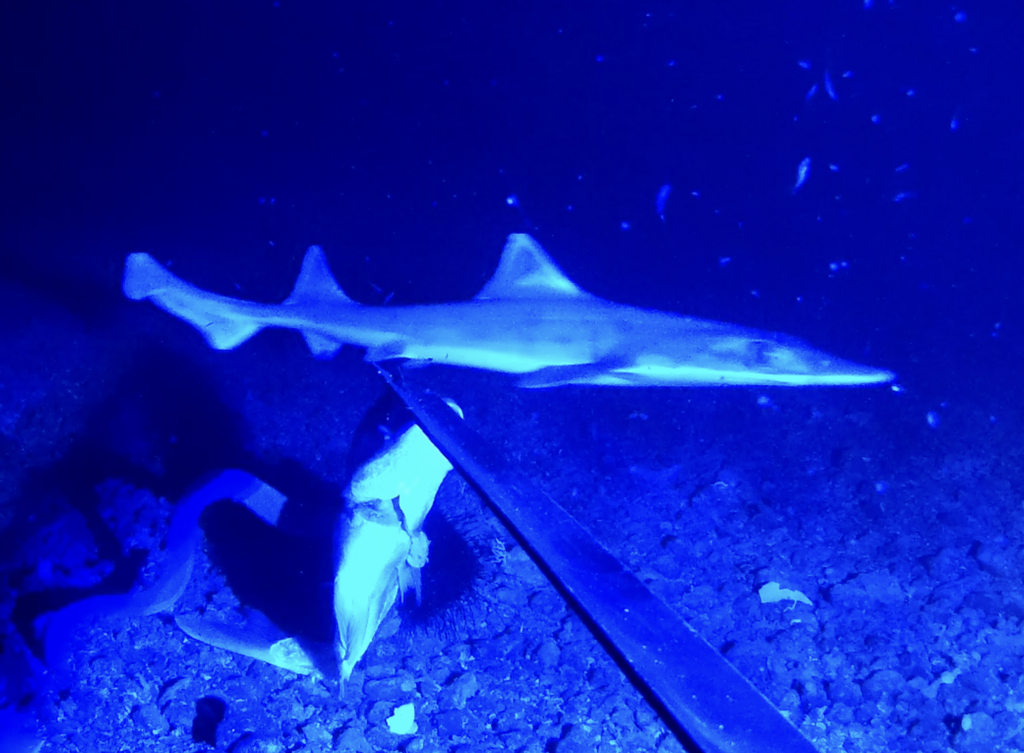
Slender Smoothhound
Gollum attenuatus
The slender smooth-hound or gollumshark (Gollum attenuatus) is a species of ground shark in the family Pseudotriakidae. It is endemic to the waters around New Zealand, where it is usually found close to the bottom over the continental slope at depths of 300–600 m (980–1,970 ft). An extremely slim, plain brownish shark reaching 1.1 m (3.6 ft) in length, the slender smooth-hound can be identified by its broad, flattened head with a long, distinctively bell-shaped snout. Its mouth is angular with short furrows at the corners, and contains a very high number of tooth rows in both jaws. Its two dorsal fins are roughly equal in size.
The diet of the slender smooth-hound is diverse, but dominated by small, benthic bony fishes and decapod crustaceans. It exhibits a specialised form of aplacental viviparity with oophagy: the females produce a single capsule in each uterus that contains 30–80 ova, of which one ovum develops into an embryo that consumes the rest of the ova and stores the yolk material in its external yolk sac. The growing embryo is mainly sustained by this yolk sac during gestation, though it may be additionally supplied with histotroph ("uterine milk") produced by the mother. The typical litter size is two pups, one per uterus. The International Union for Conservation of Nature (IUCN) has assessed the slender smooth-hound as Least Concern; it is taken as fishery bycatch but not in great numbers, and furthermore large portions of its range see minimal fishing activity.
From the article Slender smooth-hound on Wikipedia (CC BY-SA), quoted section by section
Description
The slender smooth-hound has a very thin body and a broad, highly flattened head. The snout is long, with a distinctive bell-shaped outline when viewed from above. The eyes have an elongate horizontal oval shape, and are equipped with rudimentary nictitating membranes (protective third eyelids). Beneath each eye is a prominent ridge, and behind is a much smaller spiracle. The nostrils are preceded by small, almost triangular flaps of skin. The line of the mouth forms an angle; there are very short furrows at the mouth corners. The upper and lower jaws contain 96–99 and 108–114 rows respectively of small, very closely spaced teeth; each tooth has a narrow upright central cusp flanked by smaller cusplets on both sides. The five pairs of gill slits are short. The pectoral fins originate below the fourth gill slit and have gently curved margins. The pelvic fins are small and angular; the males have pointed claspers. The two dorsal fins are similar in size and shape, with narrowly rounded apexes and concave trailing margins. The first dorsal fin originates over rear of the pectoral fins, while the second dorsal fin originates between the pelvic and anal fins. A midline ridge is present between the dorsal fins. The anal fin is less than half as high as the first dorsal fin, and has a nearly straight trailing margin. …
Range & habitat
The range of the slender smooth-hound is restricted to the upper and middle continental slope around New Zealand, including submarine features to the north such as the Three Kings Ridge, the Challenger Plateau, and the Wanganella Bank. This uncommon species is mainly found between 300 and 600 m (980 and 1,970 ft) deep, but has been recorded from 129 to 724 m (423 to 2,375 ft) deep. It prefers a temperature of around 10 °C (50 °F) and a salinity of approximately 34.8‰. Generally swimming near the sea floor, this shark inhabits both soft and rocky-bottomed habitats in terrain ranging from plateaus to steep slopes.
Wikipedia: “Distribution and habitat”
What it does
The slender smooth-hound is likely a schooling species. It preys on a variety of benthic fishes and invertebrates, and also scavenges; human garbage has been reported among its stomach contents. Small bony fishes, lanternfishes in particular, are the most important prey type, followed by decapod crustaceans. Cephalopods, gastropods, isopods, brittle stars, dogfish sharks, and cartilaginous fish egg capsules may also be consumed. On the Challenger Plateau, cephalopods are an important food source for juveniles under 50 cm (20 in) long. Like the false catshark, the slender smooth-hound exhibits aplacental viviparity with oophagy, in a form different from that in the mackerel sharks. Mature females have a single functional ovary, on the right side, and two functional uteruses. Only one embryo develops within each uterus at a time, resulting in litters of two (rarely one) pups. The uterus inner surface is covered by villi. Within a uterus, 30–80 ova 4–8 mm (0.16–0.31 in) across are packed into a single rigid, amber-colored capsule; of these, only one ovum is fertilised and develops into an embryo, while the remaining ova begin to break down. …
Wikipedia: “Biology and ecology”
Where it lives
Recorded sightings
—
geo-referenced records in GBIF, from museums, herbaria and field observers.
Drag the globe to turn it. Dots are where records exist, not a range map; darker means more records.
In the stacks
Searching the stacks…
Every page naming Gollum attenuatus in the Biodiversity Heritage Library →
This page is assembled live from iNaturalist, GBIF, Wikipedia, the Source Library and the Internet Archive. It is not yet part of the hand-edited codex. iNaturalist taxon 101638.