- Animals
- ›Chordates
- ›Vertebrates
- ›Cartilaginous Fishes
- ›Sharks and Rays
- ›Rays
- ›Stingrays
- ›Butterfly Rays
- ›Gymnura
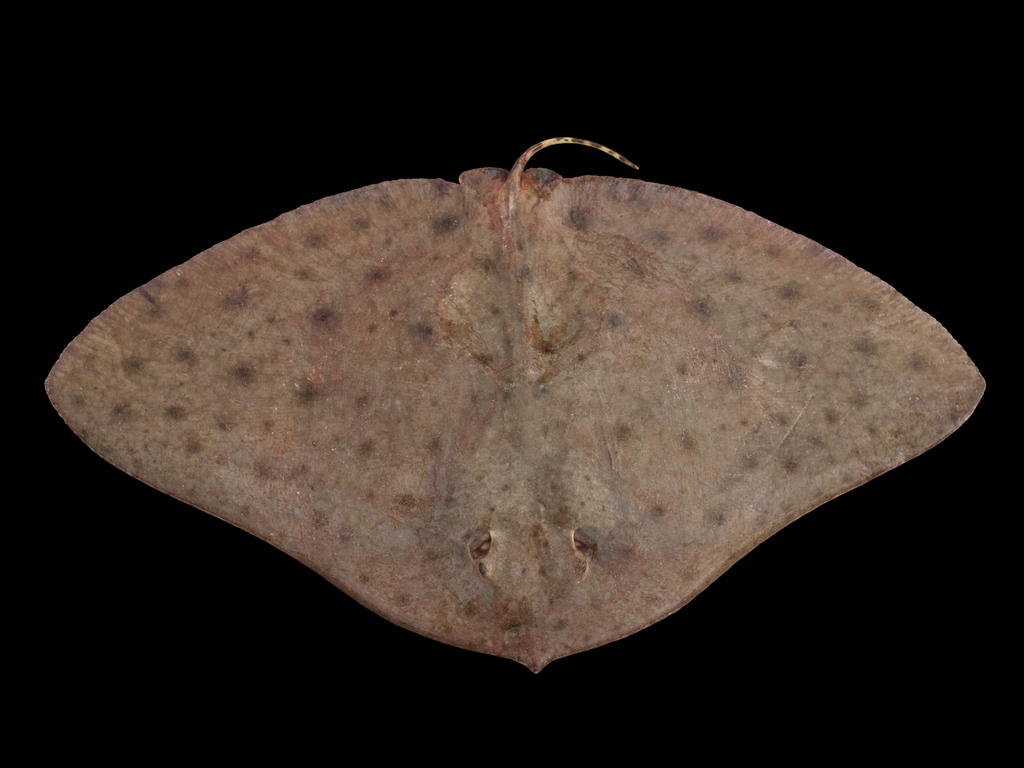
Smooth Butterfly Ray
Gymnura micrura
The smooth butterfly ray (Gymnura micrura) is a species of cartilaginous fish in the Gymnuridae family. It is a member of the Order Myliobatiformes, which contains 10 total families. Its natural habitats are shallow seas, subtidal aquatic beds, estuarine waters, and coastal saline lagoons. Its common name is derived from its compressed body, pectoral fins that are wider than their length, and overall diamond shape.
From the article Smooth butterfly ray on Wikipedia (CC BY-SA), quoted section by section
Description
These are broad diamond-shaped rays with a short tail that has low dorsal and ventral fin folds. The tail has three or four dark lines that are referred to as crossbars. The edges of the disc are concave. The caudal fin is never present and a variable number of tubercles can be found on larger specimens. The smooth butterfly rays have disc widths nearly twice the size of their body lengths and are very flat-bodied (compressed). The width of the rays are between 16 and 22 centimeters when they are born and are about 50 cm when mature for a female and about 42 cm for a male. Females are bigger than their male counterparts; this allows them to carry larger embryos and a greater abundance of embryos. They have a maximum size of 120 cm.
The ventral side is lightly colored while the dorsal side is variable in color. The ventral side is usually white but can contain a rusty or bronze coloration. The dorsal side can be grey, light green, brown, and also not uniform in color. They tend to use countershading to blend in with the bottom of their environments in order to hide from predators and to catch prey. The dorsal spine on the tail is absent; therefore, no stinging can occur to harm humans.
Range & habitat
Smooth butterfly rays are found in the western and eastern parts of the Atlantic Ocean (Maryland to Brazil) and the Gulf of Mexico. They are most commonly found in neritic waters, but are also known to enter brackish estuaries and hypersaline lagoons. They have a range that extends from the continental shelf to 40 meters deep in tropical and warm waters. They prefer habitats that have either sandy or muddy bottoms.
Wikipedia: “Distribution and habitat”
Where it lives
Recorded sightings
—
geo-referenced records in GBIF, from museums, herbaria and field observers.
Drag the globe to turn it. Dots are where records exist, not a range map; darker means more records.
In the stacks
Searching the stacks…
Every page naming Gymnura micrura in the Biodiversity Heritage Library →
This page is assembled live from iNaturalist, GBIF, Wikipedia, the Source Library and the Internet Archive. It is not yet part of the hand-edited codex. iNaturalist taxon 101910.