On eBird ↗
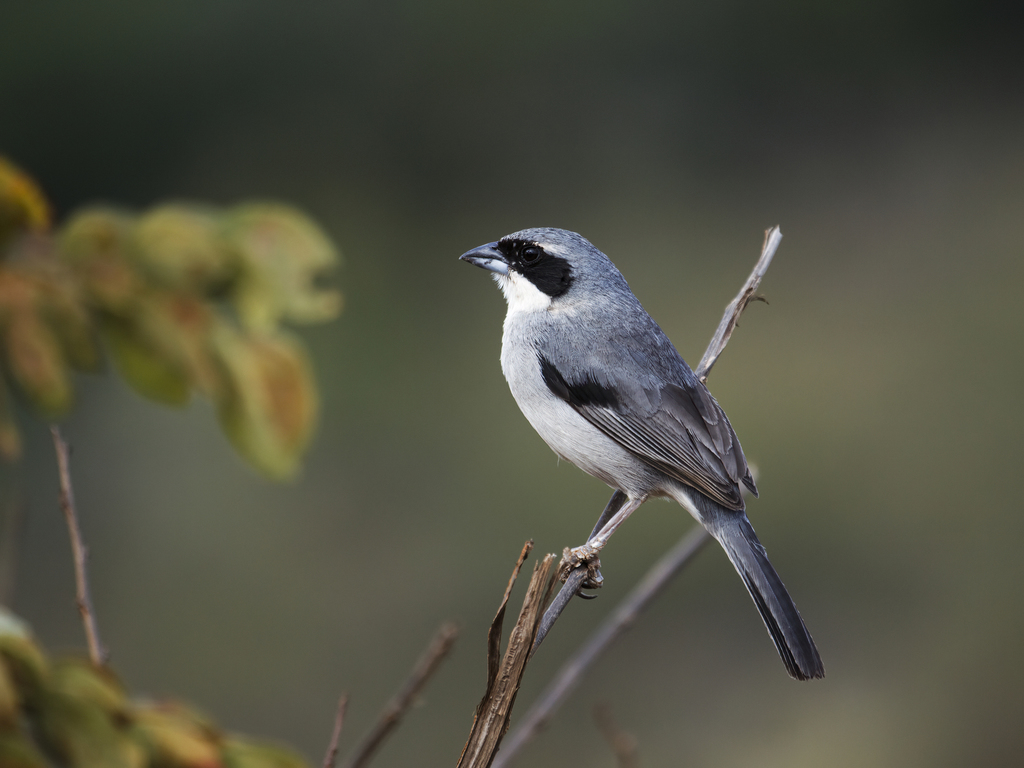
White-banded Tanager
Live sightings near you, the range map, bar charts of when it is seen, and Macaulay Library photos and recordings.
White-banded Tanager
Neothraupis fasciata
The shrike-like tanager (Neothraupis fasciata), also known as the white-banded tanager, is the only member of the genus Neothraupis in the tanager family (Thraupidae), nine-primaried oscines of the Passeroidea.
From the article Shrike-like tanager on Wikipedia (CC BY-SA), quoted section by section
Description
The plumage of the shrike-like tanager is remarkably similar to that of several species of shrikes in the genus Lanius, but these Corvoidea are quite distantly related songbirds. Males and females of this species look alike. It has a total length of about 16 cm (6+1⁄4 in) and weighs 29–32 g.
Range & habitat
It is a bird native to the interior of south-central South America at elevations of 550–1,100 m (1,800–3,610 ft). It is restricted to Cerrado, woodland and shrub of central-eastern Brazil, north-eastern Paraguay and north-eastern Bolivia. It is frequently seen in Chapada dos Guimarães, Mato Grosso, Brazil.
Wikipedia: “Distribution and habitat”
What it does
Typically seen in pairs or small groups of up to 12 individuals, with 7 being average. Eats insects. Breeds in October and November. The deep, cup-shaped nest, typically placed in a small tree or bush, is lined with grasses. Clutch size 2–3 eggs. The pair are often helped by birds from earlier broods, which have the grey parts of the plumage partially or entirely replaced by brown (this brownish plumage sometimes mistakenly referred to as the adult female plumage).
Wikipedia: “Behaviour”
Listen
Looking for field recordings…
Where it lives
Recorded sightings
—
geo-referenced records in GBIF, from museums, herbaria and field observers.
Drag the globe to turn it. Dots are where records exist, not a range map; darker means more records.
In the stacks
Searching the stacks…
Every page naming Neothraupis fasciata in the Biodiversity Heritage Library →
This page is assembled live from iNaturalist, GBIF, Wikipedia, the Source Library and the Internet Archive. It is not yet part of the hand-edited codex. iNaturalist taxon 10197.