- Animals
- ›Chordates
- ›Vertebrates
- ›Ray-finned Fishes
- ›Spiny-rayed fishes
- ›Wrasses and allies
- ›False scorpionfishes, wrasses, and parrotfishes
- ›Wrasses and Parrotfishes
- ›Rainbow Wrasses and Allies
- ›Halichoeres
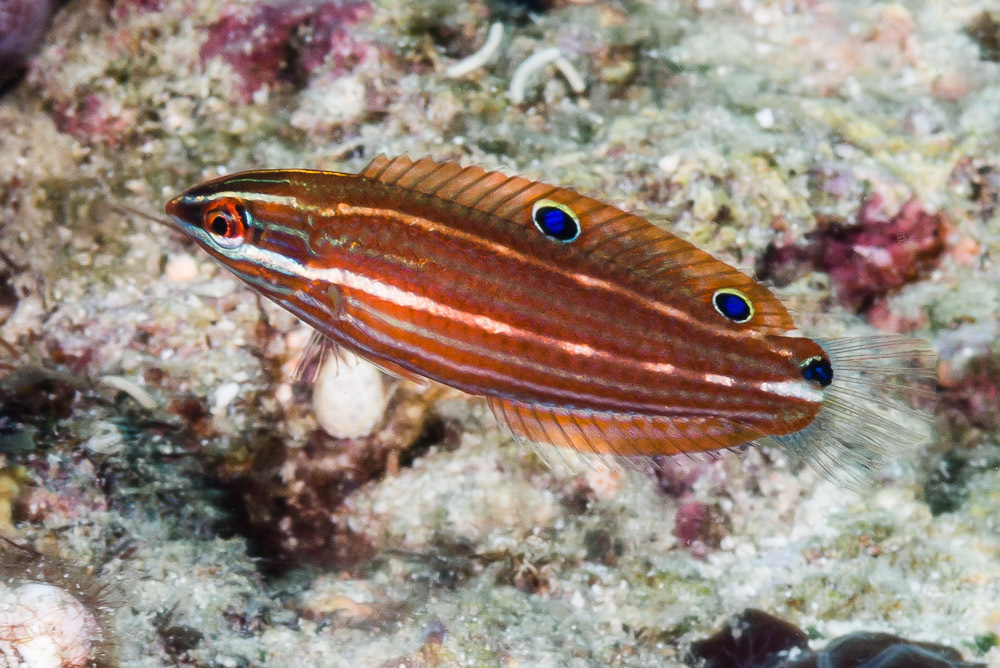
Twospot Wrasse
Halichoeres biocellatus
The red-lined wrasse, two-spotted wrasse or biocellated wrasse, Halichoeres biocellatus, is a species of wrasse native to shallow tropical waters in the western Pacific Ocean.
From the article Red-lined wrasse on Wikipedia (CC BY-SA), quoted section by section
Description
The red-lined wrasse can grow to about 12 cm (4.7 in) in length. Mature males are silvery grey with narrow, longitudinal, red stripes and a dark mark on their caudal peduncles. Females have narrow orange stripes, continuous near the front, but intermittent near the back. Juveniles and females have two distinctive, dark-coloured spots outlined in white on their dorsal fins, one in the middle and one near the back. These may fade as the fish matures. The long, narrow dorsal fin has 9 spines and 12 soft rays. The anal fin has three spines and 11 or 12 soft rays.
Range & habitat
The red-lined wrasse is found in the tropical western Pacific Ocean between 32°N and 24°S at depths down to 35 metres (115 ft). Its range includes Japan, Indonesia, the Philippines and Australia, where it is found around the northern coast from Western Australia to New South Wales. It inhabits the seaward side of coral and rocky reefs, usually with sandy patches, and is also found on reef slopes and crests with rock, rubble, and seaweed.
Wikipedia: “Distribution and habitat”
What it does
Juvenile slender groupers (Anyperodon leucogrammicus) are aggressive mimics of red-lined wrasses. In this form of mimicry, the grouper mimics the wrasse in colouring and behaviour so that a prey fish is tricked into approaching what it thinks is a harmless wrasse and can then be attacked.
Wikipedia: “Ecology”
Where it lives
Recorded sightings
—
geo-referenced records in GBIF, from museums, herbaria and field observers.
Drag the globe to turn it. Dots are where records exist, not a range map; darker means more records.
In the stacks
Searching the stacks…
Every page naming Halichoeres biocellatus in the Biodiversity Heritage Library →
This page is assembled live from iNaturalist, GBIF, Wikipedia, the Source Library and the Internet Archive. It is not yet part of the hand-edited codex. iNaturalist taxon 102029.